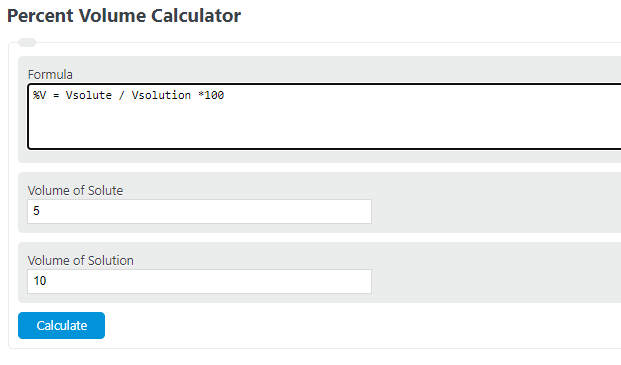
Calculate percent concentration, solute amount, or final solution amount for volume/volume, weight/volume, and weight/weight mixtures with flexible units.
- All Chemistry Calculators
- All Volume Calculators
- ML to Moles Calculator
- Mass to Volume Calculator
- Solution Density Calculator
- Percent Mixture Calculator
Percent Volume Formula
Percent volume, usually written as % v/v, expresses how much of a solution is made up of a liquid solute by volume. It is commonly used in chemistry, laboratory preparation, food and beverage formulations, and dilution calculations when both the solute and the final solution are measured as volumes.
- PV = percent volume of the solute in the solution
- Vsolute = volume of the solute
- Vsolution = total final volume of the solution
The key idea is simple: divide the solute volume by the total solution volume, then multiply by 100. The result is the percentage of the final mixture that comes from the solute.
Rearranged Forms
If you know any two values, you can solve for the third.
| Find | Formula | Use This When |
|---|---|---|
| Percent Volume | PV = (Vₛₒₗᵤₜₑ) / (Vₛₒₗᵤₜᵢₒₙ) × 100 |
You know the solute volume and total solution volume. |
| Volume of Solute | Vₛₒₗᵤₜₑ = (PV) / (100) × Vₛₒₗᵤₜᵢₒₙ |
You know the target concentration and final solution volume. |
| Volume of Solution | Vₛₒₗᵤₜᵢₒₙ = (Vₛₒₗᵤₜₑ × 100) / (PV) |
You know the solute volume and desired percent volume. |
How to Use the Calculator
- Enter the volume of solute.
- Enter the total volume of solution, or enter the desired percent volume if solving for a missing volume.
- Make sure both volume values use the same units before interpreting the result.
- Click calculate to find the missing variable.
You can use liters, milliliters, or microliters, but the solute and solution volumes must be in matching units. For example, do not divide milliliters by liters unless one value has been converted first.
What Percent Volume Means
A result of 10% v/v means that 10% of the final solution volume is solute. In practical terms, that is equivalent to:
- 10 mL solute in 100 mL of final solution
- 0.10 L solute in 1.00 L of final solution
- 50 µL solute in 500 µL of final solution
This is why percent volume is especially useful for liquid-in-liquid mixtures. It gives an intuitive concentration measure without converting to mass or moles.
Example Calculations
If 25 mL of solute is present in 200 mL of total solution, the percent volume is:
The solution is 12.5% v/v.
If you need to make 500 mL of a 6% v/v solution, the required solute volume is:
You would need 30 mL of solute and then bring the mixture to a final solution volume of 500 mL.
Important Measurement Notes
- Use final solution volume, not solvent volume. The denominator is the total finished mixture.
- Convert units first if needed. A ratio only makes sense when both volumes are expressed on the same scale.
- Keep the distinction between solute and solution clear. The solution includes everything after mixing.
- Percent volume should usually fall between 0% and 100%. Values above 100% typically indicate an input or unit error.
Percent Volume vs Other Concentration Measures
| Measure | What It Compares | Typical Use |
|---|---|---|
| % v/v | Volume of solute to volume of solution | Liquid mixtures and dilutions |
| % w/w | Mass of solute to mass of solution | Solid mixtures, formulations, composition by weight |
| % w/v | Mass of solute to volume of solution | Solutions where solute is weighed and solvent is measured by volume |
Common Mistakes
- Using the solvent volume instead of the solution volume.
- Mixing units such as mL and L without converting.
- Interpreting percent volume as a mass percentage.
- Assuming adding volumes always behaves perfectly linearly; for precise lab work, use the actual final measured solution volume.
FAQ
What does 5% v/v mean?
It means 5% of the final solution volume is solute. For every 100 mL of final solution, 5 mL is solute.
Is percent volume the same as a dilution ratio?
Not exactly. A dilution ratio compares parts of components, while percent volume expresses the solute as a percentage of the final total solution volume.
Can I use any unit of volume?
Yes. Liters, milliliters, and microliters all work, provided the units are consistent across the calculation.
When is % v/v most useful?
It is most useful when both the solute and the final mixture are measured as liquids by volume, especially in chemistry, cleaning solutions, alcohol mixtures, and general dilution preparation.