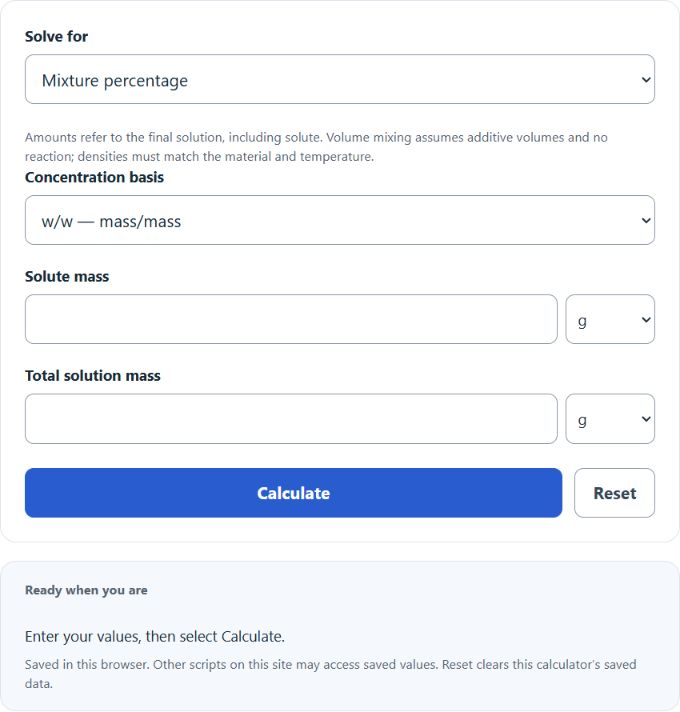
Calculate the percent of a mixture or solution from solute and total amounts, or find the solute, total, dilution or blend needed for a target percent.
- All Math and Numbers Calculators
- Percent Solution Calculator
- Solution Density Calculator
- Average Density Calculator
- Mass Percent Calculator
- Percent Volume Calculator
- Percent to Grams Calculator
- Percent Solids In Slurry Calculator
- Density Percentage Calculator
Calculator Functions
| Function | What it does | What it requires |
|---|---|---|
| Mixture percentage | Finds the concentration of a solute as a percent of the total solution | Requires a concentration basis, the solute amount and the total solution amount |
| Solute amount | Finds the solute needed for a given concentration and total | Requires a concentration basis, the concentration and the total solution amount |
| Total solution amount | Finds the total solution that a solute amount makes at a given concentration | Requires a concentration basis, the concentration and the solute amount |
| Initial concentration | Finds the starting concentration of a diluted solution | Requires the initial amount, the final concentration and the final amount |
| Initial amount | Finds how much stock solution a dilution needs | Requires the initial concentration, the final concentration and the final amount |
| Final concentration | Finds the concentration after dilution | Requires the initial concentration, the initial amount and the final amount |
| Final amount | Finds the total amount after diluting to a chosen concentration | Requires the initial concentration, the initial amount and the final concentration |
| Mix concentration | Finds the concentration of two solutions combined | Requires the concentration and amount of solution 1 and of solution 2 |
| Target mixture | Finds how much of two solutions to combine for a target concentration | Requires both source concentrations, the target concentration and the total amount |
| Convert % types | Converts a concentration between w/w, w/v and v/v | Requires a concentration basis, the concentration and the measured densities |
Every function starts with a concentration basis: w/w (mass per mass), w/v (grams per 100 mL) or v/v (volume per volume). Masses can be entered in g, mg, kg, lb or oz, and volumes in mL, L, US fl oz or US gal. Amounts are masses for w/w and volumes for w/v and v/v.
Percent Mixture Formulas
| PM | Mixture percentage (%) |
| X | Amount of solute |
| Y | Total amount of solution, including the solute |
The three bases follow standard definitions. Mass fraction is the mass of a component divided by the mass of the mixture, and mass concentration is the mass of a component divided by the volume of the mixture [1]. A w/v percent is grams of solute per 100 mL of solution, so it can be more than 100. Volume fraction is defined from the volumes of the separate components before mixing [1], which matches solute volume over final volume only when the volumes add up without shrinking or expanding.
Mixture percentage
A solution of 25 g of solute in 200 g total is 25 ÷ 200 × 100 = 12.5% w/w. A solution of 9 g in 1,000 mL is 0.9% w/v, and 200 mL in 400 mL is 50% v/v.
Solute amount
A 10% w/w solution weighing 500 g contains 50 g of solute and 450 g of solvent.
Total solution amount
At 5% w/w, 15 g of solute makes 300 g of solution, of which 285 g is solvent.
Initial concentration
C₁ and A₁ are the concentration and amount before dilution, and C₂ and A₂ after it. Adding a diluent that contains none of the solute leaves the amount of solute unchanged, which is what the equation says. The four dilution functions each solve it for one term. A 100 mL sample diluted to 250 mL at 20% v/v started at 20 × 250 ÷ 100 = 50% v/v.
Initial amount
Making 500 mL at 70% v/v from a 95% stock takes 70 × 500 ÷ 95 = 368.42 mL of stock and 131.58 mL of diluent.
Final concentration
Topping 100 mL of 95% v/v up to 500 mL gives 95 × 100 ÷ 500 = 19% v/v.
Final amount
Diluting 100 mL of 95% v/v to 70% gives a final amount of 95 × 100 ÷ 70 = 135.71 mL, so 35.71 mL of diluent is added.
Mix concentration
(A₁ + A₂)
Combining 100 g of 10% w/w with 300 g of 30% w/w gives (1,000 + 9,000) ÷ 400 = 25% w/w in 400 g.
Target mixture
C is the target concentration, Y is the total wanted, and the second amount is Y − A₁. Making 400 g at 25% w/w from 10% and 30% solutions takes (25 − 30) ÷ (10 − 30) × 400 = 100 g of the 10% solution and 300 g of the 30% solution. The target has to lie between the two source concentrations.
Convert % types
ρ is the density of the solution and ρs is the density of the pure solute, both in g/mL. A 10% w/w solution with a density of 1.07 g/mL is 10.7% w/v, and with a solute density of 1.5 g/mL it is 7.133% v/v. A conversion is left out when the density it needs is not entered.
Limits of This Estimate
- Volume amounts assume the volumes add up. Liquids such as alcohol and water shrink when mixed, so the final volume has to be measured.
- Densities have to be measured for the actual material and temperature. None is assumed.
- Dilution assumes the diluent contains none of the solute and that nothing reacts.
Sources
- NIST, Guide for the Use of the International System of Units (SP 811), Chapter 8: definitions of mass fraction, mass concentration and volume fraction