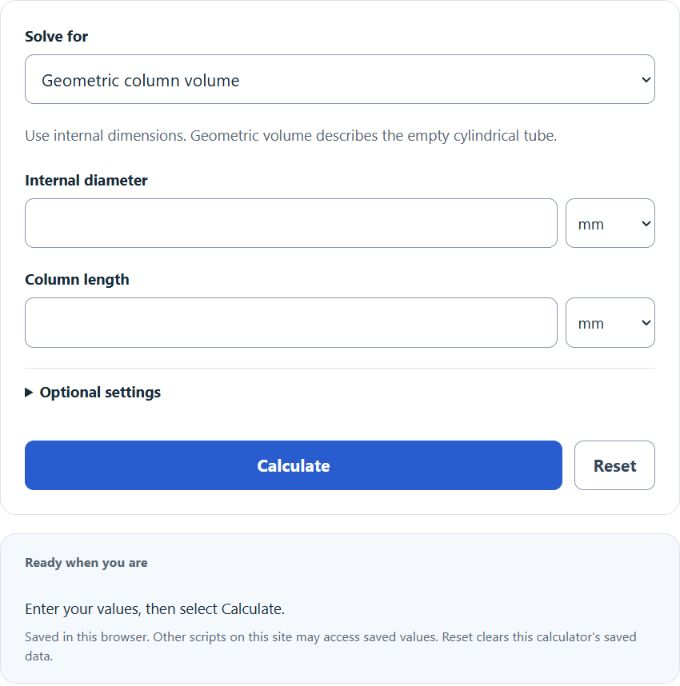
Calculate geometric HPLC column volume, internal diameter or length, with optional liquid-volume and flow-time estimates.
- All Math and Numbers Calculators
- Well Volume Calculator
- Pipe Volume Calculator
- Mass to Volume Calculator
- Volume Ratio Calculator
- Volume in Terms of Pi Calculator
- Grain Bin Capacity Calculator
- Casing Capacity (Annular Volume) Calculator
- Pile Quantity Calculator
Column Volume Formula
The calculator uses the geometric volume of a cylinder, with the column’s internal diameter and length as inputs.
- V = empty column volume (mL when ID and L are in mm and the result in mm³ is divided by 1000)
- ID = internal diameter of the column
- L = length of the packed bed
This is the geometric (empty-tube) volume. Real packed columns hold less liquid because the stationary phase occupies part of the tube. To estimate the liquid volume actually available to mobile phase, multiply by a porosity factor:
- epsilon = total porosity (about 0.68 for a typical packed HPLC column) or interstitial porosity only (about 0.40)
If you supply a flow rate F, the time to pump one column volume is:
Assumptions: the column is a right circular cylinder, ID is the internal diameter (not outer diameter), and L is the packed-bed length. Frits and end fittings are ignored.
Choose geometric volume, internal diameter or column length. Enter the two known quantities, with independent dimension units. Optional liquid-volume fraction and flow rate provide separate liquid-volume and time estimates. Dimension suggestions are editable examples; blank optional fields omit those results.
Reference Tables
Geometric volumes for common analytical and prep HPLC columns:
| Column (L × ID, mm) | Empty volume (mL) | Mobile-phase est. (mL, ε=0.68) |
|---|---|---|
| 50 × 2.1 | 0.173 | 0.118 |
| 100 × 2.1 | 0.346 | 0.236 |
| 150 × 2.1 | 0.520 | 0.353 |
| 50 × 3.0 | 0.353 | 0.240 |
| 100 × 3.0 | 0.707 | 0.481 |
| 150 × 4.6 | 2.493 | 1.695 |
| 250 × 4.6 | 4.155 | 2.825 |
| 250 × 10 | 19.63 | 13.35 |
| 250 × 21.2 | 88.25 | 60.01 |
Illustrative porosity values, which vary with packing and marker accessibility. Confirm the value for your actual column:
| Column type | Porosity used | Typical value |
|---|---|---|
| Fully porous silica HPLC | Total porosity | 0.65 to 0.70 |
| Core-shell / superficially porous | Total porosity | 0.50 to 0.55 |
| Monolithic silica | Total porosity | 0.80 to 0.85 |
| Any packed column (void only) | Interstitial porosity | 0.36 to 0.42 |
Worked Examples and FAQ
Example 1: 150 × 4.6 mm analytical column. V = π × (4.6/2)² × 150 = π × 5.29 × 150 = 2493 mm³ = 2.49 mL. At 1.0 mL/min, one column volume passes in about 2.5 minutes.
Example 2: 50 × 2.1 mm UHPLC column at 0.4 mL/min. V = π × (1.05)² × 50 = 173 mm³ = 0.173 mL. One CV takes 0.173 / 0.4 = 0.43 min, or about 26 seconds.
Example 3: 250 × 21.2 mm prep column. V = π × (10.6)² × 250 = 88,247 mm³ ≈ 88.2 mL. To flush 5 column volumes at 20 mL/min you need 5 × 88.2 / 20 = 22 minutes.
Why is the calculated volume larger than what my column actually holds? The formula gives the empty cylinder volume. A packed column’s liquid volume is roughly 0.65 to 0.70 of that for fully porous particles. Use the porosity option to estimate this.
Should I use total or interstitial porosity? Use total porosity (around 0.68) when you want the volume of all liquid in the column, including liquid inside the pores. Use interstitial porosity (around 0.40) when you only care about the volume between particles, which is closer to the void volume seen by an unretained, pore-excluded marker.
Does the formula change for different column chemistries? No. The geometric volume depends only on L and ID. C18, HILIC, ion exchange, and SEC columns of the same dimensions all have the same empty volume. Only the porosity and the mobile-phase volume differ.
How many column volumes for equilibration? Follow the manufacturer and validated method for equilibration requirements. State whether CV means geometric or liquid hold-up volume. Multiply the chosen volume by the required number of CVs and divide by flow rate to estimate pumping time.
What if I only know the outer diameter? Use the internal diameter, not the OD. Manufacturer specifications list ID. Do not infer the internal diameter from the outer diameter or nominal fitting size.