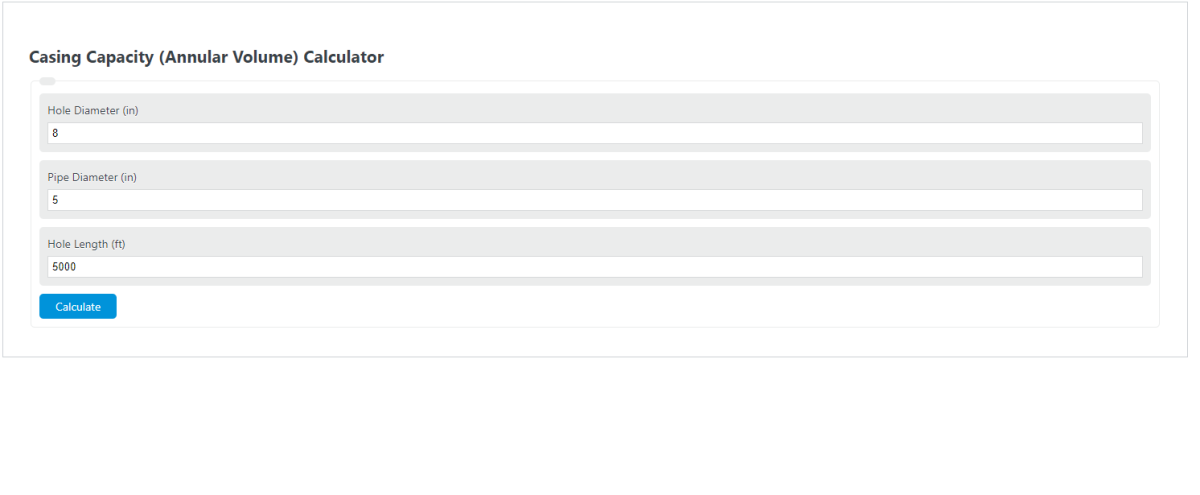
Calculate annular capacity and total well volume from hole or casing ID, pipe OD, and interval length, or reverse the required length in oilfield or metric units.
- Pipe Volume Calculator
- EMW (Equivalent Mud Weight) Calculator
- All Construction Calculators
- Cylinder Capacity Calculator
- Rod Pump Spacing Calculator
- Snub Force Calculator
- Annular Velocity Calculator
- Uphole Velocity Calculator
Casing Capacity (Annular Volume) Formula
The calculator uses the standard oilfield annular capacity formula in all three modes.
- Dh = outer boundary diameter (hole diameter or casing ID), in inches
- Dp = inner obstruction diameter (pipe, tubing, or inner casing OD), in inches
- L = interval length, in feet (bottom MD minus top MD)
- V = annular volume, in barrels
The constant 1029.4 converts square inches times feet into US oilfield barrels. The calculator converts every unit you enter into inches and feet before applying the formula, then converts the result back to your chosen output unit. The formula assumes a concentric, uniform annulus and does not account for washouts, eccentricity, tool joints, or hole rugosity. For cement jobs, add an excess factor on top of the calculated volume.
Common Annular Capacity Factors
Use the table below for quick checks. Values are in barrels per foot for common hole and pipe combinations.
| Hole / Casing ID (in) | Pipe OD (in) | Capacity (bbl/ft) | Capacity (gal/ft) |
|---|---|---|---|
| 12.250 | 5.000 | 0.1215 | 5.10 |
| 12.250 | 9.625 | 0.0558 | 2.34 |
| 8.500 | 5.000 | 0.0459 | 1.93 |
| 8.500 | 4.500 | 0.0505 | 2.12 |
| 7.000 | 3.500 | 0.0357 | 1.50 |
| 6.125 | 3.500 | 0.0245 | 1.03 |
| 4.892 | 2.875 | 0.0152 | 0.64 |
Volume unit conversions for converting calculator output:
| From | To | Multiply by |
|---|---|---|
| 1 bbl | US gal | 42 |
| 1 bbl | L | 158.987 |
| 1 bbl | m³ | 0.158987 |
| 1 bbl | ft³ | 5.6146 |
Worked Example
You are running 5 in drill pipe inside an 8.5 in open hole from 2,500 ft to 3,200 ft. You want the annular volume in barrels.
- Capacity factor = (8.5² − 5²) / 1029.4 = (72.25 − 25) / 1029.4 = 47.25 / 1029.4 = 0.0459 bbl/ft
- Interval length = 3,200 − 2,500 = 700 ft
- Annular volume = 0.0459 × 700 = 32.13 bbl
That is roughly 1,350 US gallons or 5.11 m³ of fluid in the annulus.
FAQ
Does this work for casing-in-casing or open-hole annulus? Yes. Enter the outer boundary as the inner diameter of the outer pipe (or the hole diameter for open hole) and enter the inner obstruction as the OD of the inner string.
Should I add excess for cement jobs? The calculator gives theoretical volume. Apply your standard excess factor (often 20 to 100 percent in open hole, depending on caliper data and hole condition) on top of the calculated number.
Why 1029.4? It is the conversion that turns inches squared times feet into US oilfield barrels: 1 bbl = 9,702 in³, and dividing by π/4 and 12 gives the constant 1029.4.