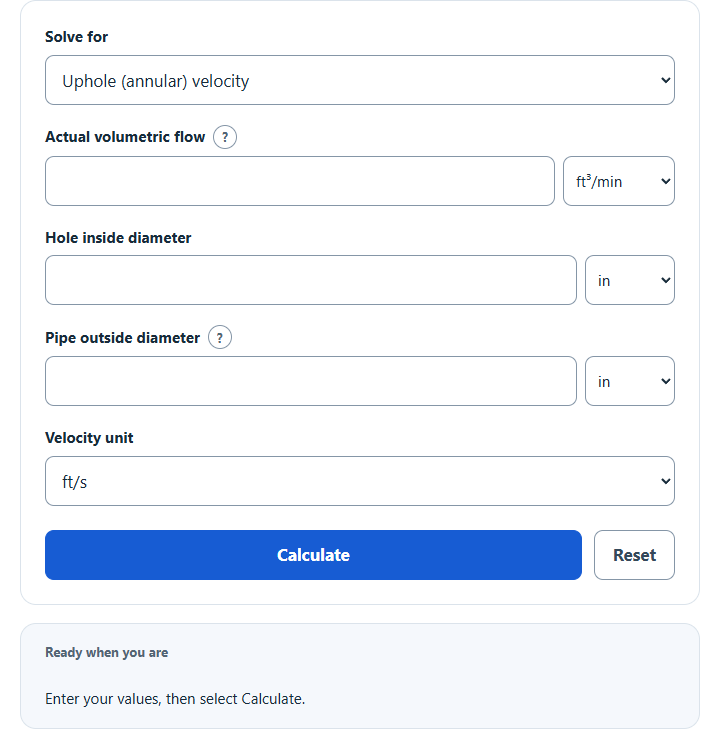
Calculate uphole or annular velocity from flow rate, hole diameter and pipe diameter for air, gas, mud and fluid drilling with unit conversions.
- All Physics Calculators
- Annular Velocity Calculator
- Casing Capacity & Annular Volume Calculator
- TFA (Total Flow Area) Calculator
- Velocity Calculator
- Flow to Velocity Calculator
- CFM to FPS Calculator
Calculator Functions
| Function | What it does | What it requires |
|---|---|---|
| Uphole (annular) velocity | Finds the mean velocity of air, gas or mud moving up the annulus between the hole wall and the pipe | Requires the actual volumetric flow, the hole inside diameter and the pipe outside diameter |
| Flow for chosen velocity | Finds the flow that produces a chosen annular velocity | Requires the target velocity, the hole inside diameter and the pipe outside diameter |
| Hole diameter | Finds the hole inside diameter that gives a chosen velocity at a known flow | Requires the flow, the velocity and the pipe outside diameter |
| Pipe outside diameter | Finds the pipe outside diameter that gives a chosen velocity at a known flow | Requires the flow, the velocity and the hole inside diameter |
Flow can be entered in ft³/min, m³/min, US gal/min or L/min, diameters in in, cm, mm or m, and velocity in ft/s, m/s, ft/min or m/min. Common bit and drill pipe sizes are offered as suggestions, and a pipe diameter of 0 treats the hole as open. Every result also shows the mean velocity in ft/min, ft/s and m/s and the annular area in in² and m².
Uphole Velocity Formulas
A = π ÷ 4 × (D² − d²)
| V | Mean uphole velocity |
| Q | Actual volumetric flow |
| A | Area of the annulus |
| D | Hole inside diameter |
| d | Pipe outside diameter |
Flow through any section equals velocity times area [1], so the mean velocity in the annulus is the flow divided by the ring-shaped area between the hole wall and the pipe. The calculator converts every input to SI units before it applies this [2].
Uphole (annular) velocity
With Q in ft³/min and both diameters in inches, this form gives V in ft/s. Use 576 ÷ π, about 183.3, in place of 9.6 ÷ π for ft/min, or 77 ÷ π, about 24.5, when Q is in US gal/min. Air at 200 ft³/min in a 7 in hole around 4 in pipe moves at 9.6 ÷ π × 200 ÷ (49 − 16) = 18.52 ft/s, or 1,111 ft/min. Mud pumped at 400 US gal/min in an 8.5 in hole around 4.5 in pipe moves at 188.5 ft/min.
Flow for chosen velocity
The 7 in by 4 in annulus has an area of 25.9 in², or 0.18 ft². Holding 3,000 ft/min in it takes 3,000 × 0.18 = 540 ft³/min of actual flow. The velocity suggestions in this function are illustrations, not operating recommendations.
Hole diameter
The flow divided by the velocity is the annular area needed, and that area is added to the pipe. A flow of 200 ft³/min at 18.52 ft/s around 4 in pipe calls for a 7 in hole.
Pipe outside diameter
A flow of 200 ft³/min at 18.52 ft/s in a 7 in hole leaves room for 4 in pipe. The flow and velocity must need less area than the open hole has, or no pipe size fits.
Limits of This Estimate
- For air or gas, Q is the actual volume at annulus pressure and temperature, not free-air (standard) flow. Gas expands as it rises, so the velocity changes along the hole.
- The result is the mean velocity across the annulus. Whether cuttings are carried out also depends on the fluid, the cutting size, the hole angle and where the pipe sits in the hole.
- The hole is taken at its nominal diameter. Washed-out sections are wider, and the velocity there is lower.
Sources
- U.S. Bureau of Reclamation, Water Measurement Manual, Chapter 2, Section 4: discharge equals velocity times flow area
- NIST, Guide to the SI (Special Publication 811), Appendix B.8: conversion factors for the inch, cubic foot, U.S. gallon and cubic foot per minute