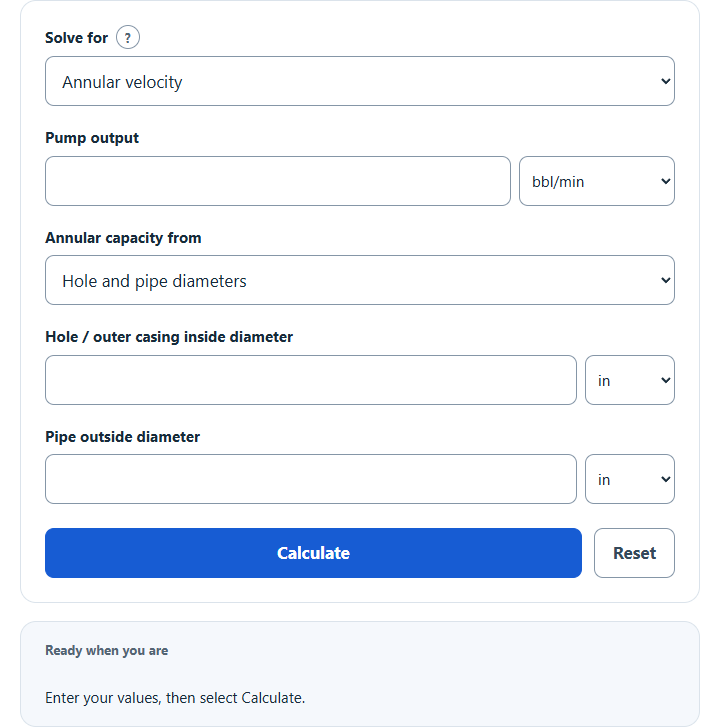
Calculate annular velocity in ft/min from pump output and hole and pipe diameters or annular capacity, or solve for pump output or annular capacity.
- All Physics Calculators
- All Velocity Calculators
- Casing Capacity (Annular Volume) Calculator
- Uphole Velocity Calculator
Calculator Functions
| Function | What it does | What it requires |
|---|---|---|
| Annular velocity | Finds the average fluid speed in the annulus | Requires pump output and either the hole and pipe diameters or a known annular capacity |
| Pump output from velocity and capacity | Finds the pump output that gives a chosen annular velocity | Requires annular velocity and annular capacity |
| Annular capacity from flow and velocity | Finds annular capacity from a measured flow and velocity | Requires pump output and annular velocity |
| Annular capacity from diameters | Finds annular capacity from the annulus dimensions | Requires the hole or outer casing inside diameter and the pipe outside diameter |
| Annular capacity from a size preset | Finds annular capacity for a listed hole and pipe pair | Requires one of four size pairs, such as an 8.5 in hole with 5 in pipe |
| Pump output from strokes and displacement | Finds combined pump output from the stroke rate | Requires strokes per minute, displacement per stroke and the number of identical pumps |
Pump output is entered in bbl/min, US gal/min or m³/min, capacity in bbl/ft or m³/m, and diameters in inches or mm. Velocity results are in ft/min with m/min alongside, and capacity results in bbl/ft with m³/m alongside. A barrel is the 42 US gallon petroleum barrel [3].
Annular Velocity Formulas
| AV | Annular velocity (ft/min) |
| PO | Pump output (bbl/min) |
| AC | Annular capacity (bbl/ft) |
Annular velocity is the speed at which drilling fluid or cement moves in the annulus. It is commonly given in feet per minute and is a different quantity from volumetric flow [2]. Dividing barrels per minute by barrels per foot leaves feet per minute.
Annular velocity
This is the same division with the capacity worked out from the diameters. Q is pump output in US gal/min, D is the hole or casing inside diameter and d is the pipe outside diameter, both in inches. The constant is 24.51 to four figures and is often printed as 24.5 [1]. A pump output of 336 gal/min in an 8.75 in hole around 4.5 in pipe gives 24.51 × 336 ÷ (76.5625 − 20.25) = 146.2 ft/min. With a known capacity, 12.5 bbl/min ÷ 0.25 bbl/ft = 50 ft/min.
Pump output from velocity and capacity
Holding 150 ft/min in an annulus of 0.0459 bbl/ft takes 150 × 0.0459 = 6.885 bbl/min, which is 289.2 gal/min.
Annular capacity from flow and velocity
A flow of 8 bbl/min moving at 160 ft/min implies a capacity of 0.05 bbl/ft.
Annular capacity from diameters
D and d are in inches and AC is in bbl/ft. The 1,029.4 is the 24.51 above multiplied by 42 gallons per barrel. An 8.5 in hole with 5 in pipe has (72.25 − 25) ÷ 1,029.4 = 0.0459 bbl/ft.
Annular capacity from a size preset
The list holds 8.5 in / 5 in, 12.25 in / 5.5 in, 6 in / 2.875 in and 152.4 mm / 101.6 mm, which is 6 in / 4 in. Their capacities are 0.0459, 0.1164, 0.0269 and 0.0194 bbl/ft.
Pump output from strokes and displacement
SPM is strokes per minute, V is the displacement per stroke and n is the number of identical pumps. Two pumps at 60 strokes/min and 0.1 bbl per stroke deliver 12 bbl/min.
Limits of This Estimate
- The result is an average across the annulus. Real flow is faster in the middle of the gap than at the walls, and an off-center pipe or a washed-out hole changes the area.
- It does not say whether a velocity is high enough to clean the hole or low enough to avoid eroding the borehole wall, which are the reasons the value is monitored [2].
- Pump output from strokes uses the displacement entered. Enter an effective displacement to allow for volumetric efficiency below 100%.
Sources
- Wyo-Ben, Annular Velocity data sheet: field formula with the 24.5 constant
- SLB Energy Glossary, annular velocity: definition, usual units and why it is monitored
- NIST Special Publication 811, Appendix B.8: 42-gallon petroleum barrel and US gallon