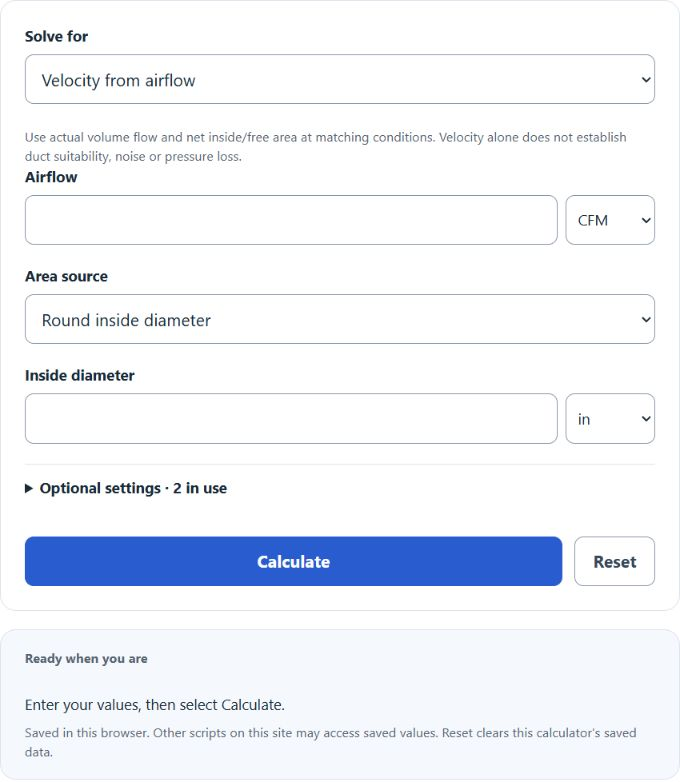
Calculate air velocity in feet per second from CFM and duct size, convert FPS back to CFM, and size a duct for a target velocity.
- All Unit Converters
- Thermodynamics and Fluid Unit Converters
- CFH Calculator
- CFM to HP Calculator
- lb/hr to SCFM Calculator
- BPM to FPS Calculator
FPS from CFM Formula
Variables:
- FPS is the air velocity in feet per second (ft/s)
- CFM is the volumetric flow rate in cubic feet per minute
- A is the cross-sectional area of the duct or pipe in square feet (ft²)
The factor of 60 converts the per-minute unit in CFM to per-second in FPS. This formula is an application of the continuity equation for incompressible flow: Q = A x V. For work in feet per minute (FPM) instead, the simpler form applies: FPM = CFM / A. The two are related by FPS = FPM / 60.
| Flow (CFM) | Velocity (ft/s) | Velocity (m/s) |
|---|---|---|
| 50 | 0.833 | 0.254 |
| 75 | 1.250 | 0.381 |
| 100 | 1.667 | 0.508 |
| 125 | 2.083 | 0.635 |
| 150 | 2.500 | 0.762 |
| 200 | 3.333 | 1.016 |
| 250 | 4.167 | 1.270 |
| 300 | 5.000 | 1.524 |
| 350 | 5.833 | 1.778 |
| 400 | 6.667 | 2.032 |
| 450 | 7.500 | 2.286 |
| 500 | 8.333 | 2.540 |
| 600 | 10.000 | 3.048 |
| 750 | 12.500 | 3.810 |
| 800 | 13.333 | 4.064 |
| 1000 | 16.667 | 5.080 |
| 1200 | 20.000 | 6.096 |
| 1500 | 25.000 | 7.620 |
| 2000 | 33.333 | 10.160 |
| 3000 | 50.000 | 15.240 |
| Formula: FPS = CFM / (Area x 60). Assumes Area = 1.00 ft². Conversion: 1 ft/s = 0.3048 m/s. | ||
What Air Velocity in FPS Reveals About a System
FPS is the linear velocity of air moving through a cross-section. The same volumetric flow rate pushed through a smaller opening produces a higher FPS, and this single value governs three distinct system behaviors that interact with each other.
Noise generation depends on duct shape, fittings, terminals, acoustic treatment, location and the required sound criterion. Higher velocity can increase generated noise, but there is no universal onset velocity or single velocity exponent that predicts installed sound. Use relevant equipment sound data and acoustic design guidance.
Dynamic pressure is ½ρV². For approximately standard air, VP ≈ (VFPM/4005)² in inches of water: about 0.022 at 600 FPM, 0.090 at 1,200 FPM and 0.249 at 2,000 FPM. For unchanged geometry, density and loss coefficient, a component pressure loss varies with velocity squared. Whole-system friction, fan power and delivered flow require their own analysis; dynamic pressure alone is not duct pressure loss.
Moisture carryover can matter in compressed-air distribution. CAGI guidance recommends distribution velocity no greater than 30 ft/s for pressure-loss control and no greater than 20 ft/s where liquid must not be carried past drip legs. These are application guidelines, not a universal droplet-entrainment threshold or a guarantee of dry air.
Illustrative Velocity Comparisons (FPM and FPS)
The following numerical bands are illustrative comparisons retained from the earlier article. They are not verified ACCA or ASHRAE design limits and do not establish suitability, comfort or compliance. Select a comparison band from equipment and project design requirements. ACCA notes that comfort duct systems have no universal minimum duct velocity.
| System / Location | Example FPM | Equivalent FPS | Context |
|---|---|---|---|
| Residential supply trunk | 700 – 900 | 11.7 – 15.0 | Illustrative assumption |
| Residential supply branches | 500 – 700 | 8.3 – 11.7 | Illustrative assumption |
| Residential return trunk | 600 – 700 | 10.0 – 11.7 | Illustrative assumption |
| Residential return branches | 400 – 600 | 6.7 – 10.0 | Illustrative assumption |
| Commercial supply main | 1,000 – 1,500 | 16.7 – 25.0 | Illustrative assumption |
| Commercial supply branch | 600 – 1,200 | 10.0 – 20.0 | Illustrative assumption |
| Commercial return / exhaust main | 800 – 1,200 | 13.3 – 20.0 | Illustrative assumption |
| Supply registers and diffusers (face velocity) | 250 – 500 | 4.2 – 8.3 | Illustrative assumption |
| Compressed air distribution main | up to 1,200 | up to 20.0 | Illustrative assumption |
| Compressed air branch drops | up to 2,000 | up to 33.3 | Illustrative assumption |
| FPS = FPM / 60. These retained numerical examples do not define universal minimum or maximum velocity limits. | |||
Compressed Air Pipelines and Actual Flow
Compressed-air velocity requires actual volumetric flow at line conditions. A compressor free-air or standard-flow rating must first be converted using compatible reference and line absolute pressures, temperatures, humidity and compressibility. For dry ideal air at unchanged temperature, 100 psig line pressure and 14.7 psia reference pressure give Qline/Qref = 14.7/(100 + 14.7) ≈ 0.1282. Gauge pressure alone is not a complete state conversion; use actual line CFM in Q = A × V.
CAGI’s 20 ft/s guidance applies where liquid should not be carried past drip legs; its general distribution guidance also considers pressure loss. Higher compressor discharge pressure can increase energy use: a DOE rule of thumb near 100 psig and full-output flow is about 1% more energy per 2 psi increase. Actual system energy and unregulated demand depend on controls, equipment and operating conditions; this is not a universal conversion for every pipe pressure loss.
Duct Cross-Section Area and the Velocity-Noise Tradeoff
At fixed actual volume flow, doubling cross-sectional area halves average velocity and reduces dynamic pressure to one quarter at unchanged density. Friction and sound also depend on geometry, fittings, surface condition and equipment. A fixed acoustic reduction cannot be inferred from velocity alone.
For example, 110 CFM through a 4-inch inside-diameter round duct gives about 21.01 ft/s (1,261 FPM); through a 6-inch duct it gives about 9.34 ft/s (560 FPM). These follow from net geometric areas 0.08727 and 0.19635 ft². At unchanged density the second dynamic pressure is about 19.75% of the first. This arithmetic does not guarantee elimination of noise or restoration of fan airflow; check the fan curve and installation.
For registers, diffusers and return grilles, distinguish gross face area, net free area and the manufacturer’s specified velocity basis. Select terminals using airflow, throw, pressure-drop and sound data for the actual installation. A single FPS value does not guarantee quiet operation or comfort.
FPS vs FPM: Which Unit to Use
FPS and FPM measure the same quantity: FPM = FPS × 60. This calculator reports average cross-sectional velocity in ft/s, with ft/min and m/s equivalents. Choose the unit required by the measurement instrument or design method. The illustrative comparison table provides arithmetic equivalents and does not replace published project-specific requirements.