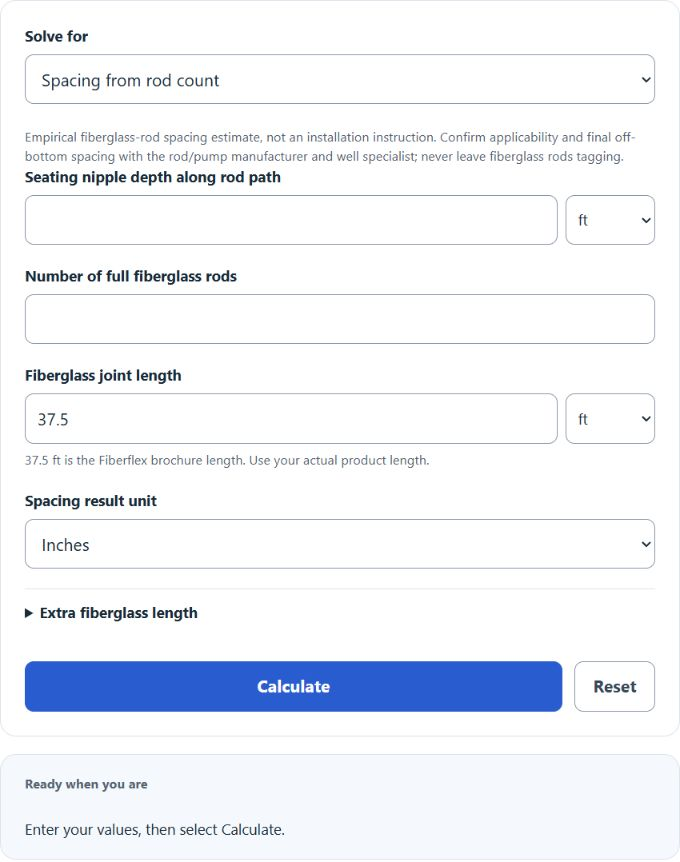
Calculate rod pump spacing from fiberglass rod count or total rod length and seating nipple depth, or find required rod length for target spacing.
- All Construction Calculators
- Casing Capacity Annular Volume Calculator
- Rod Load Calculator
- Well Volume Calculator
- Pressure Depth Calculator
- Annular Pressure Loss Calculator
- Pump Pressure Calculator
Rod Pump Spacing Formula
- RPS = rod pump spacing, in inches
- FL = total fiberglass rod length in the string, in feet
- D = seating nipple depth, in feet
The 9 and 2 coefficients form an empirical spacing rule published for Fiberflex fiberglass rods: inches of off-bottom spacing per 1,000 feet of fiberglass length and seating nipple depth, respectively. This estimate is not a universal stretch model or a setting instruction; confirm the applicable manufacturer procedure and well conditions before installation.
To solve for the fiberglass length needed to hit a target spacing, the calculator rearranges the formula:
If you enter rod count instead of total length, FL is computed as rods × joint length + extra. The Fiberflex brochure lists 37.5 ft joints; use the actual length for your product.
Reference Tables
Arithmetic examples from this formula at selected depths and fiberglass lengths; these are not recommended operating settings:
| Seating Nipple Depth (ft) | Fiberglass Length (ft) | Calculated Spacing (in) |
|---|---|---|
| 4,000 | 400 | 11.6 |
| 5,500 | 562.5 | 16.1 |
| 6,500 | 562.5 | 18.1 |
| 7,500 | 750 | 21.8 |
| 9,000 | 900 | 26.1 |
How to read the calculated spacing:
| Spacing Result | Interpretation |
|---|---|
| Under 5 in | Formula output below 5 in; this number alone cannot establish adequate clearance. |
| 5 to 36 in | Formula output from 5 to 36 in; this is not a validated safe working range. |
| Over 36 in | Formula output above 36 in; verify applicability and actual stroke clearance with the manufacturer. |
Worked Example
A well has a seating nipple at 6,500 ft with 15 fiberglass rods at 37.5 ft each.
- FL = 15 × 37.5 = 562.5 ft
- RPS = (9 × 562.5 + 2 × 6,500) / 1,000
- RPS = (5,062.5 + 13,000) / 1,000 = 18.06 in
The formula estimate is 18.0625 in off bottom. Final spacing requires the manufacturer’s procedure and well-specific verification; this example is not an instruction to set the pump.
FAQ
Why use 9 and 2 as the coefficients? They are empirical coefficients in the Fiberflex published spacing rule, not universal strain constants. Actual behavior depends on the rod system, loading and well conditions.
Does this account for tubing anchored vs unanchored? The two-input formula does not model tubing anchoring or movement explicitly. Confirm applicability and any adjustment with the rod/pump manufacturer and a well specialist.
What if the string has no fiberglass? Set fiberglass length to 0. The arithmetic reduces to 2 × D / 1,000. This reduction does not independently validate a steel-only pump spacing design.
Should I add extra spacing for fluid pound or gas interference? No universal addition is established by this formula. Fluid pound, gas interference, loading and stroke clearance require well-specific evaluation rather than an automatic 2–6 in allowance.