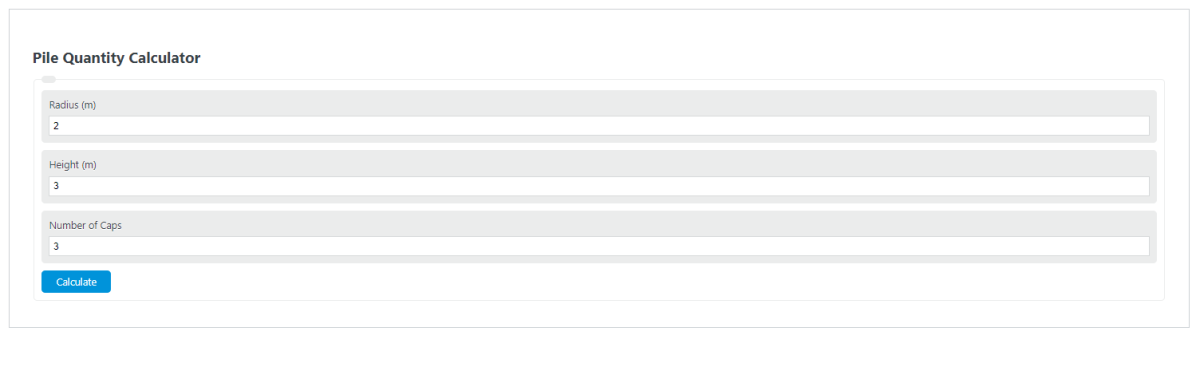
Calculate concrete volume for identical round foundation piles or reverse-solve pile count or diameter in metric or imperial length and volume units.
- All Construction Calculators
- Column Volume Calculator
- Soil Stockpile Volume Calculator
- Square Feet To Tons Calculator
- Pile Weight Calculator
Pile Quantity Formula
The pile quantity calculator estimates the total volume of a group of cylindrical piles. It is most useful when each pile has the same radius and height, and the count field is used as the number of repeated elements in the layout. In practical terms, this helps with concrete takeoffs, preliminary estimating, and quick design checks.
In this equation, the total pile quantity is found by calculating the volume of one cylindrical pile and then multiplying by the number of identical piles.
| Variable | Meaning | Typical Units |
|---|---|---|
| PQ | Total pile quantity or total volume | m³, ft³, in³ |
| r | Radius of one pile | m, ft, in |
| h | Height or length of one pile | m, ft, in |
| n | Number of identical piles or repeated units entered in the count field | count |
Useful Rearrangements
If you know the total volume and need to solve for a missing dimension, the same relationship can be rearranged.
If you start with diameter instead of radius, convert first.
How to Calculate Pile Quantity
- Measure the radius of one pile. If you only know diameter, divide it by 2.
- Measure the pile height or length using the same length unit as the radius.
- Enter the number of identical piles in the group.
- Square the radius, multiply by pi, multiply by the height, and then multiply by the count.
- Read the result in cubic units that match the input unit system.
Because the radius is squared, even a small change in pile size can create a large change in total volume. This is one of the most common reasons material estimates drift from field needs.
Example
Suppose each pile has a radius of 0.25 m, a height of 10 m, and there are 24 identical piles.
This means the total cylindrical volume for the pile group is approximately 47.12 cubic meters.
Unit Notes
- If radius and height are entered in meters, the result is in cubic meters.
- If radius and height are entered in feet, the result is in cubic feet.
- If inches are used, the output is cubic inches unless you convert afterward.
- Do not mix units without converting first. For example, entering radius in feet and height in inches will produce an incorrect result.
What This Calculator Assumes
- Each pile is modeled as a perfect cylinder.
- All piles in the calculation have the same radius and height.
- The count field is a simple multiplier for repeated identical units.
If your project includes multiple pile sizes, varying embedment depths, tapered piles, or non-cylindrical sections, calculate each group separately and add the totals together.
Common Input Mistakes
- Entering diameter where radius is required.
- Forgetting that volume grows with the square of the radius.
- Using inconsistent units between inputs.
- Using one average value for piles that actually have different lengths or diameters.
- Assuming this result is weight or structural capacity; it is volume only.
Practical Interpretation
The result from this calculator is the theoretical geometric volume of the piles. For estimating materials, field placement, or procurement, users often compare this value with project tolerances, overbreak, waste allowance, and specification requirements. As a quick planning tool, however, the formula gives a reliable baseline volume for identical cylindrical piles.