Calculate pile weight for steel pipe piles, H-piles, and concrete or timber piles from size, length and material, with weight per foot and total weight.
- All Construction Calculators
- All Weight Calculators
- Soil Stockpile Volume Calculator
- Ice Weight Calculator
- Bulk Density Calculator
Pile Weight Formula
This calculator estimates dry pile mass, commonly called weight, from material volume and mass density, or from an HP section’s nominal mass per length. It also solves length or whole pile count against a user-entered net dry-mass allowance. These are geometric and load arithmetic results, not lifting, transport or foundation approvals.
Variables:
- PW is dry pile mass, reported in kg, metric tonnes (t), lb or US short tons
- PV is material volume, excluding an empty core, in m³ or ft³
- PD is mass density in units matching the volume: kg/m³ or lb/ft³
How to Calculate Pile Weight?
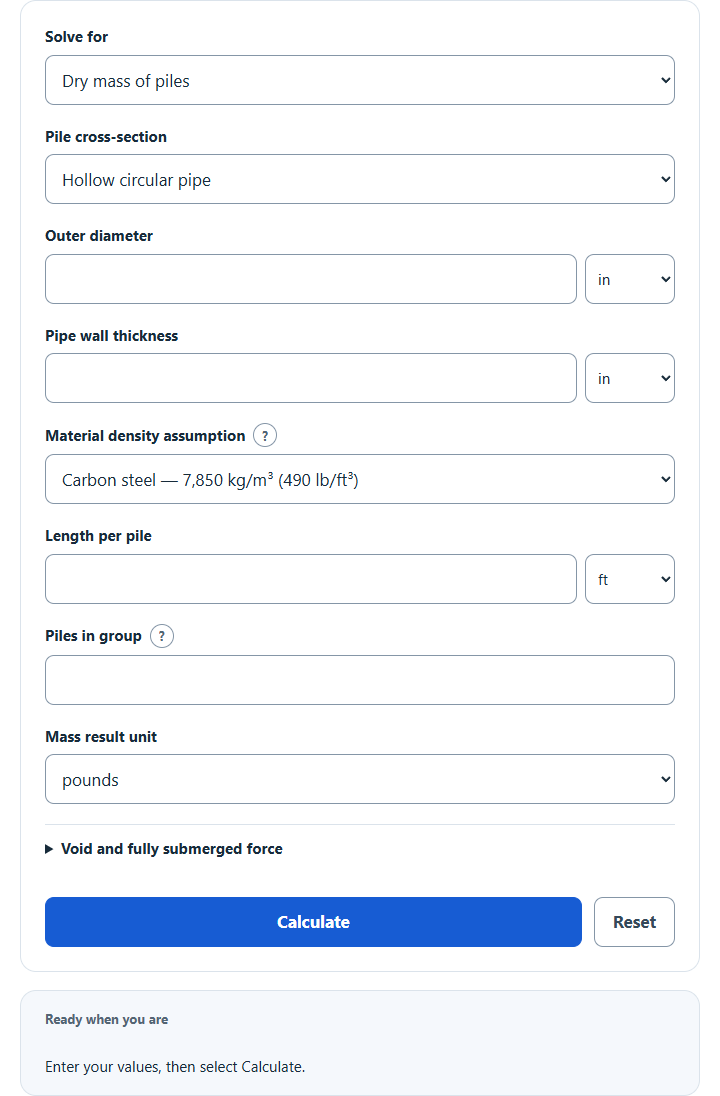
Choose the section shape and a unit for each dimension. The calculator converts dimensions before using them. Enter custom density in kg/m³ or lb/ft³, or nominal HP section mass in kg/m or lb/ft. Use project or supplier values; reference densities and section labels are estimates, not measured shipment weights.
- Find material cross-sectional area and multiply by length. Pipe area is the outer circle minus the inner circle; subtract any centered circular core from the other modeled sections.
- Multiply material volume by density. For an HP section, multiply its nominal mass per length by length instead.
- For dry mass, multiply mass per pile by whole pile count. The length bound is net allowance divided by mass per length and pile count.
- For piles per load, divide net dry-mass allowance by dry mass per pile and round downward to a whole count. No pile fits when that count is zero.
- The allowance must already account for applicable equipment, rigging and payload deductions. A mass estimate cannot establish a safe lift or load; load-weight verification and equipment limits still apply. No general safety factor is calculated here.
An optional circular core must lie wholly inside the section. Its diameter must be smaller than the round diameter, square side, regular octagon’s width across flats, or rectangle’s smaller side. A smaller core area alone does not prove it fits.
The optional submerged result assumes the entire modeled length is submerged. Buoyancy equals the weight of displaced water. A freely flooded cavity displaces material volume only; using the outer envelope requires a watertight sealed cavity that remains dry, not merely a plugged end. The signed result is net apparent force in kN, using standard gravity 9.80665 m/s²: negative means upward force in this fully submerged model. Dry mass and the dry-mass capacity calculations do not change. Closure, fittings, retained water and other added masses are excluded.
Example Problem :
This hypothetical arithmetic example uses 10 ft³ of material and an assumed density of 12 lb/ft³. It is not a recommended density for a pile material; convert the assumed density before entering it in kg/m³.
pile volume (ft3) = 10
pile density (lb/ft3) = 12
PW = PV * PD = 10 × 12 = 120 lb.