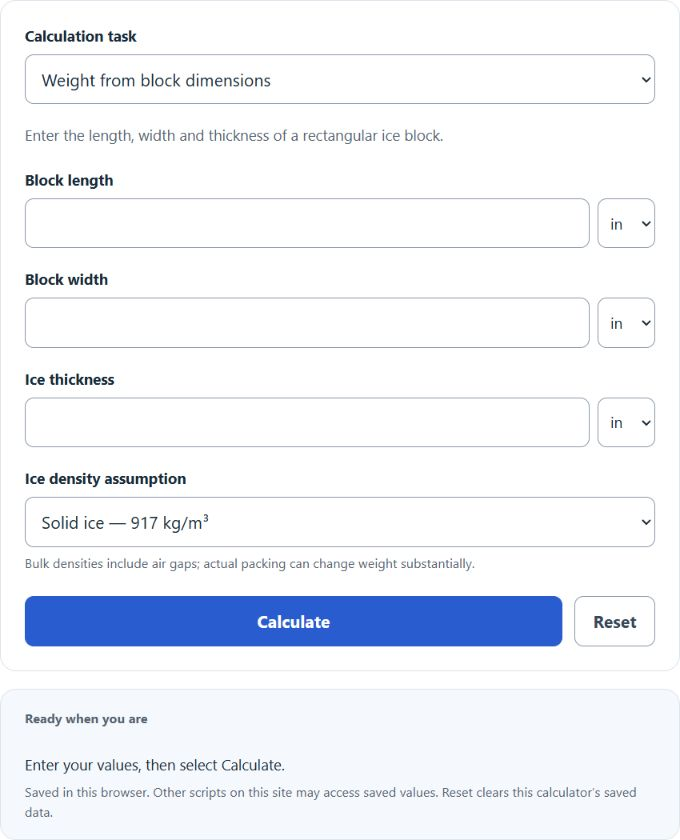
Calculate ice weight from volume or dimensions, or find ice volume from a target weight. Compare pounds, kilograms and whole-bag equivalents for solid, crushed or loosely packed cubed ice.
- All Unit Converters · All Physics Calculators
- All Weight Calculators
- Ice Melting Time Calculator
- Cubic Feet to Pounds Calculator
Ice Weight Formula
The calculator converts ice volume to mass using a selected density, or solves volume from a target mass. Shape calculations and whole-bag equivalents use that same result.
For dimensions, volume comes from the shape:
For a rough event-planning reference, separate from the calculator:
- Volume: total ice volume, converted to cubic feet.
- Density: approximately 57.25 lb/ft³ solid block, 37.02 lb/ft³ crushed, or 35.02 lb/ft³ loose cubes, corresponding to the calculator’s 917, 593 and 561 kg/m³ presets. Bulk densities are assumed packing values.
- L, W, H, D: length, width, height, diameter, all converted to feet before multiplying.
- Rate: the reference table uses illustrative 1, 1.5 or 2 lb per guest for four hours. Adjust with the supplier for drinks, cooling, weather and replenishment; these are not guaranteed requirements.
- Longer events: plan replenishment with your supplier. This calculator does not model time, heat transfer or ice loss.
Choose weight from a block, sheet, cylinder, sphere or total volume, or ice volume from target weight. Select the matching ice density assumption. Results include separate 10 lb and 20 lb whole-bag equivalents rounded up; there are no bag-count inputs, event controls or mixed-bag optimizer.
Reference Tables
The first table matches the calculator’s density assumptions; pound values are rounded. A gallon means a US gallon of ice volume, not melted-water volume. The event table is a rough four-hour reference, not an output of this calculator. Solid ice near freezing is rounded to 917 kg/m³ from IAPWS ice-density data; melted water uses 0.9982 kg/L at about 20 °C, consistent with OIV water-density data.
| Ice Form | Density (lb/ft³) | Density (kg/m³) | Weight per gallon |
|---|---|---|---|
| Solid block | 57.25 | 917 | 7.65 lb |
| Crushed | 37.02 | 593 | 4.95 lb |
| Loose cubed | 35.02 | 561 | 4.68 lb |
| Event Type | Lb per guest (4 hr) | 25 guests | 50 guests | 100 guests |
|---|---|---|---|---|
| Drinks only | 1.0 | 25 lb | 50 lb | 100 lb |
| Drinks + cooler | 1.5 | 38 lb | 75 lb | 150 lb |
| Outdoor / hot day | 2.0 | 50 lb | 100 lb | 200 lb |
Example Problems
Example 1 — Block of ice from dimensions. You have a solid ice block 24 in long, 12 in wide, and 10 in tall. Volume is 24 × 12 × 10 = 2,880 in³, or 2,880 / 1,728 = 1.667 ft³. Using 917 kg/m³ (about 57.25 lb/ft³) with the unrounded volume gives 43.2776 kg, or about 95.41 lb.
Example 2 — Cooler full of cubed ice. A cooler holds about 2 ft³ of loose cubed ice. Using the 561 kg/m³ preset, weight is about 70.044 lb. Whole-bag arithmetic rounds up: four 20 lb bags, or eleven 7 lb bags, cover that unrounded estimate. The calculator displays 10 lb and 20 lb equivalents; practical packing uncertainty is larger than this rounding difference.
FAQ
Why does the same volume give different weights? Crushed and cubed ice include air gaps between pieces. A cubic foot of solid block ice weighs about 57 lb, but the same space filled with loose cubes only holds about 35 lb of actual ice.
How much ice melts per hour? There is no fixed loss rate for every cooler. Insulation, exposed surface area, ambient temperature, sunlight, lid openings and warm contents affect melting. This calculator estimates mass and water volume after melting; it does not predict hourly loss or automatically increase event supplies.
How many 7 lb bags equal one 20 lb bag? Three 7 lb bags equal 21 lb, just over one 20 lb bag. For one bag size, divide the required pounds by bag size and round up. The displayed 10 lb and 20 lb counts are separate alternatives; the calculator does not optimize mixed bag sizes.
Can I use this for dry ice? No. Dry ice is solid carbon dioxide with a density near 97 lb/ft³, and it sublimates rather than melts. Use a dedicated dry ice calculator instead.