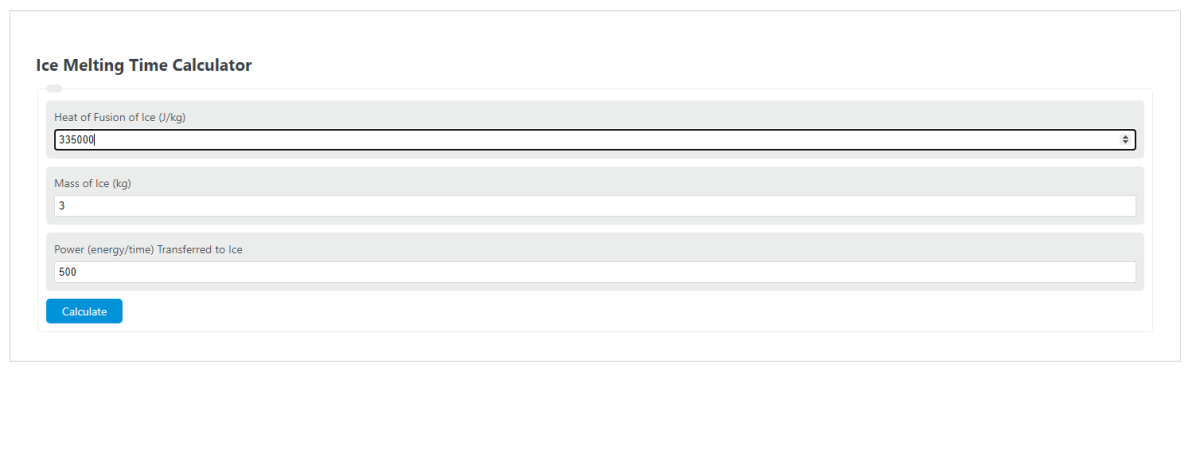
Estimate ice melting time from mass, heat of fusion, outside temperature or heating power, with results in seconds, minutes, or hours.
- All Physics Calculators
- Freezing Point Calculator
- Annealing Temperature Calculator
- Heat Absorption Calculator
- Dry Ice Calculator
- Water Freeze Time Calculator
Ice Melting Time Formula
The core formula for estimating ice melting time relates the total energy required for the phase change to the rate at which heat is delivered:
- t = melting time (seconds)
- L_f = specific latent heat of fusion (J/kg). For water ice this is 333,550 J/kg (commonly rounded to 334 or 335 kJ/kg).
- m = mass of ice (kg)
- P = rate of heat transfer into the ice (watts, i.e. joules per second)
This formula assumes all delivered energy goes exclusively toward the solid-to-liquid phase transition and that P remains constant over the entire melting period. In practice, P changes as the ice geometry shrinks, the meltwater layer grows, and surrounding conditions shift.
The Two-Stage Energy Budget
Melting ice that starts below 0 °C requires energy for two distinct thermodynamic stages. The first stage is sensible heating, where the ice warms from its starting temperature up to its melting point of 0 °C. The energy for this stage is Q_sensible = m * c_ice * (0 – T_initial), where c_ice is the specific heat capacity of ice at 2,090 J/(kg*K). The second stage is the latent heat phase change, where the ice at 0 °C transforms into liquid water at 0 °C. This requires Q_latent = m * L_f = m * 333,550 J/kg.
The latent heat stage dominates the total energy budget. Warming a 1 kg block of ice from -20 °C to 0 °C requires 41,800 J, but converting that same kilogram from solid at 0 °C to liquid at 0 °C requires 333,550 J, roughly eight times more energy. This is why ice sitting at exactly 0 °C still takes a long time to fully melt even though its temperature is not changing.
Heat Transfer and Newton’s Law of Cooling
When ice melts in open air rather than on a heated surface, the power P in the formula above comes primarily from convective heat transfer described by Newton’s Law of Cooling: Q_dot = h * A * (T_ambient – T_surface). Here, h is the convective heat transfer coefficient in W/(m^2*K), A is the exposed surface area of the ice in m^2, T_ambient is the air temperature, and T_surface is the ice surface temperature (approximately 0 °C during melting).
For natural (still air) convection around a small object like an ice cube, h typically falls between 5 and 25 W/(m^2*K). With forced convection from a fan or wind, h can reach 50 to 100 W/(m^2*K) or higher. This is the primary reason a breeze makes ice melt noticeably faster: it increases h, which increases P, which decreases t.
A complication arises because A is not constant. As the ice melts, its surface area shrinks, reducing the rate of heat transfer. The result is a non-linear melting curve where the first half of the mass melts faster than the second half when measured by elapsed time per gram lost.
Why Ice Shape Matters: Surface-Area-to-Volume Ratio
Because heat flows through the surface, the surface-area-to-volume ratio (SA:V) is the single most important geometric factor controlling melting speed. For a fixed volume of 27 cm^3, the surface area varies significantly by shape: a cube (3 cm sides) has 54 cm^2, a cylinder of equal height and diameter has roughly 50 cm^2, and a sphere has approximately 43.5 cm^2. The sphere exposes about 20% less surface area than the cube, which translates directly into a 20-40% longer melting time under the same conditions.
This is the physics behind spherical ice molds used in cocktails. A 2-inch (5 cm) diameter ice sphere contains about 65 mL of ice but exposes only about 78.5 cm^2 of surface area, compared to about 93.5 cm^2 for a cube of the same volume. The drink stays cold longer because the sphere melts more slowly, diluting the liquid at a lower rate.
The Meltwater Insulation Effect
As ice melts, a thin film of liquid water at 0 °C accumulates on its surface. This meltwater layer acts as a thermal insulator between the warm ambient air and the remaining solid ice, reducing the effective temperature gradient and slowing heat transfer. In still conditions, this layer can grow thick enough to meaningfully decrease the melting rate. Stirring or draining the meltwater removes this insulating layer and restores faster heat transfer, which is why ice in a stirred drink melts faster than ice sitting undisturbed in a glass.
Thermal Properties of Common Frozen Materials
Different frozen substances require very different amounts of energy to melt. Water ice has a latent heat of fusion of 334 kJ/kg at 0 °C. Dry ice (solid carbon dioxide) sublimes rather than melts at atmospheric pressure, absorbing 571 kJ/kg at -78.5 °C. For comparison, frozen ethanol melts at -114 °C with a latent heat of 108 kJ/kg, and frozen mercury melts at -38.8 °C requiring only 11.4 kJ/kg. Aluminum, despite being a metal, has a latent heat of 397 kJ/kg but does not melt until 660 °C. Water ice is unusual among common substances for having both a relatively high melting point and an exceptionally high latent heat of fusion, which is one reason ice is so effective for cooling.
Real-World Melting Time Reference Data
Under typical indoor conditions (22 °C, still air), a standard ice cube weighing about 30 g with approximate dimensions of 3 cm per side will melt completely in roughly 15 to 30 minutes. A 5 cm diameter ice sphere of about 65 g takes 30 to 50 minutes. A 1 kg block of ice at room temperature can take 2 to 4 hours. In a cooler held at 4 °C with minimal air movement, that same 1 kg block can persist for 10 to 15 hours because the temperature difference driving heat transfer is so small.
For ice in water rather than air, melting is dramatically faster. Water has a thermal conductivity of 0.6 W/(m*K) compared to air at 0.025 W/(m*K), and the convective heat transfer coefficient in water can exceed 500 W/(m^2*K). A 30 g ice cube dropped into a glass of water at 22 °C will melt in roughly 3 to 5 minutes, about 5 to 8 times faster than in air at the same temperature.
When the Simple Formula Breaks Down
The t = L_f * m / P formula works well when P is truly constant, such as when melting ice on an electric hot plate at a known wattage. It becomes less accurate in ambient melting scenarios for several reasons. The shrinking surface area reduces P over time. The growing meltwater layer insulates the remaining ice. Radiation contributes a small but non-zero fraction of heat transfer that the convection-only model ignores. And if the ice starts below 0 °C, the sensible heating stage consumes time and energy before the phase change even begins.
For more accurate modeling of ambient ice melting, engineers use the Biot number (Bi = h * L_c / k_ice, where L_c is the characteristic length and k_ice = 2.22 W/(m*K)) to determine whether the ice can be treated as a uniform temperature body. When Bi is less than 0.1, the interior of the ice is nearly the same temperature as its surface, and the lumped capacitance model applies. For larger ice blocks where Bi exceeds 0.1, the temperature gradient inside the ice itself becomes significant, and the full heat equation must be solved numerically.