Estimate dry ice needed, remaining mass, or cold duration from a packaging loss rate with kg/lb conversion, delay buffer, arrival reserve, and sensitivity range.
- Cooling Capacity Calculator
- Ice Melting Time Calculator
- Heat of Fusion Calculator
- Freezing Point Calculator
- All Chemistry Calculators
Dry Ice Formula
The calculator uses a planning estimate of 0.40 lb of dry ice per quart of cooler capacity per day. All cooler sizes are converted to quarts, and dry ice amounts are converted to pounds before the calculation.
- DI = dry ice needed, in pounds
- C = cooler size, in quarts
- D = days of cold needed
- 0.40 = estimated pounds of dry ice needed per quart per day
If you enter cooler size and days, the calculator estimates the dry ice needed. If you enter dry ice and days, it estimates the cooler size supported by that amount of dry ice. If you enter cooler size and dry ice, it estimates how many days of cold you can expect.
The calculator also converts units before solving:
- 1 gallon = 4 quarts
- 1 liter = 1.05669 quarts
- 1 kilogram = 2.20462 pounds
Dry Ice Estimates by Cooler Size
These estimates use the same 0.40 lb per quart per day factor as the calculator.
| Cooler Size | 1 Day | 2 Days | 3 Days |
|---|---|---|---|
| 20 quarts | 8 lb | 16 lb | 24 lb |
| 40 quarts | 16 lb | 32 lb | 48 lb |
| 60 quarts | 24 lb | 48 lb | 72 lb |
| 100 quarts | 40 lb | 80 lb | 120 lb |
Common Dry Ice Unit Conversions
| Unit | Equivalent |
|---|---|
| 1 kg dry ice | 2.20462 lb |
| 10 lb dry ice | 4.53592 kg |
| 1 gallon cooler capacity | 4 quarts |
| 1 liter cooler capacity | 1.05669 quarts |
Example
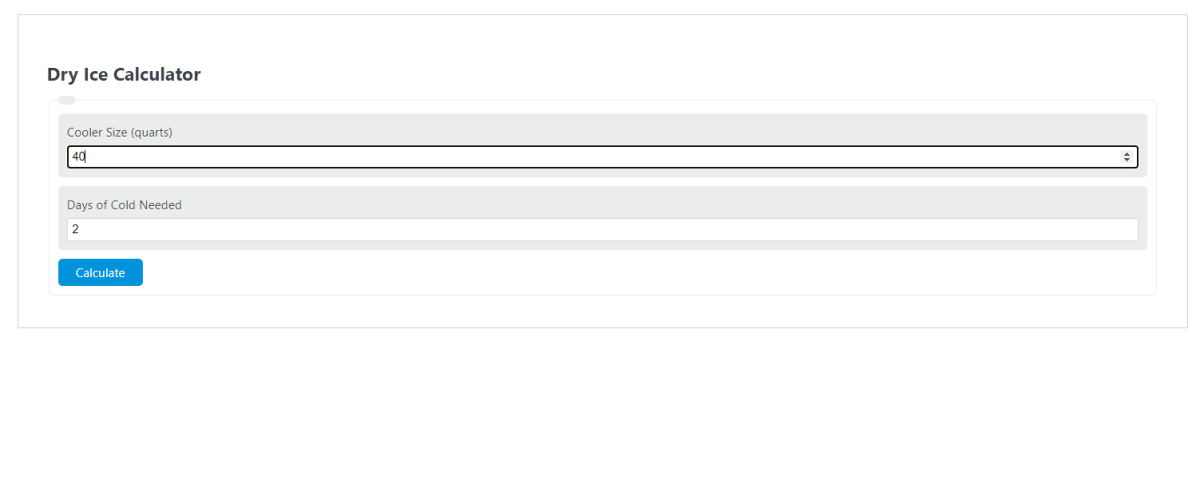
Example 1: Dry ice needed for a 40-quart cooler
You have a 40-quart cooler and need it cold for 2 days.
You need about 32 pounds of dry ice.
Example 2: Days of cold from 25 lb of dry ice
You have 25 lb of dry ice and a 50-quart cooler.
The dry ice should last about 1.25 days using this estimate.
FAQ
How accurate is the dry ice estimate?
The result is a planning estimate. Actual dry ice use depends on the cooler insulation, outside temperature, how often the cooler is opened, how full the cooler is, and whether the dry ice is placed on top or bottom. For critical storage, add extra dry ice rather than relying on the exact calculated amount.
Should dry ice go on top or bottom of the cooler?
For keeping food frozen, dry ice is commonly placed on top because cold air sinks. For general cooling, placement depends on the contents and packaging. Keep dry ice separated from items that could be damaged by extreme cold.
Can dry ice be stored in an airtight cooler?
No. Dry ice turns into carbon dioxide gas as it sublimates. An airtight container can build pressure and may burst. Use a cooler that can vent gas, and handle dry ice with insulated gloves to avoid frostbite.