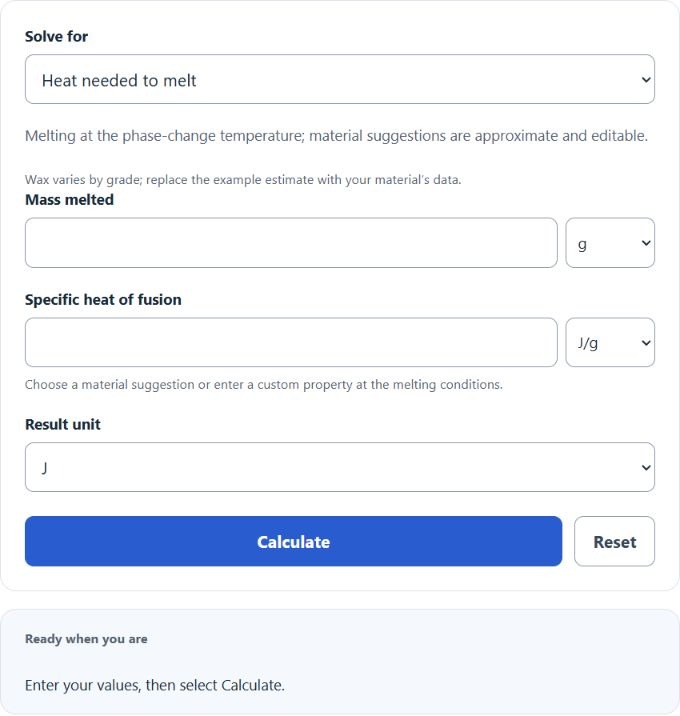
Calculate heat needed to melt a substance from its mass and heat of fusion, or find heat of fusion from heat supplied and mass melted.
- All Chemistry Calculators
- Heat Load Calculator
- Heat of Vaporization Calculator
- Ice Melting Time Calculator
- Water Freeze Time Calculator
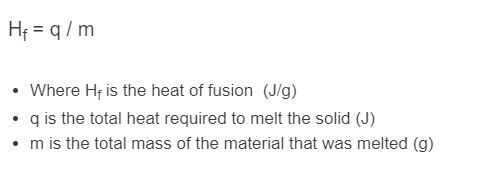
Heat of Fusion Formula
The heat of fusion is the amount of energy required to convert a solid into a liquid at its melting point, per unit mass. In this calculator, heat of fusion is treated as a mass-based quantity, which is why it can be expressed in units such as J/g, kJ/kg, or BTU/lb.
- Hf = heat of fusion
- q = total heat absorbed during melting
- m = mass of material melted
If you need to solve for a different variable, the equation can be rearranged as follows:
This relationship is used in thermodynamics, calorimetry, refrigeration, freezing and thawing analysis, material processing, and any application where a substance changes phase from solid to liquid.
How to Use the Calculator
- Choose the quantity to solve for, then enter the two known values. Use an editable material suggestion or a custom heat of fusion.
- Select the correct units for each value.
- Select Calculate to display the result and expandable calculation details.
Use only the energy associated with the actual melting process. If the sample is first heated up to its melting point, or the liquid is heated after melting, that extra energy should not be included unless you are intentionally calculating total heating energy separately.
Variable Guide and Units
| Variable | Meaning | Common Units | What to Watch For |
|---|---|---|---|
| q | Total heat absorbed during melting | J, kJ, MJ, BTU | Use the heat tied to phase change, not unrelated heating losses or gains. |
| m | Mass that actually melts | g, kg, lb | If only part of a sample melts, use only the melted portion. |
| Hf | Heat of fusion per unit mass | J/g, kJ/kg, BTU/lb | Match the heat and mass basis so the result stays consistent. |
For metric mass-based units, the following two ratios are numerically equivalent:
That equivalence is useful when switching between grams and kilograms, but you should still confirm that all inputs are expressed on the same basis before interpreting the result.
What the Result Tells You
- A larger heat of fusion means more energy is needed to melt the same mass of material.
- A smaller heat of fusion means the material melts with less energy input.
- Different substances have different heat of fusion values because their molecular structures and bonding differ.
- During melting, the added energy goes into the phase change itself rather than primarily increasing temperature.
This is why heat of fusion is commonly grouped under latent heat or specific latent heat of fusion: the energy is absorbed without a normal temperature rise while the solid is becoming a liquid.
Examples
Finding Heat of Fusion
If 4,000 J of heat melts 50 g of a solid, the heat of fusion is:
Finding Total Heat Required
If a material has a heat of fusion of 120 J/g and 35 g melts, the total heat absorbed is:
Finding Melted Mass
If 9,000 J is absorbed by a substance with a heat of fusion of 300 J/g, the melted mass is:
Common Mistakes
- Using the total sample mass when only part of the sample actually melts.
- Including energy used to warm the solid before it reaches its melting point.
- Mixing units without checking consistency between heat and mass.
- Confusing heat of fusion with heat of vaporization, which applies to liquid-to-gas phase change.
Heat of Fusion FAQ
What is heat of fusion?
Heat of fusion is the energy required per unit mass to change a material from solid to liquid at its melting point.
Is heat of fusion the same as latent heat of fusion?
Yes. Both terms describe the energy absorbed during melting. This calculator uses the value on a per-mass basis.
Does the temperature increase while the material is melting?
For a pure substance at its melting point, the added energy primarily goes into breaking the solid structure and completing the phase change rather than raising temperature.
Can this calculator also help with freezing?
Yes. The same magnitude of energy is involved, but the direction is reversed: melting absorbs energy, while freezing releases it.
Why is heat of fusion important?
It helps estimate the energy needed for melting or freezing in laboratory analysis, industrial heating and cooling, thermal storage, food processing, ice management, and many material science applications.