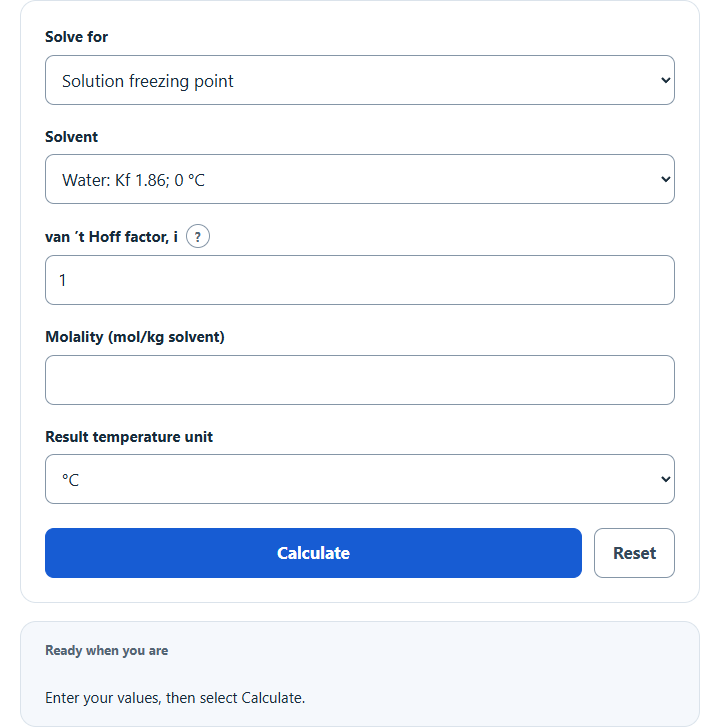
Calculate the freezing point of a solution with ΔTf = i × Kf × m using solvent presets, or solve for molality, solute mass or the Kf constant.
- Boiling Point Calculator (Water)
- Enthalpy Calculator
- All Chemistry Calculators
- Ice Melting Time Calculator
- Dry Ice Calculator
Freezing Point Formula
The following equations estimate freezing-point depression and solution freezing point in the ideal dilute limit. Concentrated mixtures and real electrolytes may require measured activity or effective van ’t Hoff data.
- Where ΔTf is the freezing point depression (the magnitude of the decrease in freezing point)
- i is the van ’t Hoff factor (≈ number of particles the solute produces in solution; often i=1 for nonelectrolytes)
- Kf is the freezing point depression constant (cryoscopic constant) of the solvent
- m is the molality (mol of solute per kg of solvent)
- Tf,pure is the freezing point of the pure solvent and Tf,solution is the freezing point of the solution
To calculate the freezing point depression, multiply i, Kf, and molality. To calculate the solution’s freezing point, subtract ΔTf from the pure solvent freezing point.
To start from solute mass, choose “Solution freezing point from solute mass.” Divide solute grams by molar mass in g/mol to get moles, then divide by solvent kilograms: m = solute grams ÷ (molar mass × solvent kilograms). Enter the solvent mass alone, excluding solute, and use the appropriate van ’t Hoff factor. The calculator shows the resulting molality and freezing-point depression as well as the estimated freezing point.
Freezing Point Definition
A freezing point is the temperature at which a liquid transitions to a solid (at a given pressure).
Freezing Point Example
How to calculate a freezing point?
- First, determine the solvent information.
Find the solvent’s freezing point (Tf,pure) and freezing point depression constant (Kf).
- Next, determine the solution information.
Measure the molality (m) and determine the van ’t Hoff factor (i) for the solute (use i=1 for a nonelectrolyte).
- Finally, calculate the freezing point.
Calculate the freezing point depression (ΔTf = i·Kf·m), then calculate the solution freezing point (Tf,solution = Tf,pure − ΔTf).
FAQ
A freezing point is a specific temperature at which a liquid begins to transition to a solid.
The freezing point depression constant (cryoscopic constant), Kf, is a property of the solvent that relates molality to freezing point depression (ΔTf = i·Kf·m). Its common units are °C·kg/mol (or K·kg/mol).
Molality is a measure of moles of solute per kilogram of solvent.