Calculate pure-water saturation temperature or absolute pressure with IAPWS-IF97, or estimate boiling point and altitude using a standard atmosphere. All four modes show Celsius, Fahrenheit and Kelvin; measured absolute pressure best reflects local conditions.
- All Chemistry Calculators
- Enthalpy Calculator
- Partial Pressure Calculator
- Water Vapor Pressure Calculator
Boiling Point Formula
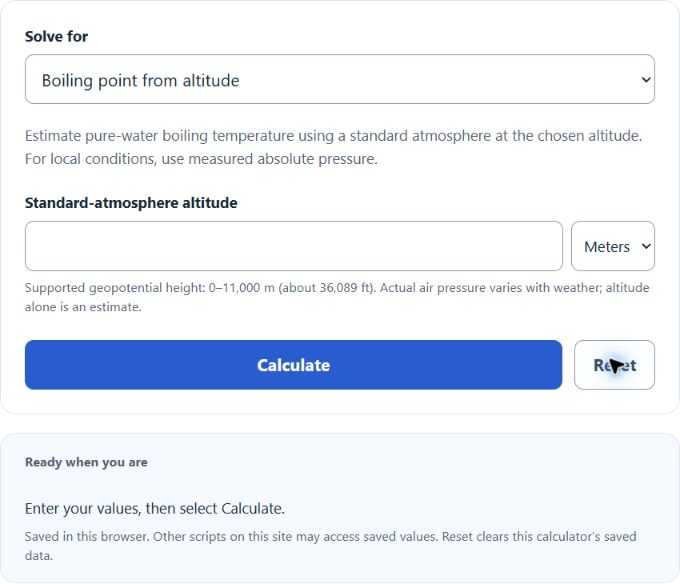
The calculator preserves four water-only modes. IAPWS-IF97 Region 4 relates water saturation temperature and absolute pressure; the altitude modes additionally use a standard-atmosphere approximation for 0–11,000 m geopotential height.
Water saturation temperature and pressure (IAPWS-IF97 Region 4):
Temperature = IF97 saturation temperature at absolute pressure; reverse: pressure = IF97 saturation pressure at temperature.
- T = saturation temperature, normalized by 1 K in the IAPWS equations (Celsius = Kelvin − 273.15)
- P = absolute pressure, normalized by 1 MPa in the IAPWS equations (1 MPa = 1,000 kPa)
- Use IAPWS-IF97 equations 30 and 31 and Table 34 coefficients. This calculator supports the triple point (0.01°C, 0.611657 kPa) up to, but excluding, the critical point (373.946°C, 22,064 kPa).
Pressure from altitude (barometric formula):
P (kPa) = 101.325 × [1 − (0.0065 × h / 288.15)]^5.2558797
- P = pressure in kPa
- h = standard geopotential height in meters, restricted to 0–11,000 m. The original rounded exponent is a close approximation of the U.S. Standard Atmosphere 1976 tropospheric equation; weather is not modeled.
The estimated absolute pressure feeds into IAPWS-IF97 to calculate pure-water saturation temperature. The inverse altitude mode is limited to the same 0–11,000 m atmosphere range.
Other liquids (illustrative Clausius-Clapeyron approximation):
1 / T2 = 1 / T1 + [R / ΔHvap] × ln(P1 / P2)
- T1 = known boiling point in K at pressure P1
- T2 = boiling point in K at the target pressure P2
- P1, P2 = reference and target pressures in the same units
- ΔHvap = heat of vaporization in J/mol
- R = 8.314462618 J/(mol·K)
Pressure and temperature modes use the water saturation curve directly. Altitude modes combine it with the standard-atmosphere estimate. The other-liquid equation and reference values below are explanatory examples; this water calculator has no solvent-selection mode.
Reference Values
Rounded water reference values calculated from the same standard-atmosphere approximation and IAPWS-IF97. These are model values, not city-specific measurements or weather forecasts:
| Elevation | Pressure (kPa) | Water boils at |
|---|---|---|
| Sea level (0 ft) | 101.3 | 100.0 °C / 212.0 °F |
| 1,000 ft | 97.7 | 99.0 °C / 210.1 °F |
| 3,000 ft | 90.8 | 96.9 °C / 206.5 °F |
| 5,280 ft (Denver) | 83.4 | 94.6 °C / 202.3 °F |
| 7,000 ft | 78.2 | 92.9 °C / 199.2 °F |
| 10,000 ft | 69.7 | 89.8 °C / 193.7 °F |
| 14,000 ft | 59.5 | 85.7 °C / 186.3 °F |
Approximate normal boiling points and vaporization enthalpies near each normal boiling temperature, for illustration. Values depend on temperature; standard-condition enthalpies are different. NIST acetone phase-change data give 29.1 kJ/mol near 329.3 K, and NIST isopropyl-alcohol data give 39.85 kJ/mol near 355.4 K.
| Liquid | Boiling point | ΔHvap (kJ/mol) |
|---|---|---|
| Water | 100.0 °C | 40.65 |
| Ethanol | 78.37 °C | 38.56 |
| Methanol | 64.7 °C | 35.21 |
| Acetone | 56.05 °C | 29.1 |
| Isopropyl alcohol | 82.6 °C | 39.85 |
| Ammonia | -33.34 °C | 23.35 |
Example Problems and FAQ
Example 1: Water in a pressure cooker. For illustration, 15 psi gauge plus local atmospheric pressure of about 14.7 psi gives about 29.7 psi absolute (205 kPa). Select boiling point from absolute pressure and enter 205 kPa. The water saturation temperature is approximately 121°C (250°F). Use the actual local atmospheric pressure to convert a gauge reading.
Example 2: Ethanol under vacuum. This is an illustrative calculation separate from the water calculator: T1 = 351.52 K, P1 = 1 atm, P2 = 0.2 atm and assumed constant ΔHvap = 38,560 J/mol. The Clausius-Clapeyron equation gives approximately 313.30 K, or 40.15°C. This constant-enthalpy approximation is not a verified ethanol saturation model.
Why does water boil at a lower temperature at high altitude? Boiling happens when the liquid’s vapor pressure equals the surrounding pressure. Atmospheric pressure drops with elevation, so vapor pressure matches it at a lower temperature.
How accurate is the altitude estimate? Altitude calculations assume a standard atmosphere. Real pressure varies with weather and temperature, so no fixed accuracy margin is guaranteed. Measured absolute pressure is the better input for current local boiling conditions.
When does the Clausius-Clapeyron estimate break down? The illustrative equation assumes constant ΔHvap and approximately ideal vapor. Accuracy depends on the substance, temperature and pressure; no universal factor-of-ten pressure range guarantees accuracy. Use substance-specific saturation data when accuracy matters.
What pressure should I enter, gauge or absolute? Always absolute pressure. If you have a gauge reading, add the local atmospheric pressure (about 14.7 psi or 101.3 kPa at sea level) before entering it.