Calculate enthalpy change from ΔU + PΔV, sensible heat, or Hess’s law, with reverse system solves, sign classification, and energy conversions.
- All Chemistry Calculators
- Air Enthalpy Calculator
- Enthalpy to Temperature Calculator
- Heat of Fusion Calculator
- Heat of Vaporization Calculator
- Specific Heat Calculator
Enthalpy Formula
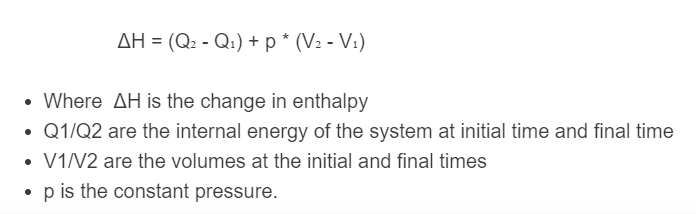
Enthalpy (H) is a thermodynamic state function defined as H = U + pV, where U is internal energy. From that definition, the change in enthalpy between two states can be written as:
- Where ΔH is the change in enthalpy
- U1/U2 are the internal energies of the system at the initial and final states
- V1/V2 are the volumes at the initial and final states
- p is the pressure (use the constant-pressure form only when pressure is the same in both states).
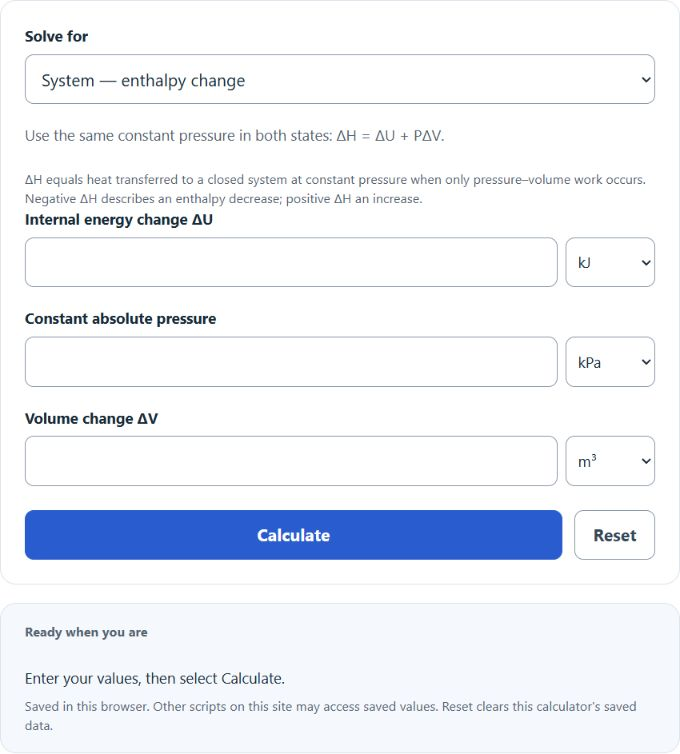
To calculate the change in enthalpy (ΔH) using the constant-pressure form, take the change in internal energy (ΔU = U₂ − U₁) and add the pressure multiplied by the change in volume (pΔV).
Enthalpy Definition
Enthalpy is a measure of a system’s energy content that combines its internal energy and the pV (“flow work”) term: H = U + pV. Like internal energy, enthalpy has units of energy (for example, joules).
Because enthalpy is a state function, its value is fixed for a given thermodynamic state (for example, a specified temperature, pressure, and composition). Enthalpy changes only when the state changes.
Enthalpy changes in both endothermic and exothermic reactions. An endothermic reaction absorbs energy, and an exothermic reaction releases energy (often as heat). The change in enthalpy will be positive for endothermic and negative for exothermic (for reactions written in the direction shown).
How to calculate Enthalpy?
How to calculate Enthalpy
- First, determine the initial internal energy of the system
With this step, we must calculate or measure the initial internal energy of the system, U1. For this example, we will assume a value of 20 joules.
- Next, determine the initial volume of the substance
Measure the initial volume empirically, or through calculations. We will assume 1 cubic meter.
- Next, measure the pressure (use the constant-pressure form only if pressure is constant)
If you use the simplified equation ΔH = ΔU + pΔV, the pressure must be the same at the start and end of the process. We will assume a constant pressure of 1 pascal.
- Now, let the process occur
Once the process has occurred, measure the final volume and internal energy of the system. For this example, we will assume U2 = 10 joules and V2 = 0.5 cubic meters.
- Finally, calculate the results
Enter the known information into the formula or calculator above to determine the change in enthalpy. Using ΔH = (U2 − U1) + p(V2 − V1), we get ΔH = (10 − 20) + 1(0.5 − 1) = −10.5 joules.
- Analyze the results
Analyze the result for accuracy and learn from this process. A negative ΔH indicates the system released enthalpy (often heat) over the process.
FAQ
Enthalpy is a thermodynamic state function defined as H = U + pV. It has units of energy (for example, joules).