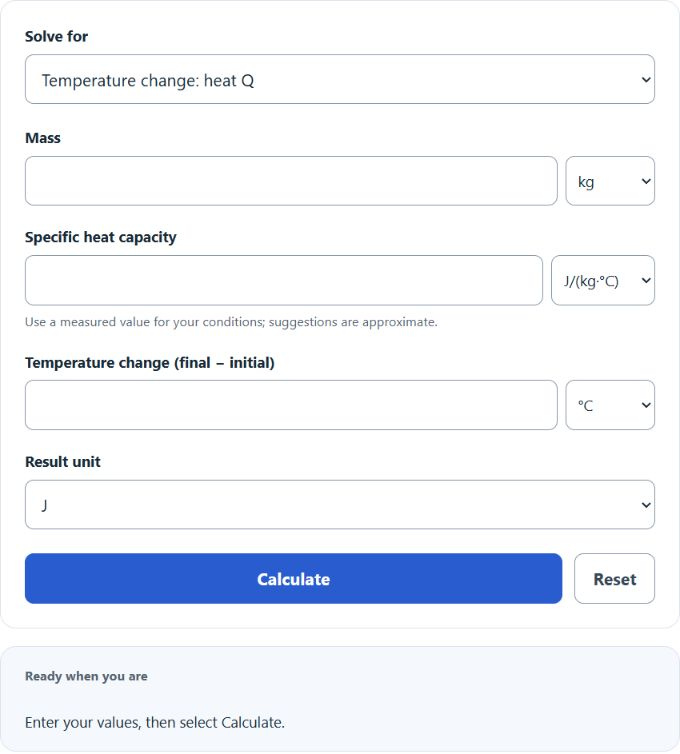
Calculate heat absorbed from mass, specific heat and temperature change, or from mass and latent heat for phase changes. Select the quantity to solve for and enter the other values; choose J, kJ or Btu for heat results.
- All Physics Calculators
- Heat Dissipation Calculator
- Cooling Capacity Calculator
- Specific Heat Calculator
- Heat Rejection Calculator
Heat Absorption Formula
The following formula is used to calculate the total amount of heat energy absorbed (or released) by a mass when its temperature changes.
- Where Q is the total amount of heat energy absorbed by a mass (J or Btu)
- m is the mass (kg or lb)
- C is the specific heat (specific heat capacity) of the material
- ΔT is the change in temperature (T2 − T1)
To calculate heat absorbed, multiply the mass by the specific heat and by the change in temperature.
The same relationship is also used for heat loss (cooling). Using ΔT = T2 − T1 is standard: for heating, ΔT is positive and Q is positive; for cooling, T2 is lower than T1, so ΔT (and Q) are negative, indicating heat released.
What is heat absorption?
Heat absorption is the process of a material gaining thermal energy from a higher-temperature object or its surroundings. The absorbed energy may raise the material’s temperature, or it may drive a phase change (latent heat) with little or no temperature change.
The methods of heat transfer include conduction, convection, and radiation.
Example Problem
How to calculate heat absorption?
First, determine the total mass of the object or solution that is absorbing the heat.
For this example problem, the total mass of the solution is found to be 50 kg.
Next, determine the specific heat of the material.
In this case, the specific heat is found to be 400 J/(kg·°C).
Next, determine the total change in temperature. The initial temperature is 20 °C and the final temperature is 60 °C. Therefore the change in temperature is calculated to be 60 °C − 20 °C = 40 °C.
Finally, calculate the total amount of heat absorbed using the formula above:
Q = m*C*ΔT
Q = 50*400*40
Q = 800,000 J.