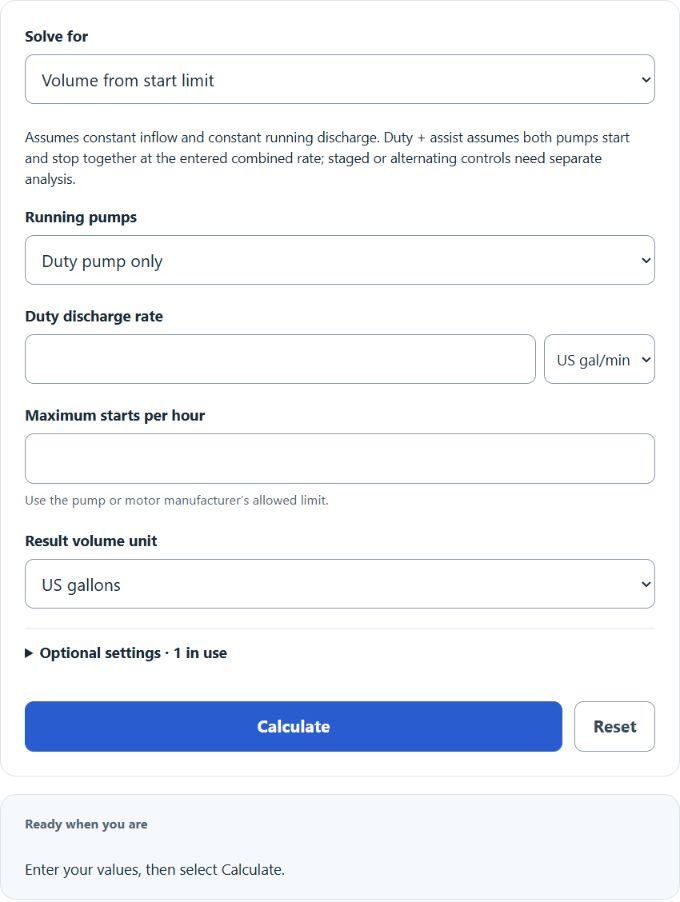
Size active wet-well volume from pump rate and start limits, calculate volume from diameter and level span, or check cycling at an actual inflow.
Active Wet Well Volume Formula (Minimum Volume / Starts per Hour)
The following equation is commonly used to estimate the minimum working (active) wet well volume for a single constant-speed pump when sizing to limit starts per hour (worst-case cycling).
- Where V is the working (active) wet well volume between the pump start and stop levels (gallons)
- CT is the time between pump starts (one full cycle) in minutes (min)
- Q is the pump capacity (gallons/min)
This “÷ 4” relationship applies at the worst-case cycling condition (maximum starts), which occurs when the inflow is approximately half the pump capacity. If you know the actual wet well geometry, use “Volume from dimensions” instead. The timing sizing checks apply at half-capacity inflow only; use “Starts at actual inflow” to check ON/OFF times at another inflow. Duty + assist assumes both pumps switch together at the entered combined discharge; alternating or staged pump controls need separate analysis.
What is an Active Wet Well Volume?
Definition:
A wet well is a collection basin (sump) in a lift station that receives influent (often by gravity) and from which pumps discharge it. The active (working) wet well volume is the usable volume between the pump start (ON) and pump stop (OFF) elevations—i.e., the volume that is alternately filled and emptied during normal cycling.
How to Calculate Active Wet Well Volume?
Example Problem:
The following example outlines the steps and information needed to estimate minimum working (active) wet well volume when sizing based on cycle time between starts.
First, determine the desired time between pump starts (cycle time). In this example, the cycle time is 5 min (equivalent to 12 starts/hr).
Next, determine the pump flow rate. For this well, the pump capacity is 20 gallons per minute.
Finally, estimate the minimum working (active) wet well volume using the formula above:
V = (CT × Q) / 4
V = (5 × 20) / 4
V = 25 gallons