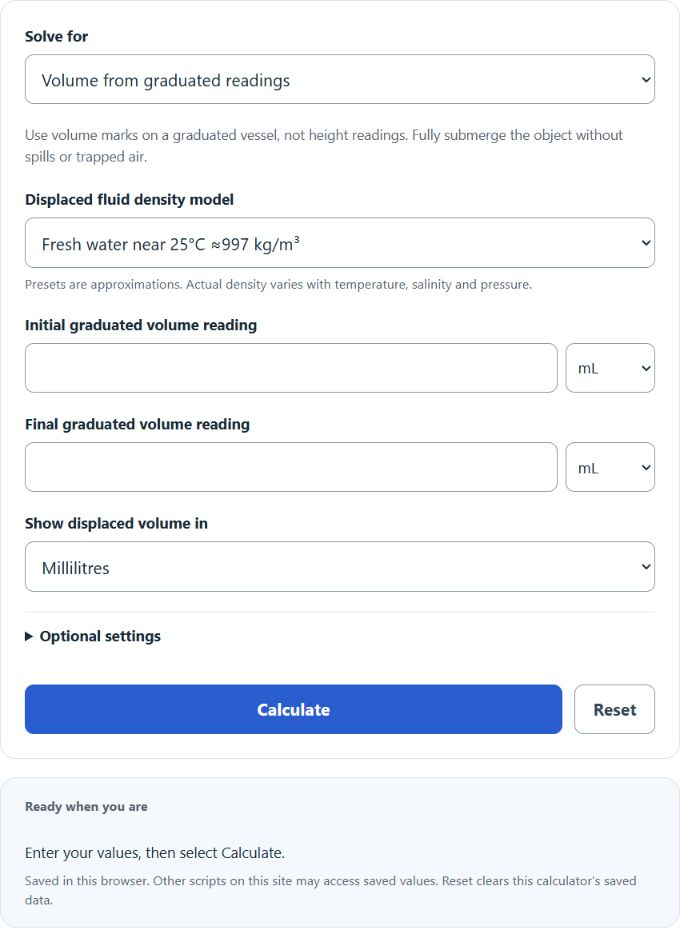
Find displaced volume from graduated volume readings or net collected overflow mass, or calculate displaced fluid mass from volume. Optional object mass gives object density; buoyancy uses the selected fluid density and standard gravity.
Water Displacement Formula
For graduated volume readings, displaced volume is V = final − initial. A fully submerged object’s density is its measured mass divided by that volume:
- Where D is the density g/cm^3
- m is the mass in grams
- FW is the final water level (mL)
- IW is the initial water level (mL)
Water Displacement Definition
Displacement is the volume of liquid moved aside. A fully submerged object displaces its submerged external volume; displacement is not itself density. From overflow weighing, V = collected liquid mass ÷ fluid density. Displaced liquid mass is ρV, and buoyant force is ρVg; this calculator uses standard g = 9.80665 m/s².
Water Displacement Example Problem
How to calculate water displacement?
The following example explores how to calculate the density of an object using the water displacement method. In this case, an irregularly shaped object is placed in a container of water and the displacement is measured.
First, determine the mass of the object in grams.
For this example problem, the mass of the object is measured to be 500 grams.
Next, read the initial volume mark on a graduated vessel before adding the object. A height reading alone needs the vessel’s geometry and is not the same input.
In this case, the water level is at 400 mL prior to anything being added to the water.
Fully submerge the object and record the final graduated volume, avoiding trapped bubbles, spills and unaccounted support displacement.
For this example, the final water level is measured to be 500 mL.
Finally, calculate the density using the formula above:
D = m / (FW – IW)
D = 500 / (500 – 400)
D = 5 g/cm^3
Since 1 mL = 1 cm³ exactly, 100 mL displaced volume with 500 g object mass gives 5 g/cm³ = 5 g/mL. In this calculator, enter the object mass under Optional settings to request density.
FAQ
Why is water displacement used to measure density?
Graduated displacement can determine the volume of an irregular fully submerged object. Combine that volume with the separately measured object mass to calculate density. Accuracy depends on the vessel, readings and material behavior.
Can water displacement be used for all types of materials?
Use a liquid that does not dissolve, react with or soak into the object. A floating object displaces only its submerged part; full-volume measurement needs a suitable submersion method with any support displacement accounted for. Trapped bubbles and open pores can change the measured volume.
How accurate is the water displacement method?
Read a suitable graduated vessel at eye level and consistently read the meniscus. Resolution, repeated readings, bubbles, spills and absorption affect the result. The density presets are approximate: fresh water depends on temperature and pressure, and seawater also depends on salinity. The calculator does not estimate measurement uncertainty.
Can the water displacement method be used to find the density of a liquid?
Known object volume and object density alone do not determine liquid density. Measure liquid mass in a known volume, or also measure the buoyant force (for example, the object’s air versus immersed apparent weight). Then fluid density ≈ buoyant force ÷ (g × displaced volume), with air buoyancy and support effects accounted for as needed. This calculator takes fluid density as an input; it does not perform that reverse weighing measurement.