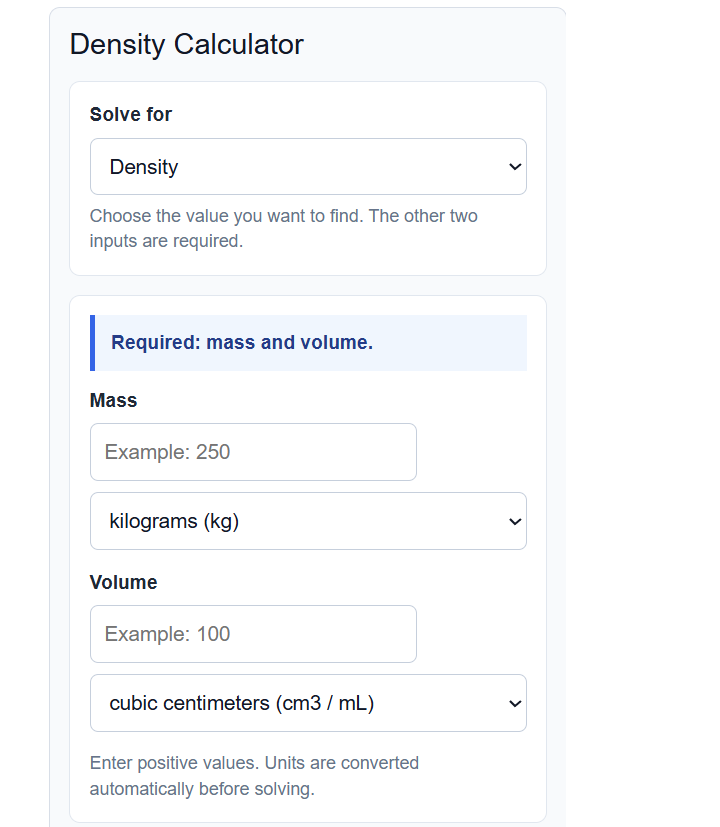
Calculate density, mass, or volume with the density formula rho = m/V, including instant unit conversion for grams, kilograms, cubic centimeters, liters, and more.
Density Formula
Density is the amount of mass packed into a given volume. The calculator uses the basic density equation and rearranges it depending on the value you choose to solve for.
rho = m / V
Rearranged for the other two unknowns:
m = rho * V
V = m / rho
- rho is the density of the substance, usually in kilograms per cubic meter (kg/m3) or grams per cubic centimeter (g/cm3).
- m is the mass of the object.
- V is the volume the object occupies.
When you set the calculator to solve for density, you enter mass and volume and it divides one by the other. When you solve for mass, you enter a density and a volume and it multiplies them. When you solve for volume, you enter mass and density and it divides mass by density. Every entry is converted to kilograms and cubic meters before solving, then the result is converted back into the units you picked, so you can mix grams with cubic centimeters or pounds with cubic feet without doing the conversion yourself.
Densities of Common Materials
If you know what a substance is, you can look up its density and use the calculator to find mass or volume. These values are at roughly room temperature and standard pressure.
| Material | Density (g/cm3) | Density (kg/m3) |
|---|---|---|
| Air | 0.00122 | 1.225 |
| Ethanol | 0.789 | 789 |
| Ice | 0.917 | 917 |
| Water | 1.000 | 1000 |
| Concrete | 2.40 | 2400 |
| Aluminum | 2.70 | 2700 |
| Iron | 7.87 | 7870 |
| Copper | 8.96 | 8960 |
| Lead | 11.34 | 11340 |
| Gold | 19.30 | 19300 |
A substance with a density below 1 g/cm3 floats on water, and a substance above 1 g/cm3 sinks. That is why ice floats and a gold ring sinks.
Common Density Unit Conversions
Density is reported in several unit systems. These conversions are exact for the SI base and approximate for the imperial entries.
| 1 of this unit | Equals (kg/m3) |
|---|---|
| 1 g/cm3 | 1000 |
| 1 kg/L | 1000 |
| 1 lb/ft3 | 16.018 |
| 1 lb/in3 | 27679.9 |
Example Problems
Example 1: Solve for density. A block has a mass of 250 grams and a volume of 100 cubic centimeters. Set the calculator to solve for density, enter 250 g and 100 cm3, and choose g/cm3 for the output. The density is 250 / 100 = 2.5 g/cm3, which is the same as 2500 kg/m3.
Example 2: Solve for mass. You have 1000 cubic centimeters of aluminum, which has a density of 2700 kg/m3. Set the calculator to solve for mass, enter a density of 2700 kg/m3 and a volume of 1000 cm3. The mass is 2700 x 0.001 = 2.7 kilograms.
Frequently Asked Questions
What units should I use for density? Use whatever units match your data. The calculator accepts grams, kilograms, ounces, and pounds for mass, and cubic centimeters, liters, cubic inches, cubic feet, and more for volume. It converts everything internally, so a result you read in g/cm3 is the same physical density as one read in kg/m3.
Why does the same object give a different density number in different units? The number changes but the density does not. For water, 1 g/cm3 and 1000 kg/m3 describe the exact same thing. Switching the density unit in the calculator only rescales the displayed value, not the underlying result.
Does temperature affect density? Yes. Most materials expand when heated, so the same mass spreads over a larger volume and the density drops. The values in the table above are for typical room conditions. For precise work, use a density measured at your actual temperature.