Choose air density, dry-air partial pressure, water vapor partial pressure, or temperature under Solve for, then enter the other three quantities. Use absolute pressures and a temperature above absolute zero.
- All Physics Calculators
- All Density Calculators
- Partial Pressure Calculator
- Specific Gravity Calculator
- Density Calculator
Air Density Formula
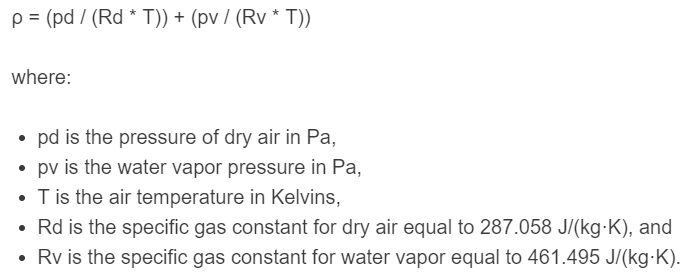
The calculator uses an ideal-gas mixture equation for dry air and water vapor. It does not test saturation or condensation limits, so a numerical result does not establish a physically stable mixture.
- ρ = air density, in kg/m³
- pd = dry-air partial pressure, in Pa
- pv = water vapor partial pressure, in Pa
- T = absolute temperature, in K
- Rd = specific gas constant for dry air, 287.058 J/(kg·K)
- Rv = specific gas constant for water vapor, 461.495 J/(kg·K)
To solve for dry-air partial pressure:
To solve for water vapor partial pressure:
To solve for temperature:
The calculator converts pressure to pascals, temperature to kelvin, and density to kg/m³ before applying the formulas. If you only know total air pressure, calculate dry-air partial pressure first using pd = p – pv.
Common Air Density Reference Values
| Condition | Approximate air density | Notes |
|---|---|---|
| Sea level, 15°C, dry air | 1.225 kg/m³ | Standard atmosphere reference value |
| Sea level, 20°C, dry air | About 1.204 kg/m³ | Typical room-temperature value |
| Sea level, 30°C, dry air | About 1.165 kg/m³ | Warmer air is less dense |
| Higher altitude | Lower than sea level | Lower pressure reduces density |
Useful Unit Conversions
| Quantity | Conversion |
|---|---|
| Pressure | 1 atm = 101,325 Pa |
| Pressure | 1 bar = 100,000 Pa |
| Pressure | 1 psi = 6,894.757 Pa |
| Density | 1 lb/ft³ = 16.0185 kg/m³ |
| Temperature | K = °C + 273.15 |
Air Density Example Problems
Example 1: Calculate air density
Given:
- Dry-air partial pressure: 100,000 Pa
- Water vapor partial pressure: 1,000 Pa
- Temperature: 293.15 K
The result is approximately 1.196 kg/m³.
Example 2: Calculate dry-air partial pressure
Given:
- Air density: 1.20 kg/m³
- Water vapor partial pressure: 1,500 Pa
- Temperature: 293.15 K
The dry-air partial pressure is approximately 100,048 Pa.
Air Density Calculator FAQ
What is the difference between dry-air partial pressure and total pressure?
Total pressure is the sum of dry-air partial pressure and water vapor partial pressure. This calculator asks for dry-air partial pressure separately. If you know total pressure, subtract the water vapor partial pressure first:
Why does humid air have a different density than dry air?
Water vapor has a larger specific gas constant than dry air, which means it contributes less density for the same pressure and temperature. At the same total pressure and temperature, humid air is usually less dense than dry air.
Why must temperature be in kelvin for the formula?
The ideal gas law requires absolute temperature. Celsius and Fahrenheit are relative scales, so they must be converted to kelvin before calculating air density.