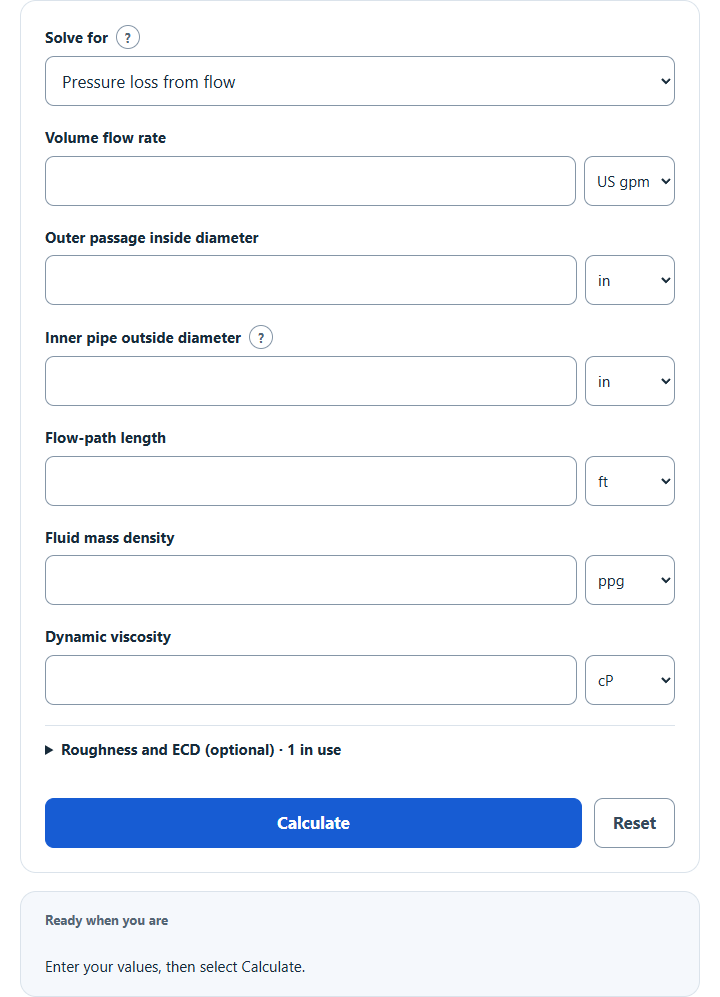
Estimate annular pressure loss from flow rate, hole and pipe diameters, fluid density and viscosity, or solve flow for a target loss, plus ECD.
- Annular Velocity Calculator
- Casing Capacity Annular Volume Calculator
- Pipe Flow Calculator
- Head Loss Calculator
- Flow Rate Pressure Calculator
- All Physics Calculators
Calculator Functions
| Function | What it does | What it requires |
|---|---|---|
| Pressure loss from flow | Finds the friction pressure loss along an annulus at a given flow rate | Requires the volume flow rate, the outer passage inside diameter, the inner pipe outside diameter, the flow-path length, the fluid density and the dynamic viscosity |
| Flow from target pressure loss | Finds the flow rate that produces a chosen friction pressure loss | Requires the target friction pressure loss, the two diameters, the flow-path length, the fluid density and the dynamic viscosity |
Flow is entered in US gpm or L/s, diameters in inches or mm, length in ft or m, density in ppg or kg/m³ and viscosity in cP or Pa·s. Two optional settings apply to both functions: absolute roughness, which starts at 0.0018 in for steel pipe, and true vertical depth, which adds equivalent circulating density. Each result also lists the mean annular velocity, hydraulic diameter, flow area, annular capacity in bbl/ft, annular volume, Reynolds number and Darcy friction factor.
Annular Pressure Loss Formulas
| ΔP | Friction pressure loss (Pa) |
| f | Darcy friction factor |
| L | Flow-path length (m) |
| Dh | Hydraulic diameter, outer passage ID minus inner pipe OD (m) |
| ρ | Fluid density (kg/m³) |
| v | Mean velocity, flow rate ÷ flow area (m/s) |
The flow area is A = π(Do² − Di²) ÷ 4, and the Reynolds number is Re = ρ × v × Dh ÷ μ, with μ the dynamic viscosity in Pa·s. The calculator converts every input to SI units, applies this Darcy relation [1] and reports the loss in psi, kPa and bar.
Pressure loss from flow
The friction factor depends on the flow regime. Below a Reynolds number of 2,300 the flow is treated as laminar:
(1 − k²) ÷ ln(1 ÷ k)] [1]
k is the inner pipe OD divided by the outer passage ID. ζ corrects the hydraulic diameter for the annular shape: it is 1 for a plain pipe and approaches 1.5 for a very narrow gap. From a Reynolds number of 4,000 up, the calculator uses the Swamee and Jain approximation [2] with the effective diameter De = Dh ÷ ζ in the roughness term [1]:
5.74 ÷ Re0.9)]² [2]
ε is the absolute roughness. Between 2,300 and 4,000 the factor is a straight-line blend of the two. For 500 US gpm of 10 ppg, 20 cP fluid in an 8.5 in hole around 5 in pipe over 5,000 ft, ζ = 1.493, the hydraulic diameter is 3.5 in, Re = 7,018 and f = 0.03535, which gives 91.41 psi.
Flow from target pressure loss
No formula gives flow directly once the friction factor changes with flow, so the calculator searches for the flow rate whose pressure loss matches the target, to within one part in 100 million. A target of 91.41 psi in the example above returns 500 US gpm.
Equivalent circulating density
(0.052 × TVD) [3]
ρ is the fluid density in ppg, ΔP the annular pressure loss in psi and TVD the true vertical depth in feet [3]. At 4,500 ft TVD the 91.41 psi example adds 0.391 ppg, for an ECD of 10.391 ppg. The loss entered must be for the whole annulus from that depth to surface, and the vertical depth is not the same as the flow-path length in a deviated well.
Limits of This Estimate
- The model is for steady flow of a Newtonian liquid in a concentric annulus with no pipe rotation. Drilling muds are usually non-Newtonian, so a single viscosity cannot stand in for them. Do not rely on this result alone for drilling-mud or well-control decisions.
- An off-center pipe, pipe rotation, tool joints, entrance and fitting losses and hydrostatic head are not included.
- NASA’s standard and the EPA’s EPANET manual treat flow as laminar below a Reynolds number of 2,000 [1] [2]. This calculator uses 2,300, and its straight-line blend up to 4,000 is a smoothing choice, where EPANET uses a curve fitted to the Moody diagram [2]. Results in that range are rough. These estimates are based on the best available data and estimations.
- The calculator accepts Reynolds numbers up to 100 million and a roughness of up to 5% of the effective diameter. Those are numerical limits, not a statement of accuracy.
Sources
- NASA Kennedy Space Center, KSC-STD-Z-0017 Revision A, Engineering Analysis: Thermal/Fluid: Darcy pressure loss, and the hydraulic diameter, ζ correction, laminar friction factor and effective diameter for a concentric annulus
- U.S. EPA, EPANET 2.2 User Manual, Analysis Algorithms: the Swamee and Jain friction factor for turbulent flow and the treatment of transitional flow
- SLB, Energy Glossary: equivalent circulating density: equivalent circulating density from mud weight, annular pressure drop and true vertical depth