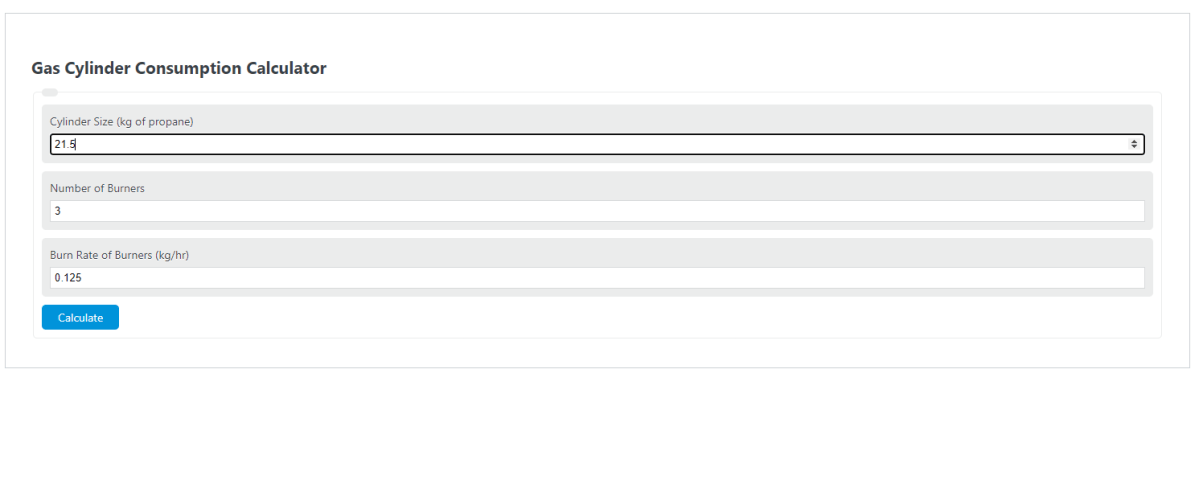
Calculate how long a gas cylinder will last, plus the cylinder size, burn rate, or burner count needed for a given setup at home or outdoors.
- Every Day Life And Education Calculators
- Gas Piping Size Calculator
- CCF to Therms Calculator
- lb/hr to SCFM Calculator
- Boiler Efficiency Calculator
- Gas Purge Calculator
Gas Cylinder Consumption Formula
The following formula is used to calculate gas cylinder consumption time:
Where:
- T = consumption time (hours)
- M = net mass of gas in the cylinder (kg)
- B = number of burners or appliances drawing from the cylinder
- BR = burn rate per burner (kg/hr)
This formula applies to any pressurized or liquefied gas cylinder where the fuel is consumed at a steady mass flow rate. For appliances rated in BTU/hr rather than kg/hr, convert using the energy density of the specific gas (see the BTU-based method below).
BTU-Based Consumption Method
Many appliances, especially in the United States, list their consumption in BTU per hour rather than kg/hr. For propane, 1 gallon contains approximately 91,500 BTU, and 1 pound of propane holds roughly 21,660 BTU. The BTU-based formula is:
Where:
- T = consumption time (hours)
- W = weight of fuel in the cylinder (lb)
- E = energy content per unit weight (BTU/lb)
- R = total appliance burn rate (BTU/hr)
For example, a standard 20 lb propane tank feeding a 35,000 BTU/hr grill: T = (20 * 21,660) / 35,000 = approximately 12.4 hours. This method is especially useful for heating appliances, outdoor grills, and generators where BTU ratings are the primary specification.
What is Gas Cylinder Consumption?
Gas cylinder consumption refers to the rate at which fuel is depleted from a pressurized cylinder, typically expressed as the total hours a cylinder will last at a given usage rate. The concept applies across LPG (propane and butane) cylinders for cooking and heating, compressed gas cylinders for welding (argon, CO2, acetylene), medical gas cylinders (oxygen, nitrous oxide), and laboratory or industrial process gases (nitrogen, helium, hydrogen).
The consumption rate depends on three primary factors: the net weight or volume of usable gas in the cylinder, the flow or burn rate of the connected appliance, and the number of appliances drawing from that cylinder simultaneously. Ambient temperature also plays a role in LPG cylinders because it affects the vapor pressure and the rate at which liquid fuel boils into usable gas. Propane maintains adequate vapor pressure down to around -42 °C (-44 °F), while butane struggles below 0 °C (32 °F), which is why propane is preferred in cold climates.
Common LPG Cylinder Sizes and Gas Content
LPG cylinders are manufactured in standard sizes worldwide. The net gas weight (not including the steel tare weight of the cylinder itself) determines how long the cylinder will last. Below are reference values for the most widely available propane and butane cylinders.
| Cylinder Name | Net Gas (kg) | Net Gas (lb) | Approx. Volume (L) | Typical Tare Weight (kg) |
|---|---|---|---|---|
| Small camping canister | 0.23 | 0.5 | 0.45 | 0.15 |
| BBQ cylinder (US 20 lb) | 9.1 | 20 | 17.8 | 7.7 |
| 9 kg household (AU/EU) | 9.0 | 19.8 | 17.6 | 8.5 |
| 14.2 kg (India domestic) | 14.2 | 31.3 | 27.8 | 15.0 |
| 19 kg (commercial) | 19.0 | 41.9 | 37.2 | 18.0 |
| 45 kg (large commercial) | 45.0 | 99.2 | 88.2 | 33.0 |
| US 100 lb tank | 45.4 | 100 | 88.9 | 35.0 |
Note: LPG cylinders are filled to approximately 80-85% of their water capacity to allow for thermal expansion of the liquid. The volume column above reflects the actual liquid propane volume at 15 °C (59 °F), using propane’s density of approximately 0.51 kg/L.
Typical Appliance Burn Rates
Burn rate varies significantly depending on the appliance type, burner size, and flame setting. The following reference data covers common propane and butane appliances.
| Appliance | Burn Rate (kg/hr) | Burn Rate (BTU/hr) | Hours per 9 kg Cylinder |
|---|---|---|---|
| Small stove burner (simmer) | 0.06 | 2,800 | 150 |
| Medium stove burner | 0.12 | 5,600 | 75 |
| Large stove burner (high) | 0.25 | 11,600 | 36 |
| Gas oven | 0.39 | 18,000 | 23 |
| BBQ grill (2-burner) | 0.75 | 35,000 | 12 |
| Patio heater | 0.86 | 40,000 | 10.5 |
| Portable camping stove | 0.14 | 6,500 | 64 |
| Propane generator (3,500 W) | 1.07 | 50,000 | 8.4 |
| Tankless water heater | 3.43 | 160,000 | 2.6 |
The BTU-to-kg conversion for propane is: 1 kg of propane = approximately 46,452 BTU (lower heating value). For butane, the value is approximately 45,370 BTU/kg. These figures assume complete combustion at standard atmospheric pressure.
Propane vs. Butane: Key Differences for Consumption
While both propane and butane are classified as LPG, their physical properties affect cylinder consumption in distinct ways. Propane (C3H8) has a boiling point of -42 °C (-44 °F), meaning it readily vaporizes in nearly all outdoor conditions. Butane (C4H10) boils at -1 °C (30 °F), which limits its usefulness in cold weather because the liquid cannot produce enough vapor pressure to sustain a steady flame below that temperature.
From a density standpoint, liquid propane is lighter at approximately 0.51 kg/L compared to butane at 0.58 kg/L. This means a cylinder of a fixed water capacity will hold more butane by mass than propane. However, propane has a slightly higher energy content per kilogram (46,452 BTU vs. 45,370 BTU), so the net runtime difference between an equal-mass charge of propane and butane is relatively small in practice, typically within 2-3%.
In many regions, LPG sold for household cooking is a blend of propane and butane. The ratio varies by season and geography. Winter blends in colder climates typically contain 60% or more propane to ensure reliable vaporization, while summer blends or tropical market LPG may contain 60% or more butane, which is slightly cheaper to produce.
Compressed Gas Cylinders (Welding and Industrial)
For compressed gases like argon, CO2, oxygen, and nitrogen, consumption is measured by volume flow rate (cubic feet per hour or liters per minute) rather than mass burn rate. The gas is stored at high pressure (typically 2,000 to 2,640 psi for a full cylinder) and expands to atmospheric pressure through a regulator. The formula for compressed gas cylinder duration is:
Where V is the total gas volume in the cylinder at atmospheric pressure (in cubic feet), and FR is the flow rate setting on the regulator (in cubic feet per hour). Common welding cylinder sizes include 40 cf, 80 cf, 125 cf, and 251 cf (often called a T-size). At a typical MIG welding flow rate of 25 cfh, an 80 cf argon/CO2 cylinder lasts approximately 3.2 hours of continuous arc time. In practice, welders achieve roughly 25-40% arc-on time during a shift, so an 80 cf cylinder may last 8 to 13 working hours in a real fabrication shop.
Factors That Affect Gas Cylinder Consumption
Ambient temperature directly impacts LPG cylinder output. As temperature drops, vapor pressure inside the cylinder decreases, reducing the maximum flow rate the cylinder can sustain. A propane cylinder in freezing conditions may deliver only 60-70% of its rated flow compared to the same cylinder at 25 °C (77 °F). For high-draw applications in cold weather, using two cylinders in parallel or a vaporizer can help maintain consistent flow.
Altitude affects combustion efficiency. At elevations above 1,500 m (5,000 ft), burners designed for sea level will run slightly rich (excess fuel, insufficient oxygen), which increases fuel consumption per unit of useful heat output by roughly 4% per 300 m (1,000 ft) of elevation gain.
Regulator condition matters. A worn or iced-over regulator can restrict flow, cause incomplete combustion, and lead to both wasted fuel and safety hazards. Regulators should be inspected annually and replaced every 10 to 15 years per most manufacturer recommendations.
Cylinder fill level is not always 100% of the rated capacity. Exchange cylinders (common for BBQ tanks in the US) are often filled to 15 lb instead of the full 20 lb capacity, which reduces runtime by 25% compared to what the label suggests. Weighing the cylinder and subtracting the tare weight stamped on the collar gives the actual fuel weight.
Wind exposure increases heat loss from the flame and cooking surface, which indirectly increases consumption. Outdoor burners in windy conditions may use 10-30% more fuel to achieve the same cooking result as in a sheltered environment. A simple windscreen can significantly extend cylinder life for camping and outdoor cooking applications.