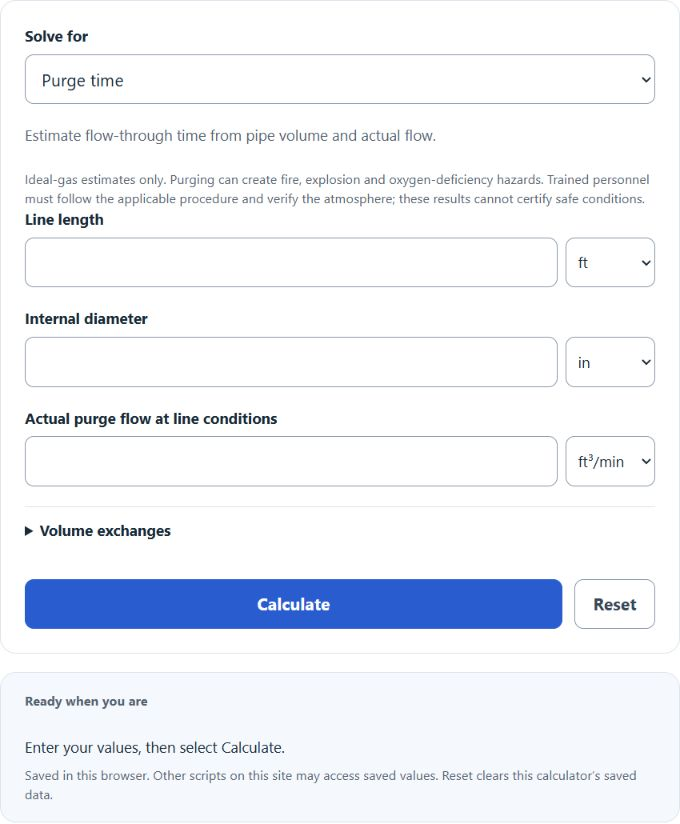
Calculate gas purge time, purity and fill volume for pipelines from line length, diameter, pressure, flow rate and temperature inputs.
- All Construction Calculators
- Gas Volume Calculator
- Purge Volume Calculator
- Purge Time Calculator
- Leak Rate Calculator
- Vacuum Leak Rate Calculator
- Gas Density Calculator
Calculator Functions
| Function | What it does | What it requires |
|---|---|---|
| Purge time | Estimates the time for a set number of line-volume exchanges at a steady purge flow | Requires the line length, the internal diameter and the actual purge flow at line conditions |
| Target purity | Finds the number of pressurize-and-vent cycles that reach a target purge-gas purity | Requires the line length, outer diameter, wall thickness, high and vent absolute pressures and the target purity |
| Fill volume | Converts the gas held in the line at its final pressure to a volume at reference conditions | Requires the line length, the internal diameter and the final absolute pressure |
All pressures are absolute. Purge time has an optional number of volume exchanges, 4 if left blank. Target purity has an optional initial impurity, 100% if left blank. Target purity and Fill volume share an optional gas temperature (60 °F), reference pressure (14.696 psia) and reference temperature (60 °F). Every result lists the internal pipe volume in cubic feet and liters.
Gas Purge Formulas
ln(Pv ÷ Ph) [1]
| n | Pressurize-and-vent cycles, rounded up to a whole number |
| Ct | Target impurity fraction: 1 − target purity |
| C0 | Initial impurity fraction |
| Pv | Vent absolute pressure |
| Ph | High absolute pressure |
Each cycle fills the line with purge gas to the high pressure, then vents the mixture. In theory every cycle multiplies the impurity concentration by Pv ÷ Ph, so after n cycles it is C0 × (Pv ÷ Ph)n [1]. Solving for n gives the formula above.
Pipe volume
D is the internal diameter and L is the line length. A 100 ft line with a 2 in internal diameter holds 2.1817 ft³, or 61.78 L.
Purge time
N is the number of volume exchanges and Q is the actual purge flow at line conditions. Four exchanges of the 2.1817 ft³ line at 10 ft³/min take 0.8727 min, and six take 1.309 min. The exchange count is an entered assumption, not a purity result.
Target purity
The internal diameter is the outer diameter minus twice the wall thickness. With a 40 psia high pressure, a 20 psia vent pressure and a 99.99% target from 100% impurity, n = ln(0.0001) ÷ ln(0.5) = 13.29, so 14 complete cycles are needed and the estimated final purity is 99.9939%. With 114.7 psia and 14.7 psia, a 99% target takes 3 cycles. A target of exactly 100% cannot be reached in a finite number of cycles.
(Tref ÷ T)
G is the purge gas used, as a volume at the reference pressure and temperature. For the 14-cycle example in a 2.1817 ft³ line at 60 °F, G = 41.57 ft³.
Fill volume
(Tref ÷ T) [2]
For a fixed amount of ideal gas, pressure × volume ÷ absolute temperature stays constant [2]. The 2.1817 ft³ line at 100 psia and 60 °F holds 14.8453 ft³ of gas at 14.696 psia and 60 °F. This is the total gas in the line at its final state, not the amount added to it.
Limits of This Estimate
- Purging can create fire, explosion and oxygen-deficiency hazards. A calculated purity is not a measured atmosphere: trained personnel must follow the applicable procedure and verify actual conditions.
- The cycle formula assumes pure purge gas, complete mixing, constant temperature and full venting to the stated pressure on every cycle. The equation is a qualitative guide [1].
- In lines with branches and dead ends, continuous flow displaces little gas from those spaces and dilutes them slowly [1], so a count of volume exchanges can understate the time needed. The default of 4 exchanges is an estimate, not a safety criterion.
- Gas volumes use the ideal gas relation, which real gases follow only approximately [2].
Sources
- Matheson Tri-Gas, Purging High Purity Gas Delivery Systems, Instructions INT-0258 Rev C: the cycle purging equation, its use as a qualitative guide, and why continuous flow is slow in branches and dead ends
- NASA Glenn Research Center, Equation of State: the ideal gas relation behind the reference-volume conversion