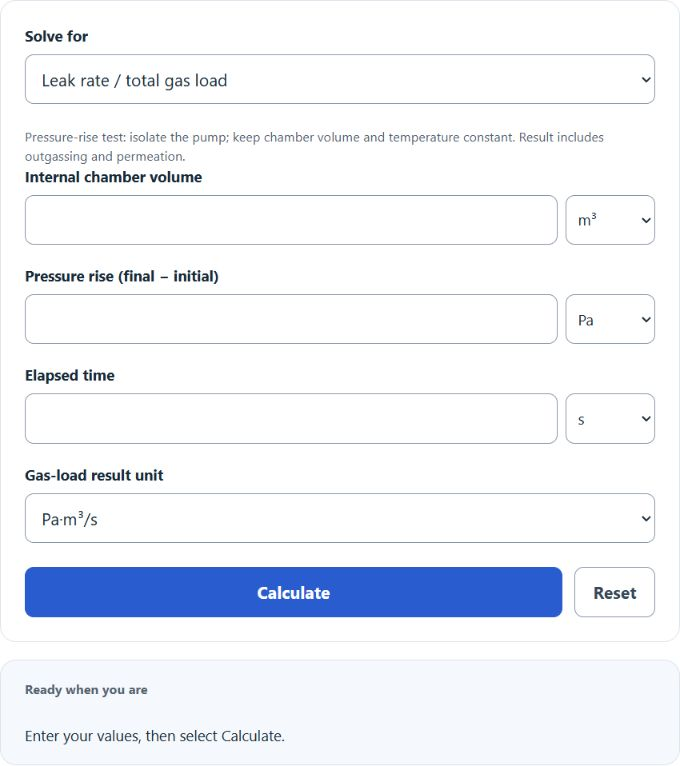
Calculate vacuum leak rate or solve for volume, pressure change, or time from the other three values in Pa·m³/s with unit options.
- All Physics Calculators
- Leak Rate Calculator
- Vacuum Force Calculator
- Vacuum Pressure Calculator
- Vacuum Temperature Calculator
- Gas Volume Calculator
- Atmospheric Pressure Calculator
Vacuum Leak Rate Formula
The vacuum leak rate calculator estimates how much gas is entering a vacuum system by measuring how quickly pressure changes inside a known volume over a known time interval. For a sealed chamber at approximately constant temperature, the basic pressure-rise relation is:
Where:
- L = vacuum leak rate or total gas load
- V = chamber volume
- ΔP = change in pressure
- Δt = elapsed time
If you are solving for another variable, the same relationship can be rearranged as follows:
What the Result Means
A higher leak rate means gas is entering the chamber faster, so pressure rises more quickly. A lower leak rate means the chamber is holding vacuum better. In real systems, this pressure rise may come from more than one source, so the calculated value is often best understood as total gas load, not only a hole or crack in the chamber.
- External leaks: fittings, flanges, seals, valves, feedthroughs, and weld defects
- Outgassing: water vapor, oils, plastics, elastomers, and porous materials releasing trapped gas
- Permeation: slow gas migration through seals and flexible materials
- Virtual leaks: trapped pockets or blind holes that slowly release gas into the main volume
How to Use the Calculator
- Enter the vessel volume in m³, ft³, or liters.
- Enter the pressure change over the test interval using a consistent vacuum unit.
- Enter the time change in seconds, minutes, or hours.
- Calculate the missing value.
The most reliable results come from a chamber that has been isolated from the pump, allowed to stabilize, and measured with a gauge appropriate for the pressure range being tested.
Example
Suppose a chamber volume is 0.25 m³, and pressure rises by 8 Pa over 40 s. The leak rate is:
This means the chamber is gaining gas at a rate of 0.05 Pa·m³/s during the test period.
Unit Notes
| Variable | Description | Typical units |
|---|---|---|
| L | Leak rate / gas load | Pa·m³/s, psi·ft³/min, bar·m³/s |
| V | Internal chamber volume | m³, ft³, L |
| ΔP | Pressure rise over the test interval | Pa, psi, bar |
| Δt | Measurement time | s, min, h |
Use consistent units throughout the calculation. If volume, pressure, and time are mixed carelessly, the leak rate will be numerically incorrect even if the equation form is right.
Important Testing Assumptions
- The chamber volume remains constant during the test.
- Temperature is approximately constant.
- The system is isolated so the observed pressure rise reflects gas entering or being released into the chamber.
- The pressure instrument has enough sensitivity and resolution for the pressure range being measured.
If temperature changes significantly, pressure can rise even without a true leak. Likewise, freshly cleaned or recently opened chambers often show pressure rise from outgassing rather than from a mechanical leak path.
Practical Interpretation
- Larger chamber, same gas input: pressure rises more slowly.
- Smaller chamber, same gas input: pressure rises more quickly.
- Longer test interval: often improves measurement stability when gauge noise is present.
- Very short tests: can exaggerate random fluctuations and lead to misleading leak estimates.
Common Mistakes
- Using the wrong chamber volume and forgetting hoses, manifolds, traps, or connected dead space
- Reading pressure before the system has thermally stabilized
- Confusing absolute pressure measurements with relative or gauge-style readings
- Assuming every pressure rise is an external leak instead of checking for outgassing and virtual leaks
- Using a time interval too short for the sensor resolution
Why Vacuum Leak Rate Matters
Leak rate affects pump-down time, base pressure, process repeatability, contamination control, and whether a system can maintain the target vacuum level. In laboratory, coating, semiconductor, freeze-drying, and analytical systems, even a modest gas load can prevent the chamber from reaching the required operating pressure.
This calculator is most useful for quick pressure-rise checks, estimating chamber integrity, comparing maintenance results, and determining whether a system is behaving normally after service, seal replacement, or reassembly.