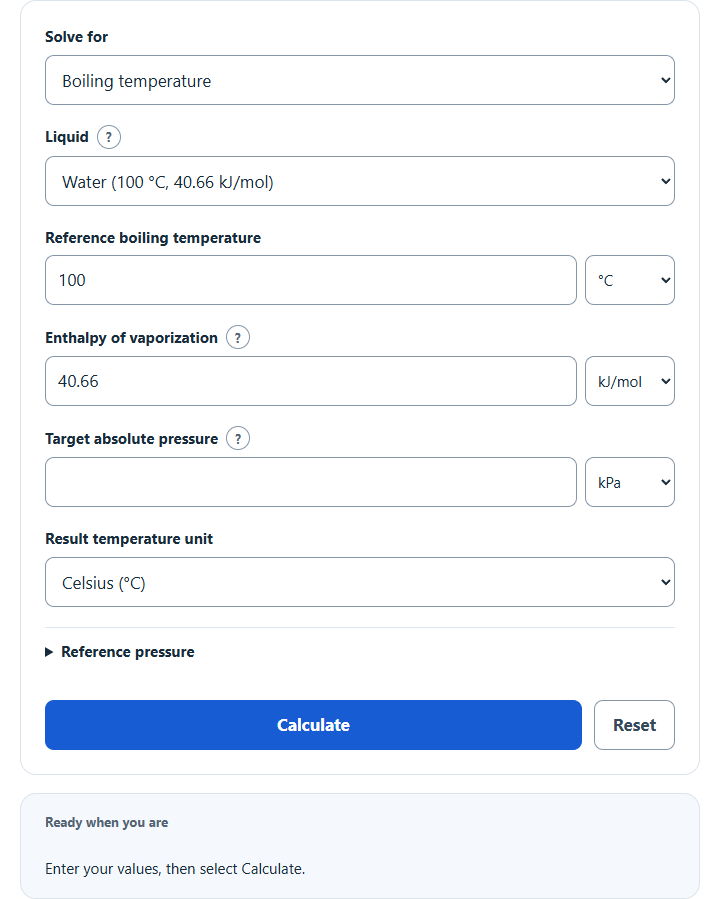
Calculate the boiling point of water or another liquid under vacuum from its absolute pressure, or find the vacuum needed to boil at a target temperature.
Related Calculators
- Equilibrium Temperature Calculator
- Vacuum Pressure Calculator
- Specific Heat Calculator
- Enthalpy to Temperature Calculator
- Temperature Difference Calculator
- All Physics Calculators
Vacuum Temperature Formula
The integrated Clausius–Clapeyron approximation relates absolute vapor pressures and boiling temperatures using a constant molar enthalpy of vaporization.
- P₁ and P₂ are reference and target absolute vapor pressures in the same unit
- ΔHᵥₐₚ is molar enthalpy of vaporization (J/mol); R = 8.31446261815324 J/(mol·K)
- T₁ and T₂ are reference and target boiling temperatures in kelvin
Select boiling temperature or required absolute pressure. Enter the reference boiling temperature, enthalpy of vaporization, and target pressure or temperature. The optional reference pressure defaults to 1 atm (101.325 kPa).
What is a Vacuum Temperature Calculator?
Definition:
This calculator estimates a pure liquid’s boiling temperature at a specified absolute pressure, or estimates the pressure corresponding to a target boiling temperature. It uses the integrated Clausius–Clapeyron approximation, assuming ideal vapor, negligible liquid volume, and constant enthalpy of vaporization. It does not calculate radiative equilibrium temperature.
How to Calculate Vacuum Temperature?
Example Problem:
The following example illustrates the constant-enthalpy model for water; it is an approximate calculation, not a steam-table value.
First, select required absolute pressure for a target boiling temperature of 50°C (323.15 K).
Use a reference temperature of 100°C (373.15 K) at 101.325 kPa and an assumed constant vaporization enthalpy of 40.7 kJ/mol.
Calculate the estimated absolute pressure using the integrated relation:
ln(P2/P1) = -(Delta Hvap/R)(1/T2 – 1/T1)
P₂ = P₁ exp[−ΔHᵥₐₚ/R × (1/T₂ − 1/T₁)]
P₂ = 101.325 × exp[−40700/8.31446261815324 × (1/323.15 − 1/373.15)] kPa
P₂ ≈ 13.311 kPa absolute. IAPWS gives about 12.35 kPa for real water at 50°C; this constant-enthalpy estimate is about 7.8% higher.
FAQ
What does the vaporization enthalpy mean?
It is the energy required to vaporize one mole of liquid at a specified temperature. Use substance-specific data near the reference temperature. The calculator holds this value constant, although real enthalpy varies with temperature.
How does a Vacuum Temperature Calculator work?
Choose the desired result explicitly. The calculator relates a known liquid–vapor reference point to a second point using the Clausius–Clapeyron approximation. Enter absolute pressure rather than a gauge-vacuum reading.
Why might the calculated temperature differ from expected values?
Constant enthalpy and ideal vapor are approximations. A stable liquid–vapor region must exist: below freezing or the triple-point region, sublimation may replace boiling; near or above the critical point, this model is unreliable. No universal phase limits can be applied without knowing the liquid. Verify practical values against substance-specific saturation data.