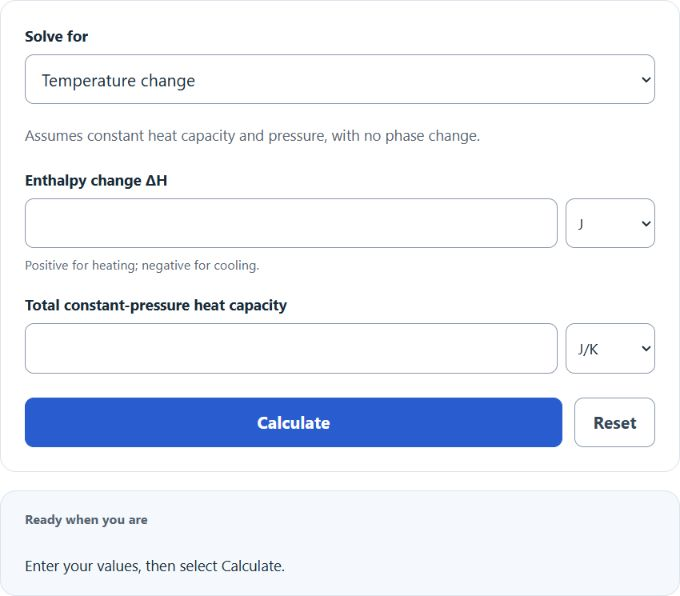
Calculate enthalpy change, total heat capacity, or temperature change using ΔH = CₚΔT. Select the quantity to solve and enter the two known values. The model assumes constant pressure, constant heat capacity, and no phase change.
Related Calculators
- Delta H Calculator
- Heat of Fusion Calculator
- Fugacity Coefficient Calculator
- Molecular Speed Calculator
- All Chemistry Calculators
Enthalpy To Temperature Formula
The following equation relates enthalpy change, total constant-pressure heat capacity, and temperature change for a fixed sample when heat capacity is approximately constant.
- Where ΔH is the enthalpy change (J)
- Cₚ is the total constant-pressure heat capacity (J/K, equivalent to J/°C)
- ΔT is the temperature change (°C)
To calculate the temperature change, divide the enthalpy change by the total heat capacity. Temperature differences in kelvin and Celsius have the same numerical value.
| Enthalpy Change (J) | Temperature Change (°C) |
|---|---|
| 100 | 0.024 |
| 250 | 0.060 |
| 500 | 0.120 |
| 750 | 0.179 |
| 1,000 | 0.239 |
| 1,500 | 0.359 |
| 2,000 | 0.478 |
| 2,500 | 0.598 |
| 3,000 | 0.717 |
| 4,000 | 0.956 |
| 5,000 | 1.195 |
| 7,500 | 1.793 |
| 10,000 | 2.390 |
| 15,000 | 3.585 |
| 20,000 | 4.780 |
| 25,000 | 5.975 |
| 30,000 | 7.170 |
| 40,000 | 9.560 |
| 50,000 | 11.950 |
| 100,000 | 23.901 |
| Assumes constant heat capacity C = 4184 J/°C (≈ 1 kg of water, cp ≈ 4.184 J/g·°C). Formula: ΔT = Q / C. | |
What is Enthalpy To Temperature?
Definition:
This calculation relates a change in enthalpy to a change in temperature at constant pressure. A positive enthalpy change produces heating and a negative change produces cooling when heat capacity is positive. Absolute enthalpy does not uniquely determine temperature without a reference state.
How to Calculate Enthalpy To Temperature?
Example Problem:
The following example outlines the steps and information needed to calculate the missing variable.
First, determine the enthalpy change. In this example, the enthalpy change is +5000 J.
Next, determine the heat capacity. In this example, the heat capacity is 100 J/°C.
Finally, calculate the temperature change using the formula above:
ΔT = ΔH / Cₚ
ΔT = 5000 / 100
ΔT = 50°C
FAQ
What does enthalpy represent in a thermodynamic process?
Enthalpy is H = U + pV, where U is internal energy. At constant pressure with only pressure–volume work, heat supplied to the system equals its enthalpy change.
How is heat capacity related to temperature change?
Heat capacity measures the amount of heat required to raise the temperature of a substance by one degree Celsius, and it directly influences the temperature change experienced when heat is added or removed.
How do I choose the missing quantity?
Choose temperature change, enthalpy change, or heat capacity from the calculation menu, then enter the two required values. Negative changes represent cooling; an inferred positive heat capacity requires matching nonzero signs.