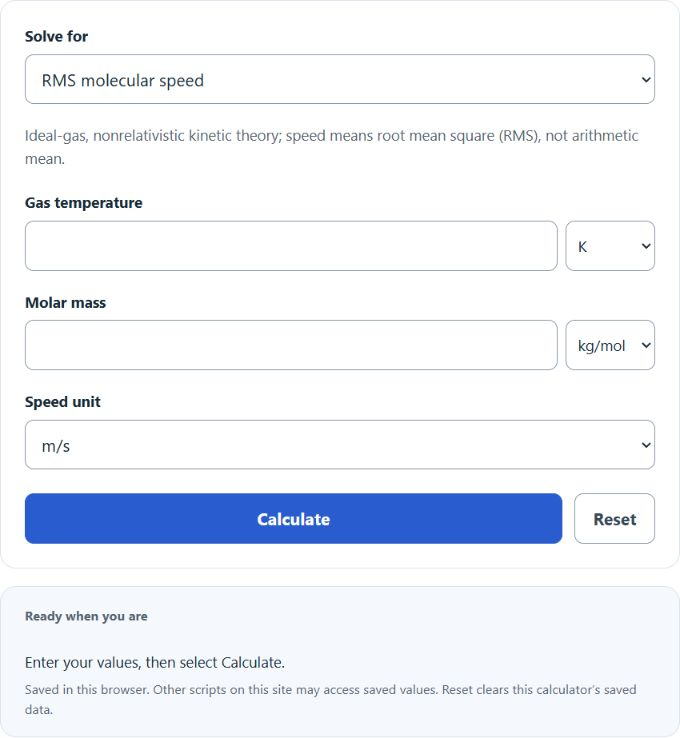
Calculate molecular speed, temperature, or molar mass from any two inputs with units in K, °C, °F, kg/mol, g/mol, lb/mol, m/s, km/h, or mph.
- All Chemistry Calculators
- Viscosity of Air Calculator
- Gas Density Calculator
- Molecular Weight to Density Calculator
Molecular Speed Formula
The molecular speed calculator estimates the root mean square (RMS) speed of gas molecules from the gas temperature and molar mass. In kinetic molecular theory, molecules in a gas do not all move at the same speed, so the RMS value is used as a practical “representative” speed for energy and motion calculations.
In this equation:
- vrms = root mean square molecular speed
- R = universal gas constant = 8.3145 J/(mol·K)
- T = absolute temperature in kelvin
- M = molar mass in kg/mol
The result is typically expressed in m/s, but it can also be interpreted in other speed units after conversion.
Variable Reference
| Variable | Meaning | Typical Unit |
|---|---|---|
| Temperature | Thermal state of the gas; higher temperature means faster molecular motion | K, °C, or °F |
| Molar Mass | Mass of one mole of the gas substance | kg/mol, g/mol, or lb/mol |
| Molecular Speed | RMS speed of the gas particles | m/s, km/h, or mph |
How to Calculate Molecular Speed
- Enter the gas temperature.
- Enter the molar mass of the gas.
- Make sure the temperature is treated as an absolute temperature and the molar mass is in compatible units.
- Apply the RMS speed equation to solve for molecular speed.
When doing the math manually, unit consistency matters. The standard form of the equation uses kelvin for temperature and kg/mol for molar mass.
Temperature and Mass Effects
Molecular speed depends strongly on temperature and inversely on molar mass:
This means:
- Hotter gases move faster, but the increase follows a square-root relationship.
- Heavier gases move slower at the same temperature.
- Doubling the absolute temperature in kelvin does not double the speed; it increases the speed by a factor of about 1.414.
- Doubling the molar mass reduces the speed by a factor of about 1.414.
| Change | Effect on RMS Speed |
|---|---|
| Absolute temperature (K) doubles | Speed increases by about 41.4% |
| Absolute temperature (K) becomes four times larger | Speed doubles |
| Molar mass doubles | Speed decreases by about 29.3% |
| Molar mass becomes four times larger | Speed is cut in half |
Useful Unit Conversions
If your temperature is not already in kelvin, convert it before using the formula manually:
If your molar mass is provided in grams per mole, convert it to kilograms per mole:
This is one of the most common manual-calculation mistakes. Using g/mol directly in the equation without conversion will give an incorrect speed.
Example Calculation
Suppose a gas has a temperature of 500 K and a molar mass of 0.0023 kg/mol. Substitute those values into the formula:
This result means the gas molecules have an RMS speed of about 2328.63 meters per second under those conditions.
What the Result Means
The RMS speed is a statistical speed, not the exact speed of every molecule. Real gases contain a distribution of molecular speeds: some particles move more slowly than the calculated value, and others move more quickly. The RMS value is especially useful because it connects directly to molecular kinetic energy and is widely used in chemistry, thermodynamics, and gas-law calculations.
It is also important to note that this equation is based on ideal-gas kinetic theory. For most educational and general engineering calculations, it provides a strong estimate of molecular motion.
Common Questions
Is RMS speed the same as average speed?
No. RMS speed is not the same as the arithmetic mean speed. It is usually slightly higher because larger speeds contribute more strongly when the values are squared.
Does pressure affect the molecular speed in this formula?
Not directly. In this equation, RMS speed depends on temperature and molar mass. Pressure does not appear as an input.
Why do lighter gases move faster?
At the same temperature, gases have the same average kinetic energy per mole. Lighter molecules therefore need higher speeds to carry that same thermal energy.
Why must temperature be in kelvin?
Kelvin is an absolute temperature scale. The kinetic theory relationship behind molecular speed requires absolute temperature, not relative scales like Celsius or Fahrenheit.