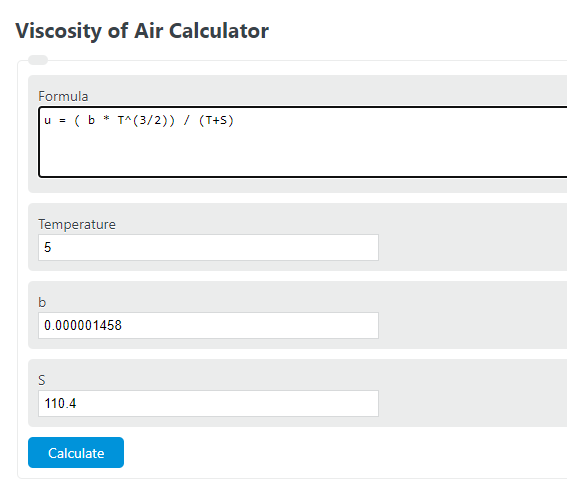
Calculate air dynamic and kinematic viscosity from temperature and pressure using Sutherland’s law, with density, cP, cSt, and Reynolds number results.
Viscosity of Air Formula
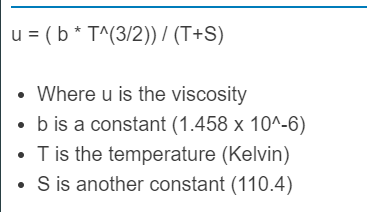
The calculator uses Sutherland’s formula for dynamic viscosity, then derives kinematic viscosity and Reynolds number from it.
- μ = dynamic viscosity (Pa·s)
- ν = kinematic viscosity (m²/s)
- T = absolute temperature (K)
- P = pressure (Pa); defaults to 101325 Pa
- ρ = air density (kg/m³)
- R = specific gas constant for air = 287.05 J/(kg·K)
- V = flow velocity (m/s)
- L = characteristic length (m)
Sutherland’s formula assumes dry air behaving as an ideal gas. It is accurate within about 1% for temperatures from roughly 100 K to 1900 K. Pressure has a negligible effect on dynamic viscosity in this range, so μ depends on temperature only. Density and kinematic viscosity do depend on pressure.
Reference Values
Use these values to spot-check inputs or to estimate without running the calculator.
| Temp (°C) | μ (Pa·s) | ν at 1 atm (m²/s) | ρ at 1 atm (kg/m³) |
|---|---|---|---|
| -20 | 1.63×10⁻⁵ | 1.16×10⁻⁵ | 1.394 |
| 0 | 1.72×10⁻⁵ | 1.33×10⁻⁵ | 1.292 |
| 20 | 1.82×10⁻⁵ | 1.52×10⁻⁵ | 1.204 |
| 40 | 1.91×10⁻⁵ | 1.70×10⁻⁵ | 1.127 |
| 100 | 2.18×10⁻⁵ | 2.30×10⁻⁵ | 0.946 |
| 200 | 2.58×10⁻⁵ | 3.46×10⁻⁵ | 0.746 |
| 500 | 3.58×10⁻⁵ | 7.92×10⁻⁵ | 0.457 |
| Reynolds Number | Flow Regime (internal pipe flow) |
|---|---|
| Re < 2300 | Laminar |
| 2300 – 4000 | Transitional |
| Re > 4000 | Turbulent |
Example
Find the dynamic and kinematic viscosity of air at 25°C and 1 atm.
- Convert: T = 25 + 273.15 = 298.15 K
- μ = (1.458×10⁻⁶ × 298.15^1.5) / (298.15 + 110.4) = 1.849×10⁻⁵ Pa·s
- ρ = 101325 / (287.05 × 298.15) = 1.184 kg/m³
- ν = μ / ρ = 1.561×10⁻⁵ m²/s
FAQ
Does humidity affect air viscosity? Slightly. Moist air has a viscosity within about 1% of dry air at typical conditions, so most engineering calculations ignore it.
Why does viscosity rise with temperature? In gases, higher temperature means faster molecular motion and more momentum transfer between layers, which increases viscosity. Liquids behave the opposite way.
Does pressure change dynamic viscosity? Not meaningfully below about 10 atm. Kinematic viscosity does change with pressure because density does.
What characteristic length should I use for Reynolds number? Pipe diameter for internal flow, chord length for an airfoil, and the dimension parallel to flow for a flat plate.