Calculate particle velocity, temperature, or mass from any two known values using Boltzmann’s constant and common temperature, mass, and speed units.
- All Physics Calculators
- Velocity Calculator
- Carnot Efficiency Calculator
- Thermal Energy Calculator
- Molecular Speed Calculator
- Thermal Velocity Calculator
Particles Velocity Formula
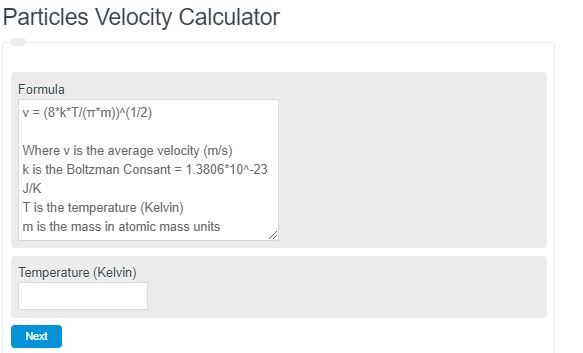
The particles velocity calculator uses the average speed formula from kinetic theory. It relates particle velocity, temperature, and particle mass using the Boltzmann constant.
To solve for mass, the formula is rearranged as:
To solve for temperature, the formula is rearranged as:
- v = particle velocity, usually in meters per second (m/s)
- T = absolute temperature in Kelvin (K)
- m = mass of one particle in kilograms (kg)
- k_B = Boltzmann constant, 1.380649 × 10⁻²³ J/K
- pi = 3.14159265…
If you enter temperature and mass, the calculator solves for particle velocity. If you enter temperature and velocity, it solves for particle mass. If you enter mass and velocity, it solves for temperature. Unit selections are converted internally to Kelvin, kilograms, and meters per second before the formula is applied.
Common Unit Conversions Used
These are the main conversions used before and after the particle velocity formula is evaluated.
| Quantity | Input Unit | Base Unit Conversion |
|---|---|---|
| Temperature | °C | K = °C + 273.15 |
| Temperature | °F | K = (°F – 32) × 5/9 + 273.15 |
| Mass | u | kg = u × 1.66053906660 × 10⁻²⁷ |
| Mass | g | kg = g × 0.001 |
| Velocity | km/h | m/s = km/h ÷ 3.6 |
| Velocity | mph | m/s = mph × 0.44704 |
Approximate Particle Speeds at 300 K
The table below gives reference values for several common gases at 300 K. These are average molecular speeds based on the same formula.
| Particle or Molecule | Approximate Mass | Average Speed at 300 K |
|---|---|---|
| Hydrogen molecule, H2 | 2.016 u | About 1,780 m/s |
| Helium atom, He | 4.003 u | About 1,260 m/s |
| Nitrogen molecule, N2 | 28.014 u | About 476 m/s |
| Oxygen molecule, O2 | 31.998 u | About 446 m/s |
| Carbon dioxide, CO2 | 44.01 u | About 381 m/s |
Example Calculations
Example 1: Find particle velocity
Suppose the temperature is 300 K and the particle mass is 28 u.
First convert mass to kilograms:
Then apply the velocity formula:
The result is approximately:
Example 2: Find temperature
Suppose the particle mass is 4 u and the velocity is 1250 m/s.
Convert mass to kilograms:
Then solve for temperature:
The result is approximately:
FAQ
What kind of particle velocity does this calculate?
This calculates the average speed of particles based on temperature and particle mass. It is not the velocity of one specific particle at one instant. In a real gas, particles have a distribution of speeds, so some particles move slower and some move faster than the calculated value.
Why does the mass need to be for one particle?
The formula uses the mass of a single particle in kilograms. If you enter atomic mass units, the calculator converts that value to kilograms for one particle. For example, nitrogen gas, N2, has a molecular mass of about 28 u, not 28 grams per molecule.
Why must temperature be in Kelvin?
Kinetic theory uses absolute temperature, so the formula must use Kelvin. Celsius and Fahrenheit values are converted to Kelvin before calculation. Negative Celsius values can still be valid as long as the converted Kelvin temperature is above absolute zero.