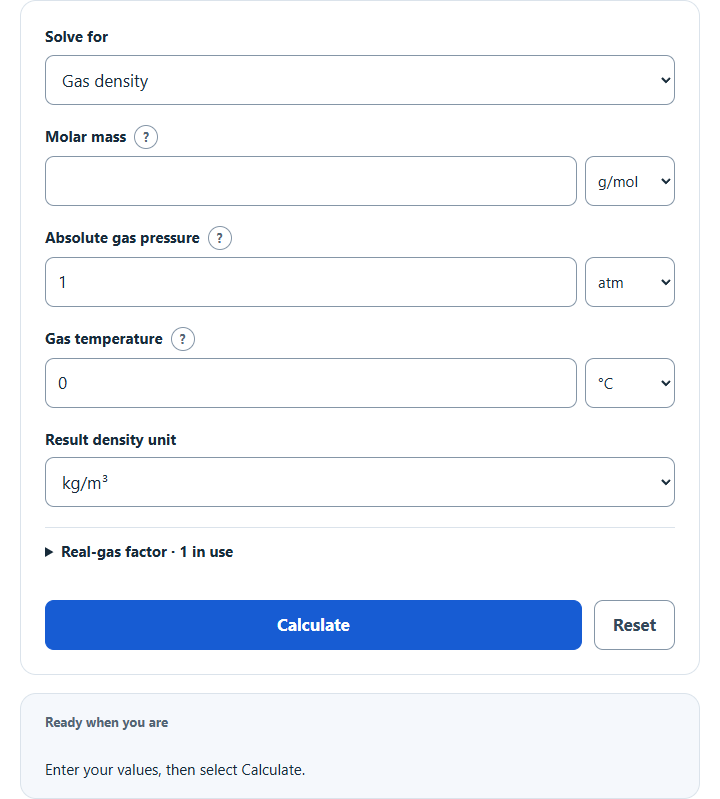
Calculate gas density from molecular weight (molar mass) at STP or your own pressure and temperature, or work back from density to molar mass.
- All Chemistry Calculators
- Gas Density Calculator
- Molar Volume Calculator
- Density to Molar Mass Calculator
- G-mol to Density Calculator
- Specific Gravity to Density Calculator
Density From Molecular Weight Formula
The gas-density relation uses dimensional molar mass M. With a prescribed compressibility factor Z, ρ = PM/(ZRT); Z = 1 gives the ideal-gas form below. Use absolute pressure and temperature in kelvin.
- Where D is the Density From Molecular Weight (kg/m^3)
- P is the absolute gas pressure (Pa)
- MW in this formula means molar mass (kg/mol); relative molecular mass is dimensionless.
- T is the temperature (K)
- R is the universal gas constant (8.314462618 J/(mol·K))
For an ideal gas, multiply absolute pressure by molar mass and divide by RT. With a known nonideal factor, divide by ZRT instead. A supplied Z must match gas composition and the resulting pressure and temperature; the calculator treats Z as prescribed and does not solve an equation of state. Molecular mass alone does not determine a liquid or solid density, and this relation does not verify gas-phase stability.
| Molecular Weight (g/mol) | Density (kg/m³) |
|---|---|
| 2 | 0.082 |
| 4 | 0.163 |
| 16 | 0.654 |
| 17 | 0.695 |
| 18 | 0.736 |
| 20 | 0.817 |
| 28 | 1.144 |
| 28.97 | 1.184 |
| 30 | 1.226 |
| 32 | 1.308 |
| 34 | 1.390 |
| 36.46 | 1.490 |
| 40 | 1.635 |
| 44 | 1.798 |
| 58 | 2.371 |
| 64 | 2.616 |
| 84 | 3.433 |
| 98 | 4.006 |
| 131.29 | 5.366 |
| 146.06 | 5.970 |
| * Rounded to 3 decimals. Ideal gas relation: ρ = (P × M) / (R × T). Assumes P = 1 atm (101,325 Pa), T = 25°C (298.15 K), R = 8.314462618 J/(mol·K). 1 g/mol → 0.040874 kg/m³ at these conditions. | |
How to Calculate Density From Molecular Weight?
The examples are hypothetical ideal-gas algebra with Z = 1. They do not identify actual substances or establish that a substance remains gaseous at the stated conditions.
Example Problem #1
- First, determine the pressure (Pa).
- The pressure (Pa) is given as 3000.
- Next, determine the molecular weight (kg/mol).
- The molecular weight (kg/mol) is calculated as .44.
- Next, determine the temperature (K).
- The temperature (K) is found to be 250.
- Finally, calculate the Density From Molecular Weight using the formula above:
D = P * MW / (R*T)
Inserting the values from above yields:
D = 3000 × 0.44 / (8.314462618 × 250) = 0.635 kg/m³
Example Problem #2
The variables needed for this problem are provided below:
pressure (Pa) = 240
molecular weight (kg/mol) = 205
temperature (K) = 100
This example problem is a test of your knowledge on the subject. Use the calculator above to check your answer.
D = 240 × 205 / (8.314462618 × 100) = 59.174 kg/m³. The given 205 kg/mol is retained as a hypothetical algebra input, not a claim about an existing gas at 100 K. See NIST on gas density and condition-specific compressibility.