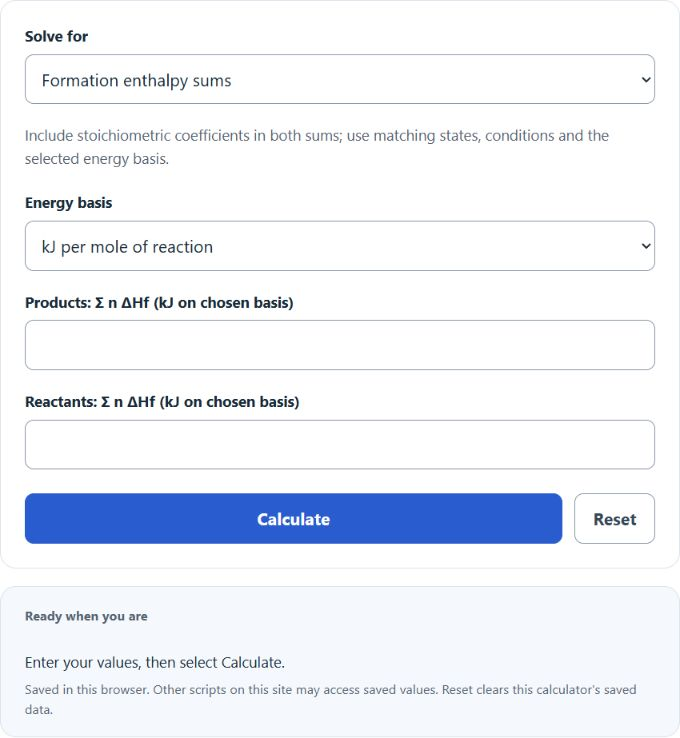
Calculate enthalpy change from coefficient-weighted formation values, reaction calorimetry, average bond-energy totals, or heating/cooling without a phase change. Choose matching units and the correct system for the heat sign.
Related Calculators
- Enthalpy Change Of Neutralisation Calculator
- Heat of Solution Calculator
- Moles To kJ Calculator
- Molar Heat Capacity Calculator
- All Chemistry Calculators
Delta H Formula (Heating/Cooling)
The following relation is used to estimate the enthalpy change when a substance is heated or cooled at (approximately) constant pressure, with (approximately) constant Cp and no phase change.
Variables:
- ΔH is the enthalpy change (joules, J)
- Cp is the specific heat capacity at constant pressure (joules per gram per degree Celsius, J/(g·°C), equivalently J/(g·K) for temperature differences)
- m is the mass (grams, g)
- ΔT is the temperature change (°C or K for temperature differences)
To calculate ΔH for heating/cooling, multiply the specific heat capacity by the mass and the temperature change. For phase changes (melting/boiling), use ΔH = m·L instead, because ΔT is ~0 during the transition.
What is Delta H?
Delta H, or enthalpy change, is the amount of heat released or absorbed during a chemical reaction or phase transition at constant pressure. It is an important concept in thermodynamics and chemistry, as it describes energy changes. Enthalpy alone does not determine spontaneity; entropy and temperature also matter. A negative Delta H indicates an exothermic reaction (releases heat), while a positive Delta H indicates an endothermic reaction (absorbs heat).
How to Calculate Delta H (Heating/Cooling Method)?
The following steps outline how to estimate the enthalpy change (ΔH) for heating/cooling a substance (no phase change) using ΔH ≈ m·Cp·ΔT.
- Determine the specific heat capacity (Cp) in joules per gram per degree Celsius (J/(g·°C)).
- Determine the mass (m) in grams (g).
- Determine the temperature change (ΔT) in °C (or K for temperature differences).
- Use the formula: ΔH ≈ Cp · m · ΔT.
- Calculate ΔH in joules (J) (or convert to kJ if desired).
- Choose Heating / cooling a substance to check this example. Reaction calorimetry instead uses ΔH = −q_surroundings/n or +q_system/n, divided by 1000 for kJ/mol of reaction extent. Formation and bond-energy sums must include stoichiometric counts and use the selected total or molar basis.
Example Problem :
Use the following variables as an example problem to test your knowledge.
Heat capacity (C_p) = 4.18 J/g°C
Mass (m) = 100 g
Temperature change (ΔT) = 25 °C
ΔH ≈ (4.18 J/g°C)(100 g)(25 °C) = 10,450 J ≈ 10.45 kJ