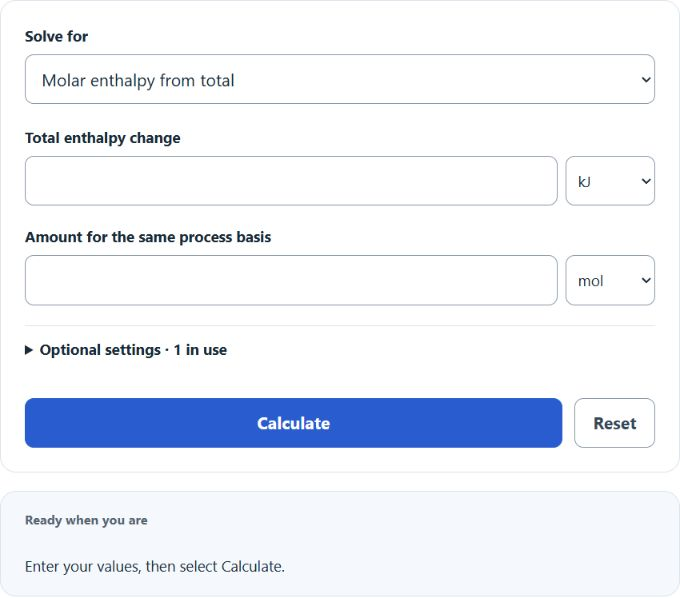
Calculate molar enthalpy, reaction ΔH, or heat using mass, temperature change, moles, and formation values for chemistry problems.
- All Chemistry Calculators
- All Enthalpy Calculators
- Standard Enthalpy Calculator
- Enthalpy of Water Calculator
- Heat of Formation Calculator
Molar Enthalpy Formula
Molar enthalpy measures the enthalpy change for each mole of substance or reaction amount being considered. This calculator is useful when you know the total enthalpy change and the number of moles and want the energy change on a per-mole basis.
| Variable | Description | Common Units |
|---|---|---|
| Em | Molar enthalpy | J/mol, kJ/mol, MJ/mol |
| ΔH | Total enthalpy change | J, kJ, MJ |
| n | Amount of substance | mol, kmol |
The result tells you how much enthalpy changes for each mole. If the total enthalpy change is negative, the process releases energy. If it is positive, the process absorbs energy.
Rearranged Forms
The same relationship can be rearranged depending on which value you need to solve for.
How to Use the Calculator
- Enter the total enthalpy change for the process.
- Enter the total number of moles associated with that enthalpy change.
- Select matching units for energy and moles.
- Calculate to find the molar enthalpy.
Unit consistency matters. The calculator converts energy and amount internally; choose J/mol, kJ/mol, or MJ/mol in the output settings.
How to Calculate Molar Enthalpy Manually
- Identify the total enthalpy change, not the per-mole value.
- Identify the number of moles for the same basis as the enthalpy change.
- Divide enthalpy by moles.
- Keep the sign of the enthalpy change in the final answer.
This means a larger magnitude of molar enthalpy represents a larger energy change per mole, while the sign indicates whether energy is released or absorbed.
Examples
If a process has a total enthalpy change of 500 J for 3 mol, the molar enthalpy is:
If a reaction has a total enthalpy change of -24 kJ for 2 mol, then:
The negative sign indicates an exothermic process, meaning energy is released to the surroundings.
Sign Convention
- Negative molar enthalpy: the process is exothermic.
- Positive molar enthalpy: the process is endothermic.
- Zero or near zero: little to no net enthalpy change on the chosen basis.
Always interpret the sign before comparing values. A result of -150 kJ/mol is not “smaller” in energetic effect than +20 kJ/mol; it indicates a much larger energy change in the exothermic direction.
If You Need to Convert Mass to Moles First
Many chemistry problems provide mass instead of moles. In that case, convert mass to moles before using the molar enthalpy equation.
Here, m is the sample mass and M is the molar mass. Once moles are found, substitute that value into the molar enthalpy formula.
Common Unit Considerations
- J/mol is common for smaller energy changes.
- kJ/mol is common in chemistry and thermodynamics.
- MJ/mol may be used for very large energy scales.
- kmol is often used in engineering calculations; pairing kJ with kmol changes the numerical scale of the answer.
Be careful not to mix unit scales unintentionally. For example, 1 kJ/mol is equal to 1000 J/mol, so a unit mismatch can make the final value appear off by a factor of 1000.
Common Mistakes
- Using grams instead of moles.
- Ignoring the negative sign on the enthalpy change.
- Using a mole value that does not match the same process basis as the enthalpy value.
- Forgetting to convert between J and kJ when comparing answers.
- Trying to divide by zero moles, which is undefined.
Interpretation Tips
Molar enthalpy is especially helpful for comparing processes on an equal basis. Total enthalpy change depends on sample size, but molar enthalpy normalizes the result so different quantities can be compared directly.
- Use total enthalpy change when analyzing the whole sample or batch.
- Use molar enthalpy when comparing substances, reactions, or conditions per mole.
- For reaction data, make sure the mole value matches the amount described by the enthalpy measurement.
Where This Calculation Is Commonly Used
- Chemistry reaction analysis
- Calorimetry and lab data reduction
- Phase change calculations
- Comparing fuel or material energy changes
- Engineering mass and energy balance problems