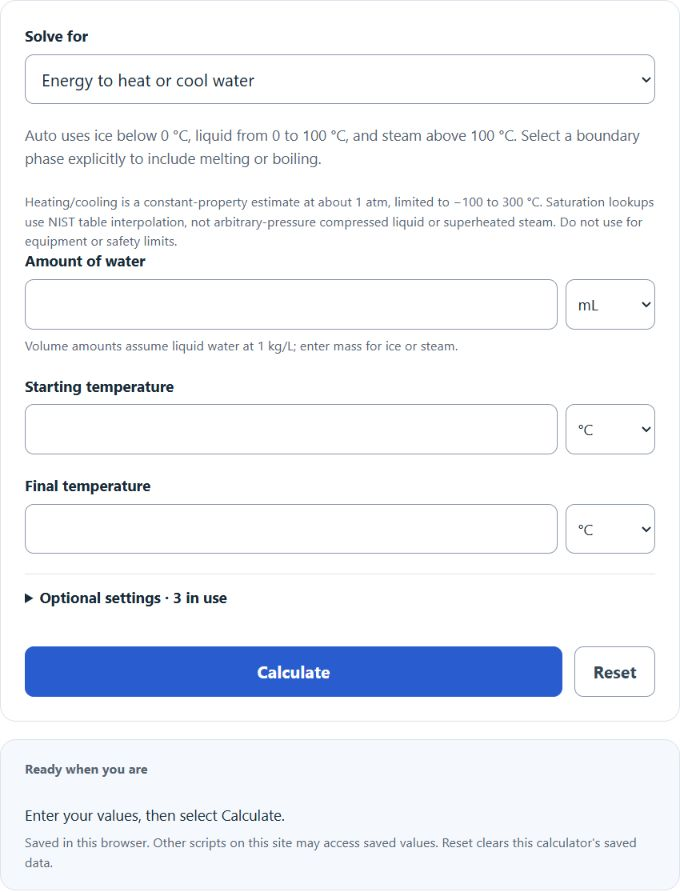
Calculate water enthalpy in kJ from mass, start and end temperature, with latent heat, steam-table hf and hg, and the final temperature from energy added.
- All Chemistry Calculators
- Enthalpy Calculator
- Heat of Fusion Calculator
- Heat of Vaporization Calculator
- Pool Heat Time Calculator
- Total Energy To Heat Water Calculator
- Standard Enthalpy Calculator
Enthalpy of Water Formula
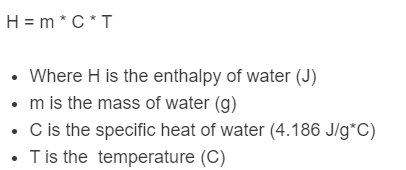
The calculator estimates heat transferred through ice, liquid water and steam at about 1 atm, solves final temperature from signed heat, and looks up saturated-water enthalpy by temperature or absolute pressure. For sensible heating within a single phase, it uses:
- q = heat energy transferred, usually in kJ
- m = mass of water in kg
- c = specific heat capacity of liquid water, 4.184 kJ/(kg·°C)
- ΔT = temperature change in °C
- T1 = starting temperature
- T2 = target temperature
Saturation modes estimate liquid enthalpy hf, vapor enthalpy hg, or wet-steam enthalpy h = hf + x(hg − hf). NISTIR 5078 Table 1 supplies rounded IAPWS-95 values at 1 °C intervals and the triple and critical endpoints. Enthalpy interpolates linearly in temperature and saturation pressure logarithmically. Interpolation is approximate, especially near the critical point.
- hf = specific enthalpy of saturated liquid water in kJ/kg
- T = entered water temperature
- T1, T2 = the nearest lower and upper steam-table temperatures
- h1, h2 = the corresponding saturated liquid enthalpy values
Energy and final-temperature modes use constant specific heats of 2.09, 4.184 and 2.01 kJ/(kg·K) for ice, liquid and steam, plus latent heats of 333.55 kJ/kg at 0 °C and 2256.4 kJ/kg at 100 °C. This approximate 1 atm model is limited to −100 through 300 °C. Positive heat is added; negative heat is removed. Volume amounts assume 1 kg/L. Heater time and cost apply only to heating.
Saturation modes allow saturated liquid, saturated vapor and wet steam. Wet-steam quality x is vapor mass fraction, from 0 to 1; it is undefined at the critical point. These modes do not model superheated steam or compressed liquid at arbitrary temperature and pressure. Optional mass gives total enthalpy relative to the same table reference.
Common Water Heating and Enthalpy Values
These values are useful for checking whether your result is in the expected range.
| Water amount | Temperature change | Energy needed | Approximate Wh |
|---|---|---|---|
| 250 mL | 20 °C to 100 °C | 83.7 kJ | 23.2 Wh |
| 500 mL | 20 °C to 100 °C | 167.4 kJ | 46.5 Wh |
| 1 L | 20 °C to 100 °C | 334.7 kJ | 93.0 Wh |
| 1 kg | 0 °C to 100 °C | 418.4 kJ | 116.2 Wh |
| Temperature | Saturated liquid enthalpy, hf | Typical interpretation |
|---|---|---|
| 0.01 °C | 0.0 kJ/kg | Rounded triple-point reference value |
| 25 °C | 104.8 kJ/kg | Room-temperature liquid water |
| 80 °C | 335.0 kJ/kg | Hot liquid water |
| 100 °C | 419.2 kJ/kg | Saturated liquid at normal boiling temperature |
| 200 °C | 852.3 kJ/kg | Pressurized saturated liquid |
Example Calculations
Example 1: Energy to heat 500 mL of water
Find the energy required to heat 500 mL of water from 20 °C to 100 °C.
The energy required is about 167.4 kJ.
Example 2: Specific enthalpy at 80 °C
Find the saturated liquid water enthalpy at 80 °C.
The specific enthalpy is about 335.0 kJ/kg.
FAQs
Is enthalpy the same as heat energy?
No. Heat energy, q, is energy transferred because of a temperature difference. Enthalpy, h, is a thermodynamic property of a substance. In the heating mode, you calculate the amount of heat needed to change the water temperature. In the specific enthalpy mode, you get a property value for saturated liquid water at a chosen temperature.
What reference do the saturation values use?
The rounded values use the IAPWS-95 reference convention. It sets saturated-liquid internal energy and entropy to zero at the triple point, 0.01 °C; enthalpy there is approximately 0.000612 kJ/kg and rounds to 0.00 in this table. This reference does not mean the water contains no energy.
Does this include the energy needed to boil water into steam?
Yes. Energy mode includes latent heat when the selected starting and final phases cross melting or boiling at about 1 atm. At 0 or 100 °C, select ice or steam explicitly when needed; Auto treats both boundary temperatures as liquid. Final-temperature mode also reports partial melting or vaporization. Container heating and environmental losses are not separately modeled.