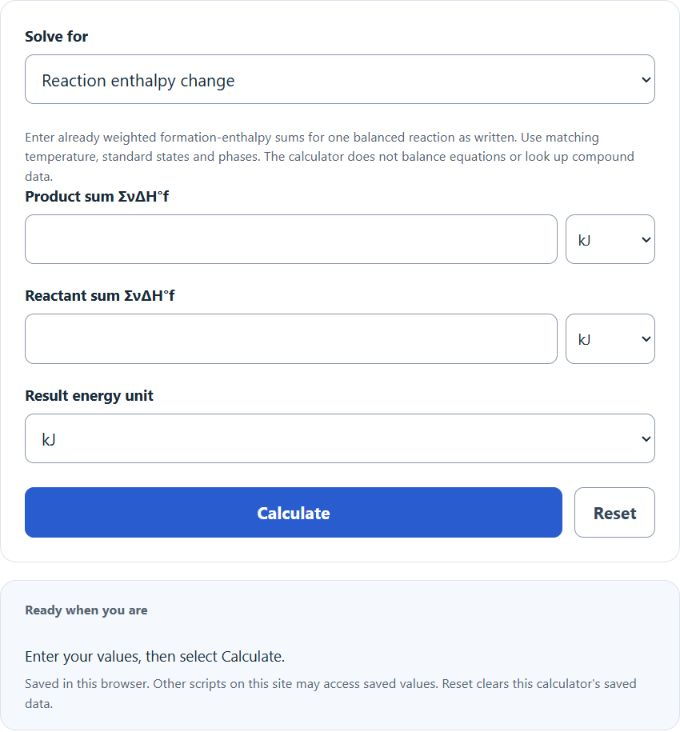
Calculate standard enthalpy change from product and reactant formation enthalpy sums, or solve either missing sum in kJ, J, thermochemical calories, or International Table Btu. All quantities use the same balanced-reaction basis.
- All Chemistry Calculators
- All Enthalpy Calculators
- Enthalpy Calculator
- Air Enthalpy Calculator
- Molar Enthalpy Calculator
Standard Enthalpy Formula
The standard enthalpy change of reaction compares the total standard enthalpies of formation of the products to those of the reactants. This calculator is useful when you already know the stoichiometrically weighted sums for each side of the balanced chemical equation and want to solve for the missing value.
If you are solving for one of the sums instead of the reaction enthalpy, rearrange the equation as needed:
Variable Definitions
| Symbol | Meaning | What to Enter |
|---|---|---|
| ΔH°rxn | Standard enthalpy change of the reaction | The net heat change for the balanced reaction as written |
| ΣνΔH°f(products) | Sum of product formation enthalpies | Add each product’s standard enthalpy of formation after multiplying by its stoichiometric coefficient |
| ΣνΔH°f(reactants) | Sum of reactant formation enthalpies | Add each reactant’s standard enthalpy of formation after multiplying by its stoichiometric coefficient |
| ν | Stoichiometric coefficient | The number in front of each substance in the balanced equation |
How to Use the Calculator
- Write the balanced chemical equation.
- Look up the standard enthalpy of formation for each compound in the correct phase.
- Multiply each value by its stoichiometric coefficient.
- Add the weighted values for all products to get the product sum.
- Add the weighted values for all reactants to get the reactant sum.
- Select the quantity to solve, then enter the two displayed known values.
- Choose each input’s energy unit. The calculator converts mixed units automatically; cal means the small thermochemical calorie (4.184 J), and Btu means the International Table unit (1055.05585262 J).
How to Interpret the Result
- Negative ΔH°rxn: the reaction is exothermic and releases heat.
- Positive ΔH°rxn: the reaction is endothermic and absorbs heat.
- Value near zero: there is little net enthalpy change under standard-state conditions.
Important Chemistry Notes
- The reaction must be balanced first; otherwise the weighted sums will be incorrect.
- Standard enthalpy values depend on physical state. For example, liquid water and water vapor do not use the same formation enthalpy.
- The result is reported for the reaction as written, not automatically per mole of a single product unless the equation is written that way.
- Elements in their standard states have a standard enthalpy of formation of zero.
- Standard values are commonly tabulated for a specified reference temperature, often 298.15 K, so use values from the same table or database set.
Example
Consider the formation of liquid water from its elements:
Using the liquid-water standard formation enthalpy −285.83 kJ/mol at 298.15 K, with the elemental reactants in their reference standard states, the weighted sums for the reaction as written are:
This negative result means the reaction releases heat under standard conditions.
Why Stoichiometric Weighting Matters
The calculator uses sums because reaction enthalpy depends on the full balanced equation, not just on individual compounds. If a substance has a coefficient of 2, its contribution to the enthalpy sum must also be doubled. Missing this step is one of the most common causes of wrong answers.
Common Input Mistakes
- Using an unbalanced equation.
- Forgetting to multiply by the stoichiometric coefficient.
- Selecting a unit that does not match an entered value. Mixed units are supported when each input’s selector is correct.
- Using a formation enthalpy for the wrong phase, such as gas instead of liquid.
- Entering raw compound values instead of the already-summed product and reactant totals.
When This Calculator Is Most Useful
This standard enthalpy calculator is especially helpful in general chemistry, thermodynamics, and reaction energy analysis when you want to quickly determine whether a reaction is heat-releasing or heat-absorbing. It can also be used to solve backward for an unknown product or reactant sum when the other two quantities are known.