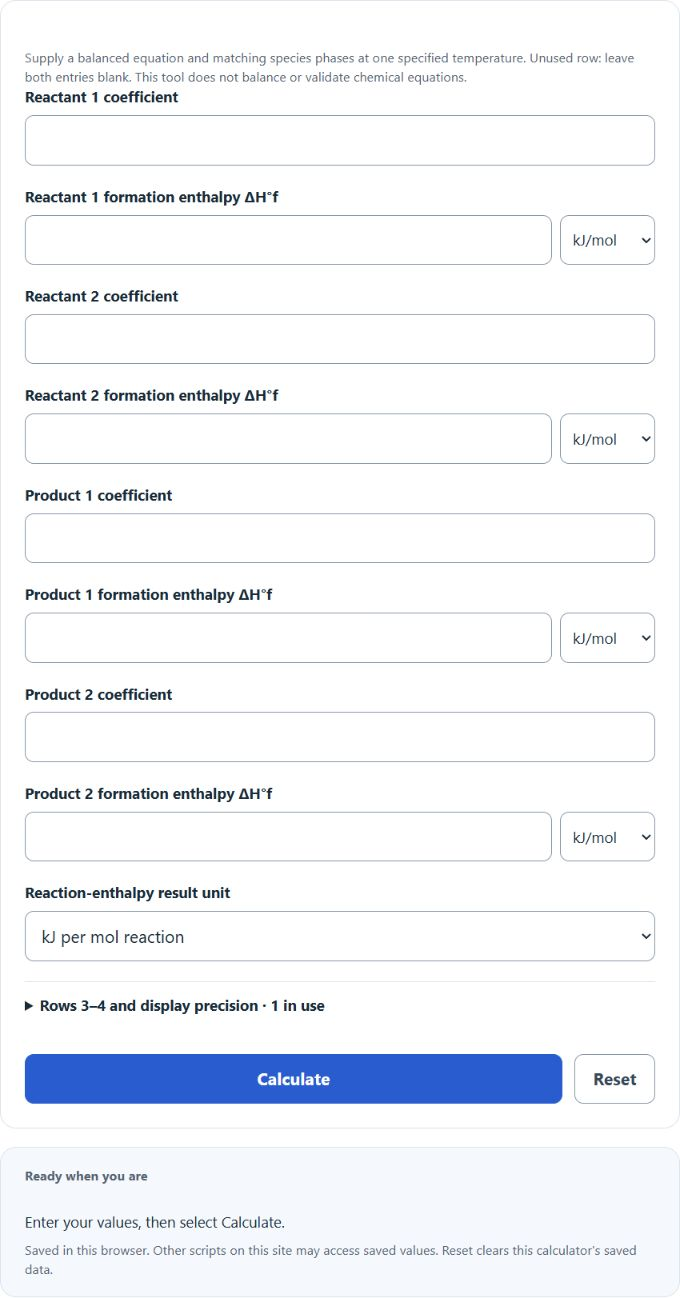
Calculate standard reaction enthalpy from up to four reactants and four products using supplied formation enthalpies and coefficients from a balanced equation. The tool does not balance equations or supply preset species data.
- All Chemistry Calculators
- All Heat Calculators
- Heat of Fusion Calculator
- Heat of Solution Calculator
Standard Reaction Enthalpy (ΔH°rxn) from ΔH°f Formula
The following example outlines the steps and information needed to calculate the standard enthalpy change of reaction (ΔH°rxn) using tabulated standard enthalpies of formation (ΔH°f).
Variables:
- ΔH°rxn is the standard enthalpy change of reaction (kJ/mol of reaction as written)
- ν is the stoichiometric coefficient for each species (use positive values on each side)
- ΔH°f is the standard enthalpy of formation of each species (kJ/mol), defined for formation of 1 mol of the substance from its elements in their reference states at the specified temperature and standard pressure (1 bar). Tables often use 298.15 K; standard state alone does not fix temperature
To calculate ΔH°rxn from ΔH°f values, sum νΔH°f for the products and subtract the sum νΔH°f for the reactants (elements in their standard states have ΔH°f = 0).
How to Calculate ΔH°rxn from ΔH°f?
The following steps outline how to calculate the standard enthalpy change of reaction.
- Write the balanced chemical equation and identify each species on the reactant and product sides.
- Find ΔH°f for each species in the correct phase at a common specified temperature. Elements in their reference states have ΔH°f = 0. Select the correct kJ/mol or thermochemical kcal/mol input unit for each row.
- Compute Σ(νΔH°f) for the products and Σ(νΔH°f) for the reactants.
- Subtract: ΔH°rxn = Σ(νΔH°f)products − Σ(νΔH°f)reactants.
- Check your answer with the calculator above.
Example Problem:
Compute ΔH°rxn for the formation of liquid water: 2 H2(g) + O2(g) → 2 H2O(l). Use ΔH°f[H2O(l)] = −285.83 kJ/mol and ΔH°f for H2(g) and O2(g) (standard states) = 0.
Σ(νΔH°f) products = 2 × (−285.83) = −571.66 kJ per mol of reaction as written
Σ(νΔH°f) reactants = 2 × 0 + 1 × 0 = 0 kJ per mol of reaction as written
ΔH°rxn = −571.66 − 0 = −571.66 kJ per mol of reaction as written (exothermic). This doubled water-formation equation produces 2 mol of water; the molar formation enthalpy of H₂O(l) is −285.83 kJ/mol. Use the balanced equation basis consistently.