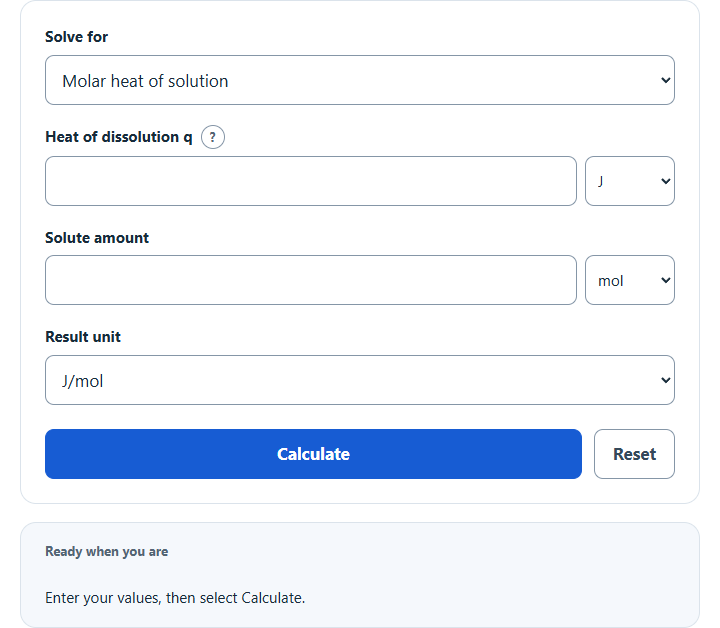
Calculate molar heat of solution from the heat released or absorbed and the moles dissolved, or from calorimetry using solution mass, specific heat and ΔT.
Heat of Solution Formula
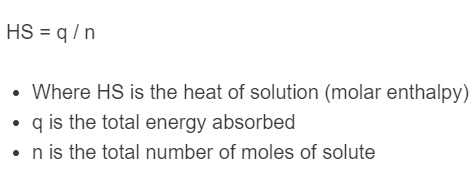
The following formula is used to calculate a heat of solution.
- Where HS is the heat of solution (molar enthalpy)
- q is the signed heat of dissolution: positive when absorbed, negative when released
- n is the total number of moles of solute
At constant pressure, divide signed dissolution heat by moles of solute. For calorimetry, qdissolution = −m c (Tfinal − Tinitial), assuming negligible heat loss and calorimeter heat capacity.
Heat of Solution Definition
Molar heat of solution is the enthalpy change per mole of solute dissolved under the stated conditions. Positive values are endothermic; negative values are exothermic.
Heat of Solution Example
How to calculate a heat of solution?
- First, determine the signed dissolution heat.
qdissolution = -c*m*(Tfinal - Tinitial)
- Next, determine the number of moles of solute.
Calculate the number of moles of solute.
- Finally, calculate the heat of solution.
Calculate the heat of the solution using the formula above.