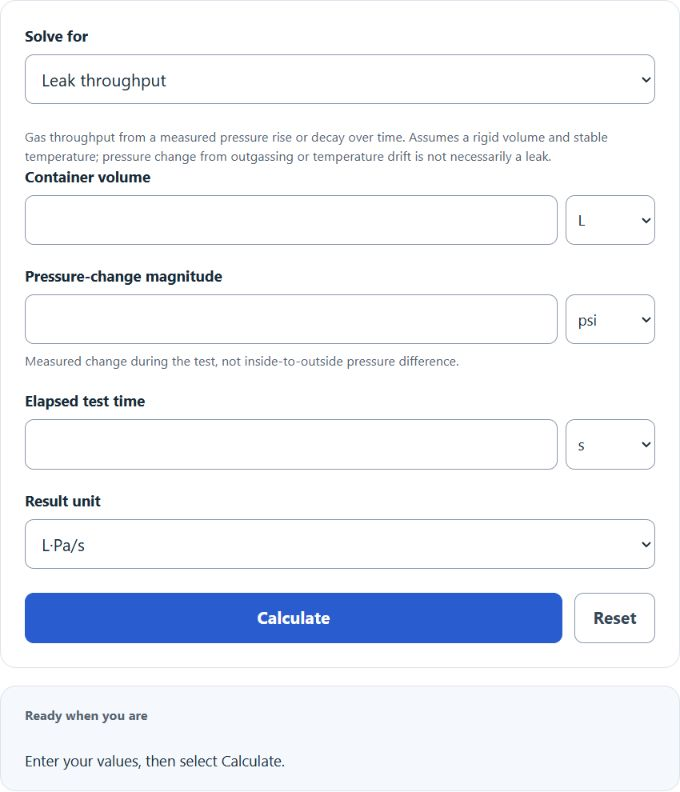
Calculate leak rate, container volume, pressure change, or time by entering any three values with units like liters, psi, seconds, or Pa.
- All Construction Calculators
- Diffusion Rate Calculator
- Chimney Draft Calculator
- Vacuum Leak Rate Calculator
Leak Rate Formula
The following formula is used to calculate a leak rate. This pressure-throughput formula follows the ideal gas law for a rigid volume at stable temperature. Other pressure-change sources, including outgassing, must be separated from a real leak.
- Where LR is the leak rate (ft-lbf/sec)
- V is the volume of the part (ft^3)
- ∆t is the time (seconds)
- ∆P is the change in pressure or pressure loss (psf)
To calculate a leak rate, multiply the volume of the part by the change in pressure (pressure loss), then divide by the change in time.
Leak Rate Definition
A leak rate is defined as the rate of flow, or “leak”, of gas out of a container that is attempting to hold the gas.
Example
How to calculate leak rate?
First, determine the volume of the container that’s holding the gas. For this problem, the volume of the container is found to be 50 ft^3.
Next, measure the magnitude of the container pressure change during the test. In this case, the measured pressure drop over the test interval is 100 lb-f/ft^2.
Next, measure the total time that the leak is occurring. In this example, the measured time is 25 seconds.
Finally, calculate the leak rate.
Using the formula above, the leak rate is found to be:
LR = (V*∆P) / ∆T
= 50 * 100/ 25
= 200 ft-lbf/sec