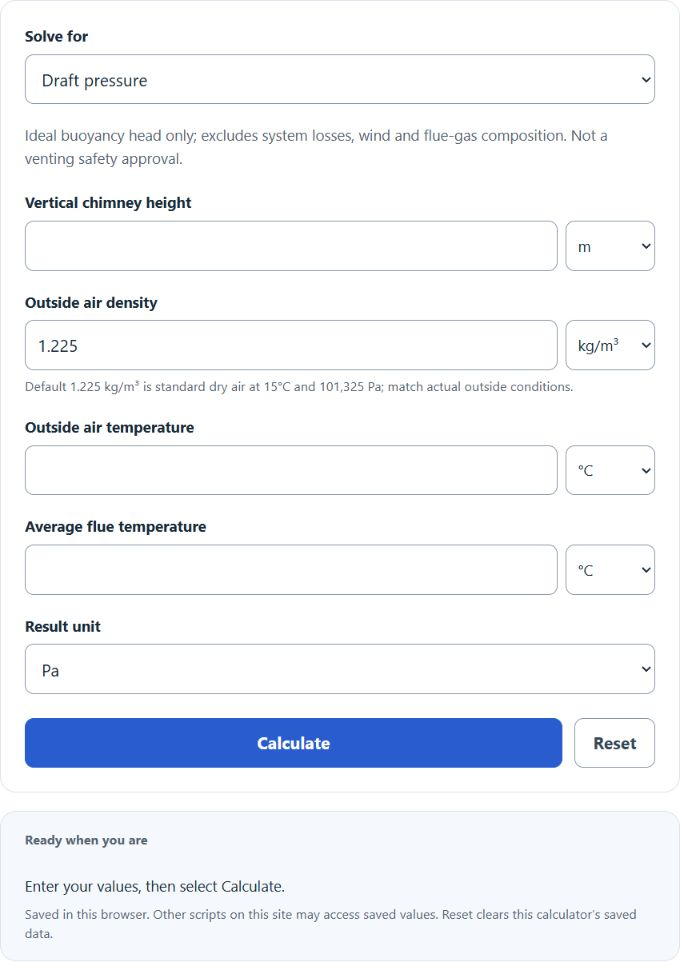
Calculate chimney draft, height, air density, or outside and inside chimney temperatures from four known values in your chimney draft formula.
Chimney Draft Formula
The chimney draft calculation uses stack effect pressure from the height of the chimney and the temperature difference between outside air and the hotter gases inside the chimney. Temperatures are converted to kelvin before the formula is applied.
- D = chimney draft pressure, in pascals (Pa) in the base calculation
- H = chimney height, in meters (m) in the base calculation
- rho = outside air density, held fixed in the model, in kilograms per cubic meter (kg/m³)
- g = gravitational acceleration, 9.81 m/s²
- T_out = outside air temperature, in kelvin (K)
- T_in = inside chimney gas temperature, in kelvin (K)
Select the value to solve, enter the four shown quantities and choose the result unit. The default outside density of 1.225 kg/m³ represents standard dry air at 15°C and 101,325 Pa; adjust it for actual conditions. Temperature entries in °C or °F are converted to kelvin because the ratio T_out/T_in must use absolute temperature.
Common Chimney Draft Unit Conversions
| Quantity | Unit | Base conversion used |
|---|---|---|
| Height | 1 ft | 0.3048 m |
| Height | 1 in | 0.0254 m |
| Air density | 1 lb/ft³ | 16.0184633739601 kg/m³ |
| Draft pressure | 1 psi | 6894.757293168 Pa |
| Draft pressure | 1 bar | 100,000 Pa |
Illustrative Inputs for Chimney Draft Estimates
| Input | Illustrative value or range | How it affects draft |
|---|---|---|
| Air density at sea level | About 1.225 kg/m³ at 15°C and 101,325 Pa | Higher density increases calculated draft. |
| Chimney height | Example heights: 5 to 10 m; not a design recommendation | A taller chimney increases draft pressure. |
| Outside temperature | Example outside temperatures: -10°C to 30°C | Colder outside air generally increases draft. |
| Inside chimney temperature | Example mean flue temperatures: 100°C to 250°C; use measured conditions | Hotter chimney gases increase draft. |
Example Chimney Draft Calculations
Example 1: Calculate chimney draft
You have a chimney height of 8 m, air density of 1.225 kg/m³, outside temperature of 10°C, and inside chimney temperature of 150°C.
Convert temperatures to kelvin:
- Outside temperature: 10°C = 283.15 K
- Inside chimney temperature: 150°C = 423.15 K
The result is approximately 31.8 Pa.
Example 2: Calculate required chimney height
You want a draft of 25 Pa with air density of 1.225 kg/m³, outside temperature of 5°C, and inside chimney temperature of 120°C.
Convert temperatures to kelvin:
- Outside temperature: 5°C = 278.15 K
- Inside chimney temperature: 120°C = 393.15 K
The model height is approximately 7.11 m; this does not establish a code-required or safe chimney height.
Chimney Draft Calculator FAQ
Why are temperatures converted to kelvin?
The formula uses a temperature ratio, not a simple temperature difference. Ratios must use an absolute temperature scale, so °C and °F inputs are converted to kelvin before calculation. Using Celsius or Fahrenheit directly in the ratio would give the wrong result.
Why does draft increase when the chimney is taller?
A taller chimney creates a larger vertical column of warm, lower-density gas compared with the cooler outside air. This increases the stack effect pressure, so the calculated draft rises in direct proportion to chimney height.
Does this calculation include friction, bends, or appliance restrictions?
No. This calculation estimates ideal draft pressure from stack effect only. Real chimney performance can be reduced by flue friction, elbows, dampers, poor insulation, leaks, blockage, wind effects, and appliance design.