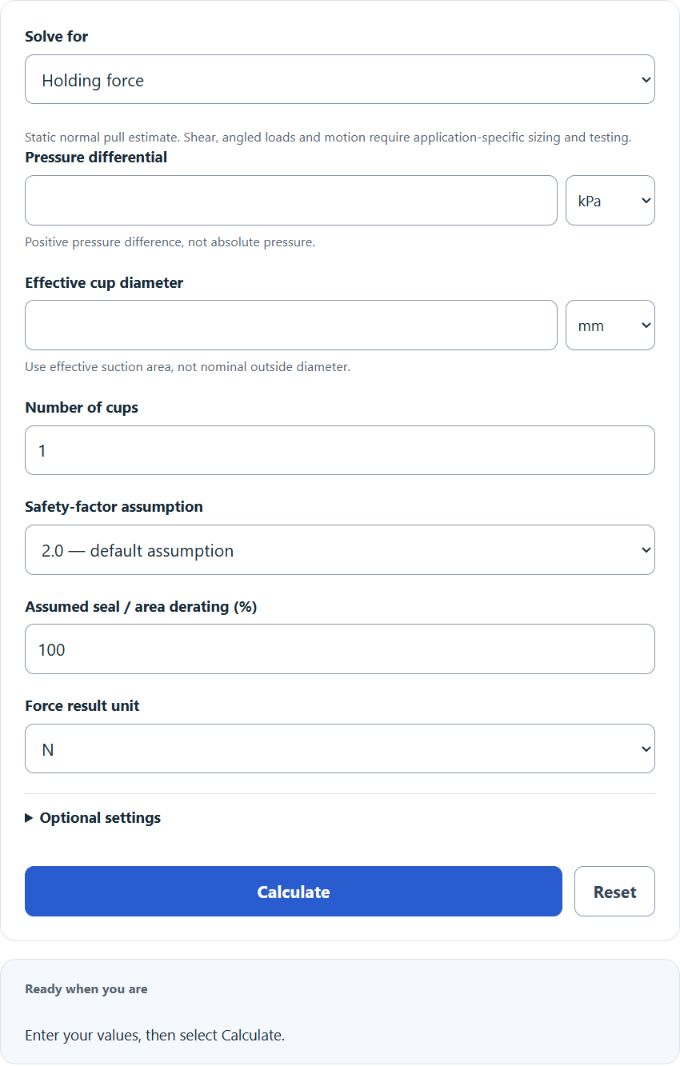
Estimate static normal-pull capacity, minimum effective cup diameter, or cups needed from pressure differential, normal load, chosen safety factor and assumed derating.
- All Physics Calculators
- All Force Calculators
- Vacuum Leak Rate Calculator
- Force From Pressure Calculator
- Pressure Gradient Force Calculator
- Nozzle Reaction Force Calculator
Vacuum Force Formula
The calculator uses the pressure difference across a suction cup and the cup contact area to estimate vacuum holding force. All internal calculations are converted to SI units: pascals, meters, square meters, and newtons.
For the required cup diameter mode, the calculator rearranges the force equation:
For the cups needed mode, the calculator solves for the number of cups and rounds up to a whole cup:
- A = suction cup contact area
- d = suction cup diameter
- P = vacuum level or pressure differential
- eta = seal efficiency as a decimal, so 85% becomes 0.85
- SF = safety factor
- n = number of suction cups
- L = load to hold
- F_theoretical = derated normal force before safety factor
- F_safe_per_cup = estimated factored normal capacity for one cup
- F_safe_total = estimated factored normal capacity for all cups combined
The holding force mode calculates ideal force, derated force and factored normal capacity. For an entered load, achieved force/load factor uses derated total force divided by load; capacity margin uses factored total capacity divided by load.
The cup diameter tab calculates the minimum cup diameter needed to hold a given load with the selected number of cups.
The cups needed tab calculates how many cups are required for a given load, pressure, cup size, safety factor, and seal efficiency.
Safety-Factor Assumptions for Normal Pull
| Lift condition | Example chosen factor | Use case |
|---|---|---|
| Smooth, dense workpiece only | 1.5 | Minimum assumption; application verification required |
| Default normal-pull assumption | 2.0 | Verify against manufacturer and actual conditions |
| Higher chosen normal-pull factor | 2.5 | Does not model angled or lateral loads |
| Higher chosen normal-pull factor | 4.0 | Does not model friction or shear capacity |
These numeric factors do not certify a safe lift. Shear, angled loads, acceleration and moments require separate application-specific sizing, measured friction where relevant, and testing. Use effective suction area rather than nominal outside diameter.
Vacuum Pressure Unit Conversions
| Unit | Equivalent in pascals | Notes |
|---|---|---|
| 1 kPa | 1,000 Pa | Common metric vacuum input |
| 1 bar | 100,000 Pa | Near atmospheric pressure at sea level |
| 1 psi | 6,894.757 Pa | Common imperial pressure unit |
| 1 inHg | 3,386.389 Pa | Often used for vacuum gauges |
| 1 mmHg | 133.322 Pa | Also called torr in many contexts |
Example Calculations
Example 1: Holding force from a 100 mm cup
You have a 100 mm diameter suction cup, a 60 kPa pressure differential, 1 cup, 100% seal efficiency, and a safety factor of 2.
The estimated factored normal capacity is about 236 N, or about 24.0 kgf.
Example 2: Cups needed for a 500 N load
You need to hold a 500 N load using 80 mm diameter cups, 60 kPa pressure differential, 100% seal efficiency, and a safety factor of 2.
You need at least 4 cups.
FAQ
What is vacuum holding force?
Vacuum holding force is the force created by the pressure difference between the outside air and the lower pressure inside the suction cup. A larger pressure difference or a larger cup area creates more theoretical holding force.
Why does the calculator divide by a safety factor?
The theoretical force assumes ideal contact, no leakage, no shock loading, and perfect load sharing. Real vacuum systems can lose capacity because of surface texture, acceleration, cup wear, part flexing, or uneven cup contact. The safety factor reduces the theoretical value to a safer working value.
Why should seal efficiency be less than 100%?
Use less than 100% when the cup is not sealing perfectly. Rough, porous, dirty, curved, or flexible surfaces can reduce effective holding force. Worn cups and vacuum leaks also lower seal efficiency. A lower efficiency input gives a more conservative result.