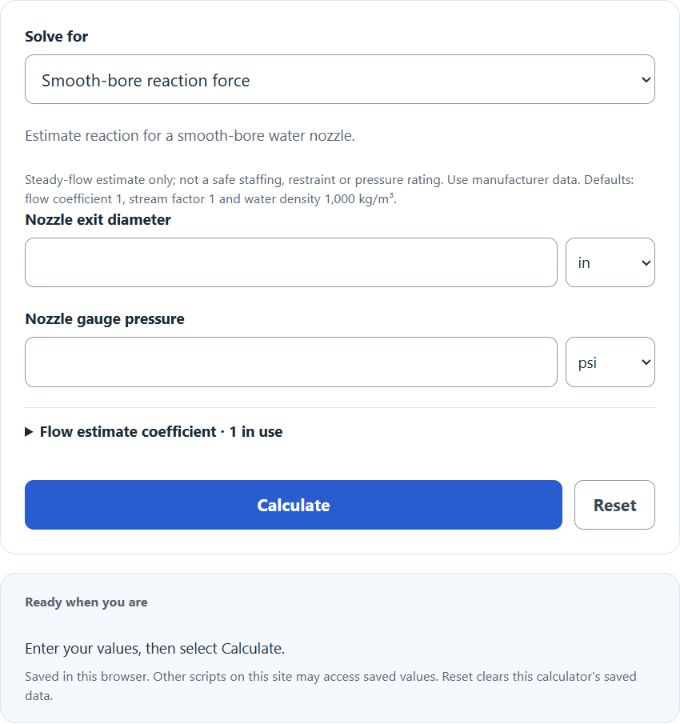
Calculate nozzle reaction for smooth-bore, fog-stream, or SI momentum models, or reverse-solve nozzle pressure, with flow, velocity, and force conversions.
- All Physics Calculators
- All Force Calculators
- Pressure Gradient Force Calculator
- Force From Pressure Calculator
- Vacuum Force Calculator
- Water Jet Force Calculator
- Nozzle Velocity Calculator
- Nozzle Pressure Calculator
- CFM from Differential Pressure Calculator
Nozzle Reaction Force Formula
The nozzle reaction force is the backward force produced when water is accelerated through a nozzle and exits as a straight jet. The smooth-bore water model uses NR = 1.57d²P (lbf, inches, psi), with estimated flow Q = 29.7Cdd²√P in US gpm. The fog-stream model uses NR = 0.0505Q√P × factor (lbf, US gpm, psi). The general SI model uses F = ρQ²/A, with diameter converted to area. Pressure can also be solved from target reaction in the two water field models.
Where:
| Symbol | Description | Common Units |
|---|---|---|
| NR | Nozzle reaction force | lbf, N, kgf |
| P | Nozzle pressure relative to ambient pressure | psi, kPa, bar, Pa |
| A | Nozzle cross-sectional area | in², cm², m² |
This relationship is linear, so:
- If pressure doubles and area stays the same, the ideal reaction force doubles.
- If area doubles and pressure stays the same, the ideal reaction force doubles.
- If nozzle diameter changes, the force changes quickly because area depends on diameter squared.
Finding Area from Nozzle Diameter
If you know the nozzle diameter instead of the area, calculate the opening area first.
Substituting that into the main equation gives a diameter-based form:
Rearranged Forms
For the ideal straight-jet relationship, the algebraic pressure and area forms are shown below. The calculator reverse-solves pressure using the selected field equation; it does not offer an area solve mode.
How to Use the Calculator
- Select the smooth-bore reaction, smooth-bore pressure, fog-stream reaction, fog-stream pressure, or general SI momentum task.
- Enter exit diameter for smooth-bore or SI momentum calculations, and volume flow for fog-stream or SI momentum calculations. Select matching units.
- For field reaction, enter nozzle gauge pressure. For a pressure solve, enter target reaction. SI momentum requires fluid density.
- Select Calculate to show force or pressure, flow conversions and calculation details. Smooth-bore flow coefficient and fog stream factor default to 1; entered values remain active when their section is closed.
For consistent unit systems:
- psi with in² produces force in lbf.
- Pa with m² produces force in N.
Why the Formula Uses a Factor of 2
The recoil comes from jet momentum. In an ideal nozzle, pressure energy is converted into exit velocity, and the exiting stream produces an equal and opposite reaction on the nozzle body.
The 2PA relation assumes an ideal straight incompressible jet and negligible inlet momentum. The smooth-bore field constant 1.57 approximates π/2. The fog field equation and general momentum model are separate estimates; use manufacturer performance data for real nozzles.
Example
Suppose a nozzle operates at 50 psi gauge and has an opening diameter of 0.875 in.
The ideal nozzle reaction force is about 60.1 lbf.
What the Result Means
The calculated value is the approximate force pushing backward on the nozzle assembly. In practice, that force matters when evaluating:
- operator handling effort,
- hose and nozzle stability,
- support or restraint requirements,
- mounting loads on fixed spray equipment, and
- changes in reaction as pressure or nozzle size is adjusted.
Assumptions and Limits
- The jet is straight and exits directly to atmosphere.
- The fluid is treated as incompressible, such as water.
- Losses from turbulence, nozzle inefficiency, and internal friction are neglected.
- The pressure used is gauge pressure at the nozzle.
- Spray nozzles, fog patterns, angled outlets, and unusual discharge conditions can produce different actual forces.
Common Mistakes
- Using diameter where the formula requires area.
- Using absolute pressure instead of pressure relative to ambient.
- Mixing unit systems, such as psi with m².
- Using hose diameter instead of the actual nozzle exit diameter.
- Assuming the estimate includes all real-world losses and flow pattern effects.
Quick Interpretation Rules
- A larger nozzle opening increases reaction force directly.
- A higher nozzle pressure increases reaction force directly.
- A modest increase in diameter can create a large increase in recoil because area rises with the square of diameter.
- Real nozzles may produce lower or higher practical handling force depending on jet shape and hardware configuration.