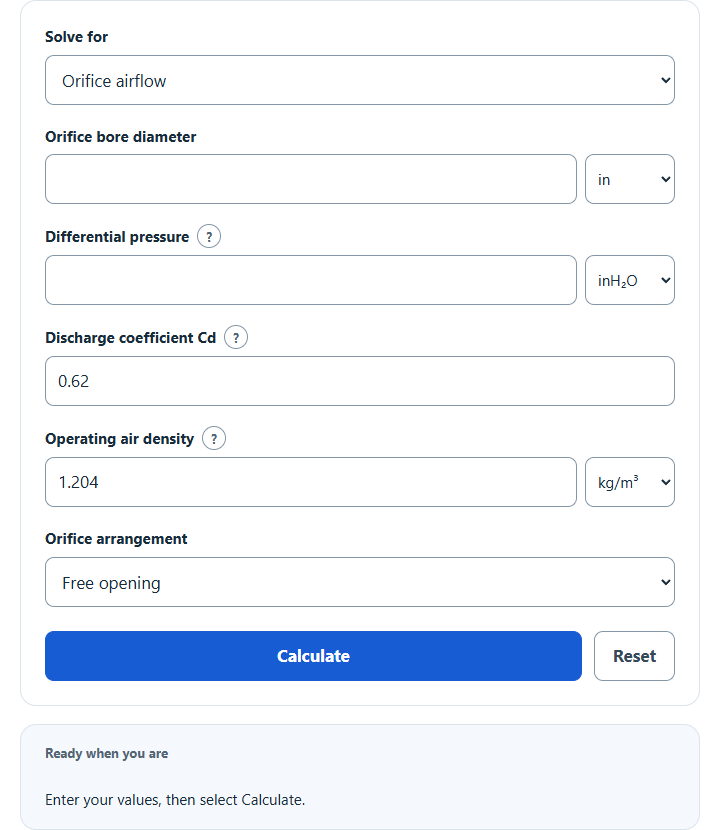
Calculate CFM from differential pressure across an orifice, with an equipment K-factor or a pitot tube, or find the pressure needed for a target airflow.
- All Construction Calculators
- Flow Rate Pressure Calculator
- Nozzle Pressure Calculator
- Velocity To Pressure Calculator
CFM From Differential Pressure Formula
The following two example problems outline the steps and information needed to calculate the CFM From Differential Pressure.
Variables:
- CFM is the CFM From Differential Pressure (ft3/min)
- dP is Pitot velocity pressure (total minus static), in conventional inches of water; arbitrary fan or filter pressure drop is unsuitable.
- A is the cross-sectional area (ft2)
For the Pitot path, the approximate 4005 factor assumes standard air density of 0.075 lb/ft³ and a representative mean velocity. The calculator instead uses the entered operating density: Q = A × √(2ΔP/ρ), converted from m³/s to CFM. For a traverse, average velocities rather than pressures.
How to Calculate CFM From Differential Pressure?
Select Orifice airflow for Q = Cd × A × √(2ΔP/ρ)/√(1−β⁴), using bore area, β = bore/pipe diameter and the correct discharge coefficient and meter taps. Free-opening mode omits the beta term. Select Orifice pressure for its inverse. These are constant-density estimates, not ISO 5167 certification. Equipment K airflow uses CFM = K × √(ΔP in inH₂O), with the manufacturer’s calibration. Use Pitot airflow for the velocity-pressure formula below.
- First, measure representative Pitot velocity pressure (total minus static), in conventional inH₂O.
- Next, determine duct cross-sectional area (ft²) and operating air density.
- Select Pitot airflow and enter the measured area, pressure and density.
- Finally, calculate the CFM From Differential Pressure.
- After inserting the variables and calculating the result, check your answer with the calculator above.
Example Problem :
Use the following variables as an example problem to test your knowledge.
differential pressure (W.C.) = .50
cross-sectional area (ft2) = 2.5
For A = 2.5 ft², velocity pressure = 0.50 inH₂O and density = 0.075 lb/ft³, the density-aware result is about 7,086.184154 CFM. The rounded 4005 shortcut gives about 7080 CFM.