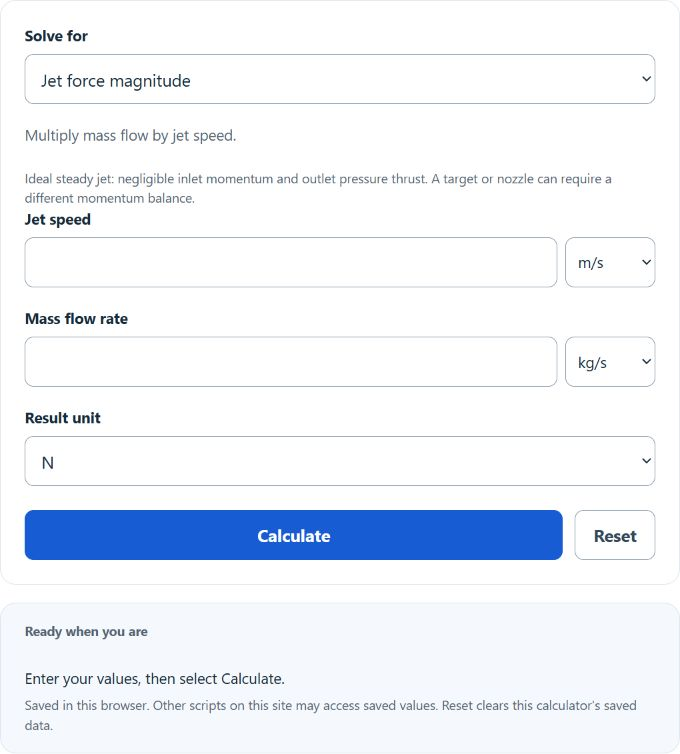
Choose jet force magnitude, jet speed, or mass flow rate and enter the two requested values. Unit conversion and calculation details are included.
- All Physics Calculators
- All Force Calculators
- Nozzle Reaction Force Calculator
- Driving Force Calculator
- Nozzle Velocity Calculator
Water Jet Force Formula
Water jet force is the force created by the momentum of water leaving a nozzle or striking a surface. For an ideal straight, steady jet with negligible inlet momentum and outlet pressure thrust, the calculator uses the momentum-flow relationship below.
F is the water jet force, \(\dot{m}\) is the mass flow rate, and v is the jet velocity. This same equation can be rearranged to solve for any one of the three variables when the other two are known.
What the Calculator Measures
This calculator estimates the force associated with a moving stream of water based on how much mass leaves the nozzle each second and how fast that water is traveling. In momentum terms, higher flow and higher speed both increase force directly.
- Water Jet Force
- The resulting force from the moving water, typically expressed in newtons (N) or pounds-force (lbf).
- Mass Flow Rate
- The amount of water mass passing through the nozzle each second, commonly in kg/s, lbm/s, or g/s (lbm denotes pounds of mass).
- Velocity
- The speed of the water as it exits the nozzle, commonly in m/s, ft/s, km/h, or mph.
Equivalent Forms
If you know volumetric flow rate instead of mass flow rate, you can convert using water density.
When nozzle area and exit velocity are known, the force can also be written as:
Where \(\rho\) is fluid density, Q is volumetric flow rate, and A is nozzle cross-sectional area. For quick engineering estimates, water is often approximated as having a density near 1000 kg/m3.
How to Calculate Water Jet Force
- Determine the jet velocity at the nozzle exit.
- Determine the mass flow rate of the water.
- Multiply mass flow rate by velocity.
- Report the result in N or convert to lbf if needed.
If you are calculating manually, unit consistency matters. The standard SI unit check is:
Example Calculation
If water exits a nozzle at 100 m/s and the mass flow rate is 3 kg/s, then the jet force is:
If you want the same result in pounds-force:
What Increases or Decreases Water Jet Force?
- Mass flow rate: More water per second means more momentum transfer and a larger force.
- Exit velocity: Faster water produces more force for the same mass flow.
- Nozzle size: A smaller nozzle can increase exit speed, but the final result depends on actual flow conditions.
- Fluid density: Denser fluids produce more force at the same volumetric flow and velocity.
- Jet direction change: A jet that is stopped, redirected, or reversed transfers force differently than a free straight jet.
Engineering Interpretation
The force in a water jet comes from momentum change. For more general steady cases, such as a jet turning or impacting a plate, the net external force on the water follows its velocity-vector change; the reaction on the target or nozzle has the opposite direction. Pressure and other external forces must also be accounted for.
For a simple straight nozzle discharge where inlet momentum is neglected and the jet exits into ambient conditions, the reduced form \(F = \dot{m}v\) is usually the practical estimate. Real systems may differ due to nozzle losses, turbulence, pressure effects, and nonuniform flow profiles.
Common Applications
- Nozzle reaction estimates
- Pressure washer and jet cleaning systems
- Fire hose and monitor nozzle analysis
- Industrial spray systems
- Hydraulic test rigs and fluid handling equipment
- Impact force estimates for jets striking surfaces
Helpful Notes
Mass flow rate vs. volumetric flow rate: They are not the same. Mass flow rate includes density, while volumetric flow rate only measures volume per unit time.
Pressure alone is not enough: Pressure affects jet performance, but jet force in this calculator is determined from the resulting flow rate and velocity.
Nozzle reaction and impact force: For many idealized cases, the nozzle reaction magnitude and the force delivered by a jet that is brought nearly to rest are both tied to the same momentum principle.