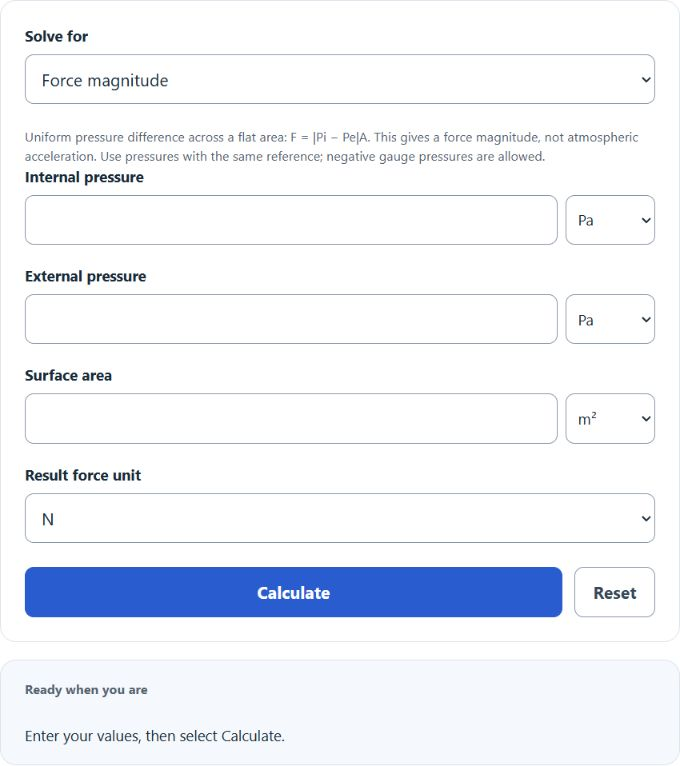
Calculate force from pressure difference by entering internal and external pressure plus surface area in Pa, psi, bar, atm, or lbf.
- All Physics Calculators
- All Force Calculators
- Force From Pressure Calculator
- Vacuum Force Calculator
- Wind Pressure & Force Calculator
- Nozzle Reaction Force Calculator
Pressure Difference Force Formula
This calculator estimates force from uniform pressures on opposite sides of a flat surface. It reports a non-negative magnitude F = |Pi − Pe|A. Atmospheric pressure-gradient acceleration instead depends on the spatial pressure gradient and fluid density.
To solve for surface area:
To solve for internal pressure, assuming the internal pressure is greater than or equal to the external pressure:
To solve for external pressure, assuming the internal pressure is greater than or equal to the external pressure:
- F = force caused by the pressure difference
- P_i = internal pressure
- P_e = external pressure
- A = surface area the pressure acts on
- |P_i – P_e| = absolute pressure difference
The calculator can solve for any one missing value when you enter the other three. If force is missing, it multiplies the absolute pressure difference by area. If area is missing, it divides force by the absolute pressure difference. If one pressure is missing, select the pressure ordering; the default assumes internal pressure is higher. Use the same reference for both pressures. Negative gauge pressures are allowed, but absolute pressure cannot be negative.
Common Pressure, Area, and Force Unit Conversions
The calculation is easiest to check in base SI units: pressure in pascals, area in square meters, and force in newtons.
| Unit | Type | Equivalent in base unit |
|---|---|---|
| 1 psi | Pressure | 6,894.757 Pa |
| 1 bar | Pressure | 100,000 Pa |
| 1 atm | Pressure | 101,325 Pa |
| 1 ft² | Area | 0.09290304 m² |
| 1 in² | Area | 0.00064516 m² |
| 1 lbf | Force | 4.44822 N |
Pressure Difference Force Examples
Example 1: Calculate force from pressure difference
You have an internal pressure of 300,000 Pa, an external pressure of 100,000 Pa, and an area of 0.5 m².
The pressure difference force is 100,000 N.
Example 2: Calculate surface area
A pressure difference force is 2,000 N. The internal pressure is 150,000 Pa and the external pressure is 100,000 Pa.
The required surface area is 0.04 m².
FAQ
Why is the force always positive?
The calculator reports force as a magnitude. It uses the absolute value of the pressure difference, so a higher external pressure and a higher internal pressure both produce a non-negative result. Direction is not included in the result.
What happens if internal and external pressure are equal?
If the two pressures are equal, the pressure difference is zero. That means the pressure difference force is also zero, no matter how large the area is. You cannot solve for area from force when the pressure difference is zero because that would require division by zero.
Does area need to be perpendicular to the pressure?
Pressure acts normal to each local surface. For uniform pressure on a flat surface, use its actual area for the normal-force magnitude. To find a component along another axis, project that force onto the axis. Curved surfaces or nonuniform pressure require integration.