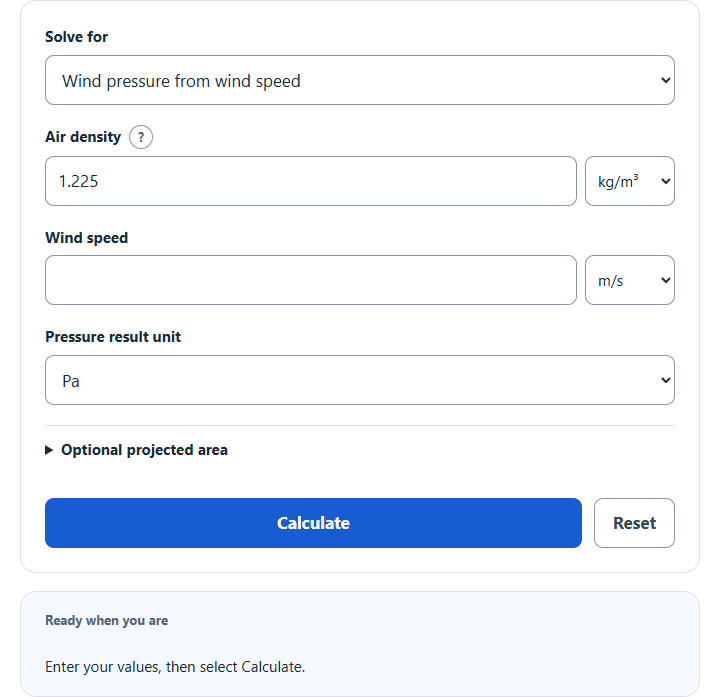
Calculate wind pressure from wind speed (q = ½ρV²) in Pa, psf or psi, and the ideal wind force on an area, using standard air density or your own.
- All Construction Calculators
- Lift Force Calculator
- Sail Force Calculator
- Wind Velocity Calculator
- Wind Loading Calculator
- Air Density Calculator
Wind Pressure Formula
The following ideal formula estimates force from dynamic pressure with an effective coefficient of 1. Actual object loads require shape, gust, exposure and other design factors.
- Where F is the wind force (N)
- p is the air density (kg/m3)
- V is the air velocity (m/s)
- A is the surface area (m2)
The wind force is also known as the wind load.
The formula can further be reduced to the following:
- Where WP is the wind pressure (Pa)
- p is the air density
- V is the air velocity
Wind Pressure Definition
Here wind pressure means the nonnegative dynamic pressure q = ½ρV². Actual surface pressure and drag depend on pressure or drag coefficients and are not generally equal to q.
Example Problem
How to calculate wind pressure?
- First, determine the density of air.
Dry air is estimated to have 1.2 kg/m3.
- Next, determine the surface area of the object.
In this example, use a projected area of 50 m2 and an assumed effective coefficient of 1. This does not model actual sphere drag.
- Next, determine the wind speed.
In this example, the wind velocity is 1.5 m/s.
- Finally, calculate the wind pressure using the formula above:
First, the wind force is calculated as:
F = 1/2*p*V2*A
F = 1/2*1.2*1.52*50
F = 67.5 N.
Then the wind pressure is calculated by dividing the force by area:
WP = F/A
WP = 67.5/ 50
WP = 1.35 Pa