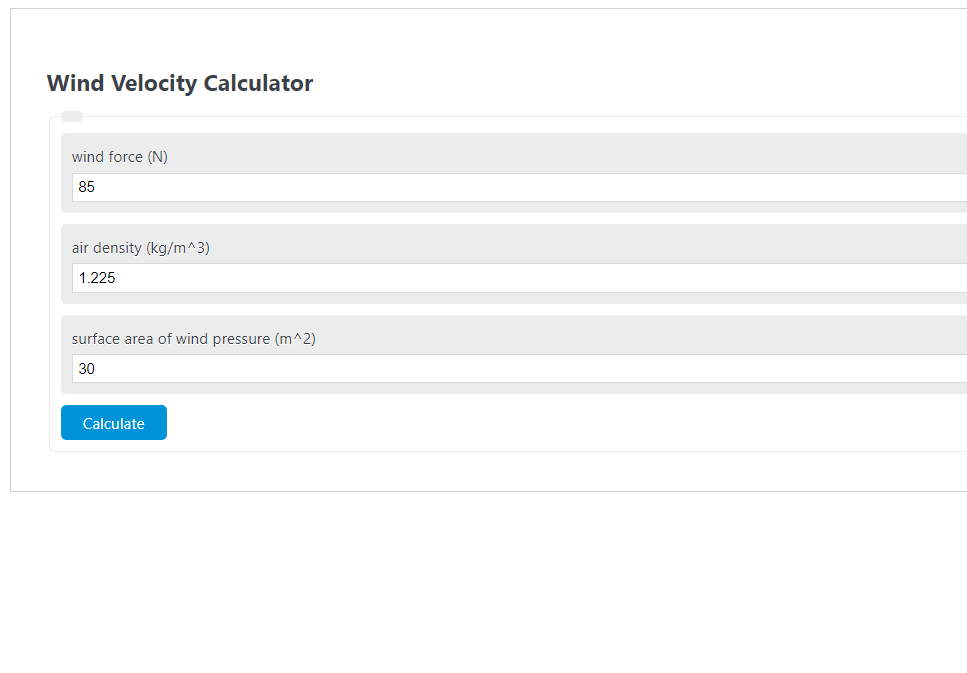
Calculate wind velocity from measured force and projected area or directly from dynamic pressure, with m/s, mph, km/h, knots, and density sensitivity.
- All Physics Calculators
- All Velocity Calculators
- Velocity Calculator
- Wind Pressure & Force Calculator
Wind Velocity Formula
The following simplified equation is used to calculate the wind speed from a force on a surface when the force is approximated as dynamic pressure times projected area (equivalent to assuming an overall drag/pressure coefficient of about 1).
- Where Vw is the wind speed (m/s)
- F is the wind force on the surface (N)
- ρ is the air density (kg/m³)
- A is the projected surface area normal to the wind (m²)
To calculate wind speed, divide 2 times the wind force by the product of air density and projected area, then take the square root of this result. If you have a drag/pressure coefficient (often written as Cd or Cp) for the shape and orientation, a more general form is V = √(2F/(ρ Cd A)).
What is a Wind Velocity?
Definition:
Wind velocity is a vector that describes both the speed and direction of the wind (rate of change of position with respect to time). This page’s force-based formula and “Basic” tab estimate wind speed (the magnitude of the velocity).
How to Calculate Wind Velocity?
Example Problem:
The following example outlines the steps and information needed to calculate wind speed using the simplified relation above (assuming an overall coefficient of about 1).
First, determine the wind force. In this example, the wind force is found to be 85 N.
Next, determine the air density. For this problem, the air density is found to be 1.225 kg/m³.
Next, determine the projected surface area normal to the wind. In this case, the area is measured to be 30 m².
Finally, calculate the wind speed using the formula above:
Vw = √(2F/(ρA))
Vw = √(2·85/(1.225·30))
Vw = 2.15 m/s