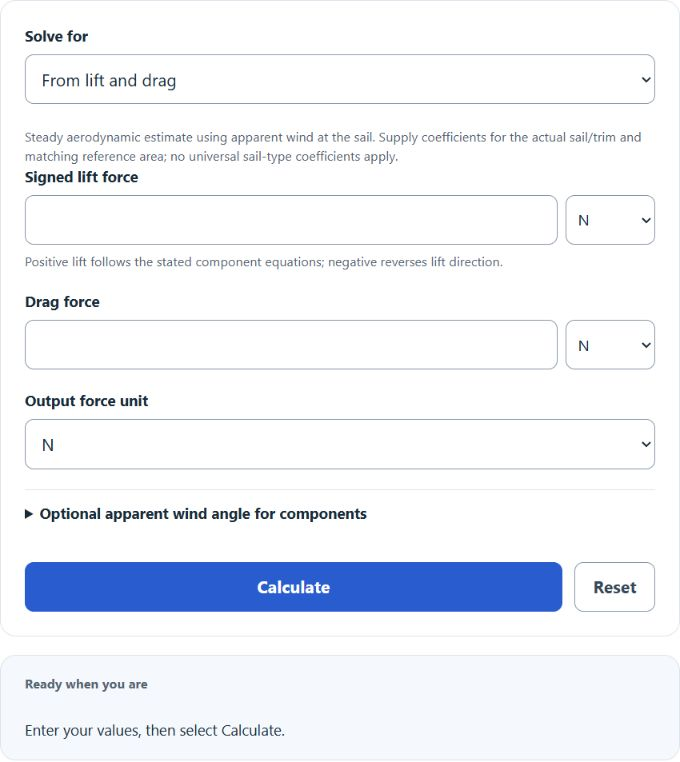
Calculate resultant sail force plus drive and side forces from lift, drag, apparent wind angle, or estimate them from wind speed and sail area.
- All Physics Calculators
- All Force Calculators
- Lift Force Calculator
- Drag Equation Calculator (Drag Force Calculator)
- Drag Coefficient Calculator
Sail Force Formula
The following equations resolve perpendicular signed lift L and nonnegative drag D. Apparent wind angle a is measured from the bow (0° headwind, 180° astern), using the lift direction convention below. Negative drive means aft force; the lateral sign is relative to that convention, not an independently modelled tack.
Area/wind mode uses q =ρV²/2, L =qACL and D =qACD. Use apparent wind speed, local air density and coefficients for the actual sail, trim, angle of attack and matching reference area. No universal sail-type coefficient preset applies. 1.225 kg/m³ is a standard sea-level 15°C density assumption, not measured weather. This steady model does not determine rigging capacity, stability or gust safety.
- Where SF is the magnitude of the resultant aerodynamic force on the sail (N)
- Fdrive is the forward (driving) component of the aerodynamic force (N)
- Fside is the side (lateral/heeling) component of the aerodynamic force (N)
- L is the lift force (N)
- D is the drag force (N)
- a is the apparent wind angle (degrees, converted to radians inside trigonometric functions)
What is a Sail Force?
Definition:
A sail force is the aerodynamic force acting on a sail due to airflow (apparent wind).
This aerodynamic force is commonly described using two perpendicular components relative to the apparent wind: lift (perpendicular to the apparent wind) and drag (parallel to the apparent wind). The combined “total” force is the resultant magnitude SF = √(L² + D²). That resultant can also be resolved into forward (driving) and side (lateral/heeling) components based on the apparent wind angle.
How to Calculate Sail Force?
Example Problem:
The following example outlines the steps and information needed to calculate Sail Force.
First, determine the lift force. In this example, the lift force is 50 N.
Next, determine the drag force. The drag force in this case is 20 N.
Next, determine the apparent wind angle. This is measured to be 47 degrees.
Finally, calculate the resultant sail force magnitude and (optionally) the forward/side components:
SF = √(L² + D²)
SF = √(50² + 20²) = 53.8516 N
Fdrive = L·sin(a) − D·cos(a) = 50·sin(47°) − 20·cos(47°) = 22.9277 N
Fside = L·cos(a) + D·sin(a) = 50·cos(47°) + 20·sin(47°) = 48.7270 N
FAQ
What factors can affect the sail force on a sailboat?
Several factors can affect the sail force, including the size and shape of the sail, the material and trim of the sail, the apparent wind speed and direction, air density, and nearby obstacles or waves that alter the airflow.
How does changing the apparent wind angle affect the sail force?
Changing the apparent wind angle changes how the lift and drag forces are resolved into forward (drive) and side (lateral/heeling) components. In real sailing, it also changes the effective angle of attack and therefore the lift and drag coefficients, so the magnitudes of lift and drag can change as you head up or bear away.
Why is understanding sail force important for sailors?
Understanding sail force helps sailors optimize performance and handling. By estimating the resultant force and its forward/side components, sailors can make better decisions about sail trim and course to balance speed, efficiency, and safety under different conditions.