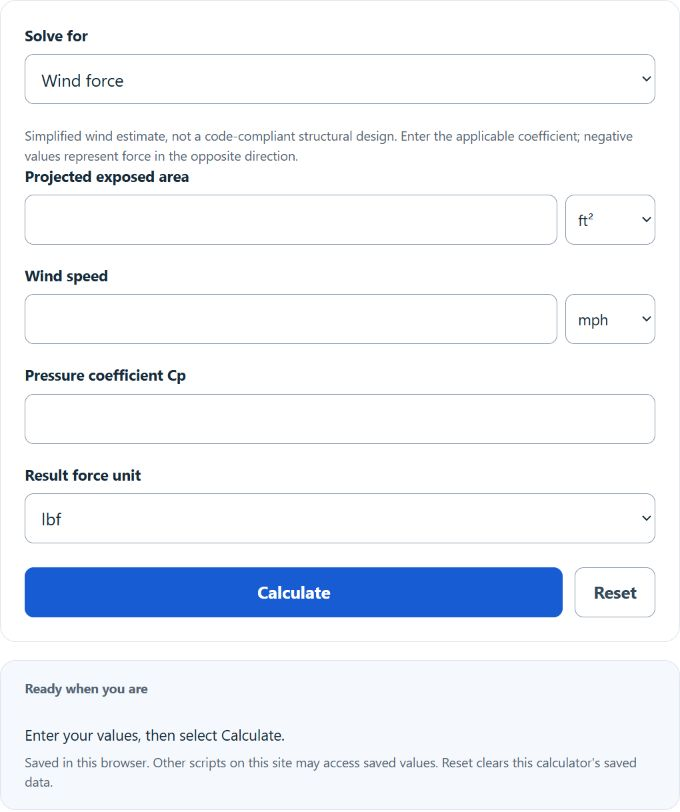
Select wind force, projected area, wind speed, or pressure coefficient to solve, then enter the three required quantities. Unit changes convert the entered quantity. This simplified estimate does not replace a code-compliant structural wind-load calculation.
Related Calculators
- Concrete Shear Capacity Calculator
- Axial Force Calculator
- Weld Section Modulus Calculator
- Overburden Pressure Calculator
- All Construction Calculators
Wind Loading Formula
The calculator uses a simplified imperial wind pressure relationship, omitting exposure, height, gust, topographic, directionality and internal-pressure effects. Inputs are converted to base units before calculation: area in square feet, wind speed in mph, and wind load in pounds-force.
Rearranged formulas are used for the selected solve mode.
- F = wind load, or total wind force, in pounds-force (lbf)
- A = exposed area in square feet (sq ft)
- V = wind speed in miles per hour (mph)
- Cp = pressure coefficient, unitless
- 0.00256 = conversion constant for wind pressure when wind speed is in mph and pressure is in lb/sq ft
Select the quantity to solve. Wind force multiplies velocity pressure by the coefficient and projected area. The inverse modes solve for area, nonnegative wind speed, or the coefficient implied by the other quantities. Negative coefficients and forces use a consistent signed direction; zero-denominator inverses are nonunique or inconsistent.
Common Wind Speed and Pressure Reference Values
The pressure below uses q = 0.00256V². It does not include the pressure coefficient or area.
| Wind speed | Velocity pressure | General description |
|---|---|---|
| 30 mph | 2.30 psf | Strong breeze |
| 60 mph | 9.22 psf | Severe wind |
| 90 mph | 20.74 psf | Illustrative speed only; not a location-specific design value |
| 120 mph | 36.86 psf | Illustrative speed only; use the governing design standard |
Illustrative Coefficient Ranges — Not Design Values
| Surface or object | Typical pressure coefficient | Use note |
|---|---|---|
| Flat plate facing wind | 1.0 to 1.3 | Illustrative only; verify geometry and the governing method |
| Long round pole or cylinder | 0.6 to 1.2 | Depends on shape, surface, and flow conditions |
| Building wall zone | Varies by code zone | Use the coefficient from the applicable design standard |
Example Calculations
Example 1: Calculate wind load
You have an exposed area of 50 sq ft, a wind speed of 90 mph, and a pressure coefficient of 1.2.
The wind load is 1,244.16 lb.
Example 2: Calculate wind speed
You have a wind load of 500 lb, an exposed area of 40 sq ft, and a pressure coefficient of 1.0.
The wind speed is 69.88 mph.
FAQs
What does exposed area mean?
Exposed area is the area that wind acts on. For a flat rectangular sign, it is usually width times height. For round or irregular objects, use the projected area facing the wind, not the full surface area.
What pressure coefficient should you use?
The pressure coefficient depends on shape, wind direction, surface type, and design method. The ranges above are illustrative and are not validated defaults for a particular object. For building design or safety-critical work, use the coefficient required by the applicable building code or engineering standard.
Why does wind speed have such a large effect on wind load?
Wind load changes with the square of wind speed. If wind speed doubles, the wind pressure becomes four times larger, assuming the area and pressure coefficient stay the same.