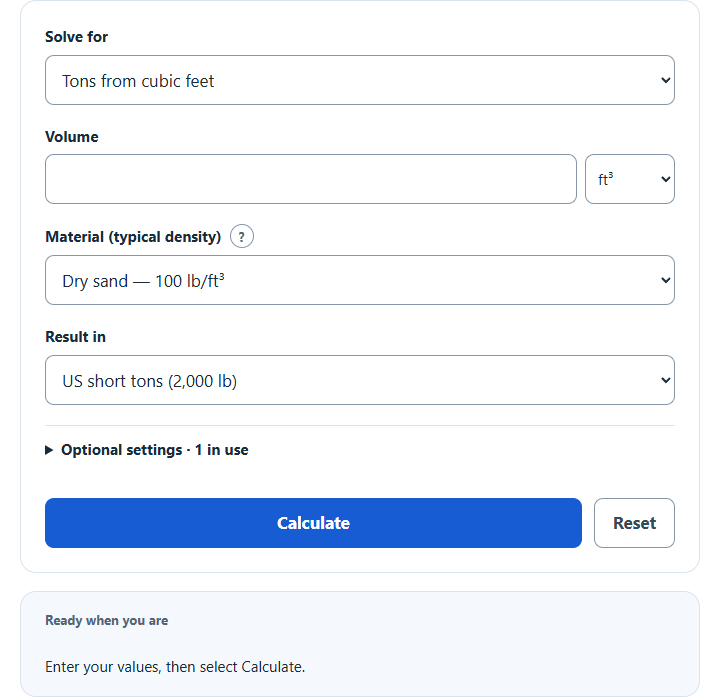
Convert cubic feet (cft) to tons of sand, gravel, stone or other materials using typical densities, in short or metric tons, or convert tons back to cft.
- All Unit Converters
- Cubic Feet to Pounds Calculator
- Gallons to Tons Calculator
- Square Feet to Tons Calculator
- Area to Tons Calculator
- Bulk Density Calculator
- Specific Gravity to Density Calculator
- Cubic Feet Calculator
Calculator Functions
| Function | What it does | What it requires |
|---|---|---|
| Tons from cubic feet | Converts a volume of material to its weight in tons | Requires the volume in ft³, yd³ or m³, a material or a custom density, and the ton type for the result |
| Cubic feet from tons | Converts a weight in tons to the volume it fills in cubic feet | Requires the mass in short, long or metric tons, and a material or a custom density |
The material list sets a typical bulk density, and Custom density accepts a supplier or measured value in lb/ft³, kg/m³ or g/cm³. Every result also shows the weight in the other ton types, pounds and kilograms, and the volume in cubic yards and cubic meters. Optional settings set the decimal places and add an ordering allowance in percent.
Cubic Feet to Tons Formulas
| T | Weight in US short tons |
| V | Volume (ft³) |
| D | Bulk density of the material (lb/ft³) |
| 2,000 | Pounds in one short ton [1] |
A cubic foot is a volume and a ton is a weight, so the conversion always runs through the density of the material. 100 ft³ of dry sand at 100 lb/ft³ weighs 100 × 100 ÷ 2,000 = 5 short tons.
Tons from cubic feet
Volume times density gives pounds, and the pounds are divided by the size of the chosen ton: 2,000 lb for a US short ton, 2,240 lb for a long ton and 2,204.62 lb (1,000 kg) for a metric ton [1]. A volume in cubic yards is multiplied by 27 and a volume in cubic meters by 35.3147 to get cubic feet first. The material list uses these densities:
| Material | Density (lb/ft³) | Short tons per ft³ | ft³ per short ton |
|---|---|---|---|
| Dry sand | 100 | 0.05 | 20 |
| Wet sand | 120 | 0.06 | 16.67 |
| Gravel | 110 | 0.055 | 18.18 |
| Crushed stone / aggregate | 100 | 0.05 | 20 |
| Water | 62.4 | 0.0312 | 32.05 |
| Loose topsoil | 90 | 0.045 | 22.22 |
| Compacted topsoil | 100 | 0.05 | 20 |
| Asphalt | 145 | 0.0725 | 13.79 |
| Concrete | 150 | 0.075 | 13.33 |
| Mulch | 25 | 0.0125 | 80 |
Cft to ton conversion table
Cft is another way of writing cubic feet. The table gives the weight of common volumes at two of the listed densities: 100 lb/ft³ for dry sand or crushed stone, and 110 lb/ft³ for gravel. A metric ton is 1,000 kg.
| Cubic feet (cft) | Sand or stone, short tons | Sand or stone, metric tons | Gravel, short tons | Gravel, metric tons |
|---|---|---|---|---|
| 1 | 0.05 | 0.0454 | 0.055 | 0.0499 |
| 100 | 5 | 4.54 | 5.5 | 4.99 |
| 200 | 10 | 9.07 | 11 | 9.98 |
| 250 | 12.5 | 11.34 | 13.75 | 12.47 |
| 300 | 15 | 13.61 | 16.5 | 14.97 |
| 500 | 25 | 22.68 | 27.5 | 24.95 |
| 600 | 30 | 27.22 | 33 | 29.94 |
| 650 | 32.5 | 29.48 | 35.75 | 32.43 |
| 700 | 35 | 31.75 | 38.5 | 34.93 |
| 750 | 37.5 | 34.02 | 41.25 | 37.42 |
| 850 | 42.5 | 38.56 | 46.75 | 42.41 |
| 900 | 45 | 40.82 | 49.5 | 44.91 |
| 1,000 | 50 | 45.36 | 55 | 49.9 |
| 1,200 | 60 | 54.43 | 66 | 59.87 |
| 1,500 | 75 | 68.04 | 82.5 | 74.84 |
| 2,000 | 100 | 90.72 | 110 | 99.79 |
Cubic feet from tons
M is the mass in tons and P is the pounds in that ton type: 2,000, 2,240 or 2,204.62. One short ton of gravel at 110 lb/ft³ fills 2,000 ÷ 110 = 18.18 ft³, and one short ton of dry sand at 100 lb/ft³ fills 20 ft³. The last column of the density table gives this figure for each listed material.
Ordering allowance
An allowance entered under the optional settings multiplies the converted result by (1 + allowance ÷ 100) and shows it as a separate line. With a 10% allowance, 5 short tons becomes 5.5 short tons. The main answer and the density are not changed.
Limits of This Estimate
- The listed densities are typical values for loose, dry material. One state highway design manual puts dry crushed surfacing at 2,850 to 2,950 lb per cubic yard (106 to 109 lb/ft³) loose in a truck and 3,700 lb per cubic yard (137 lb/ft³) once compacted, and raises those weights in proportion to the water content [2]. These estimates are based on the best available data and estimations.
- A supplier weigh ticket or a measured density is more reliable than a preset. Sand, soil and mulch change the most with moisture.
- The ordering allowance is a simple percentage added to the result. It does not model compaction, settlement or spillage.
- Short, long and metric tons differ by up to 12%, so the ton type on a quote has to match the one selected.
Sources
- NIST, Guide for the Use of the International System of Units (SP 811), Appendix B.8: pounds in a short ton and a long ton, the metric ton, and the pound, cubic foot and cubic yard in SI units
- Washington State Department of Transportation, Design Manual M 22-01, Chapter 620, Exhibit 620-1: dry unit weights of gravel base and crushed surfacing, loose in a truck and compacted, and the water-content correction